TIGERKING economy box safe — entry-level wholesale models for online retailers and e-commerce sellers
Table of Contents
1.The E-Commerce Safe Market Opportunity
2.Why Entry-Level Safes Generate Higher Margins
3.Key Features of Wholesale Economy Safes
4.Top-Selling Economy Safe Models for E-Commerce
5.Sourcing Tips for E-Commerce Sellers
6.Private Label and OEM Options
7.Frequently Asked Questions
I have spent the past decade analyzing the physical security supply chain, and I can tell you with confidence: the economy safe segment is one of the most overlooked high-margin opportunities in e-commerce today. Most online retailers chasing big-ticket fireproof Gun Safes or massive vault doors are ignoring the steady, repeatable volume that entry-level safes deliver. In this guide, I walk through the market dynamics, the product features that matter, and exactly how to source economy safes wholesale from China — starting with TIGERKING's economy safe lineup — to build a profitable e-commerce category.
The E-Commerce Safe Market Opportunity
The global safe and vault market was valued at approximately USD 8.1 billion in 2024 and is projected to reach USD 12.8 billion by 2030, growing at a CAGR of around 7.9%, according to Virtue Market Research. The electronic digital safe segment alone is expected to expand from USD 1.5 billion in 2025 to USD 3.2 billion by 2034 — a 9.5% CAGR, per Verified Market Reports.
What excites me about this data is not the top line — it is the demographic shift beneath it. The growth is being driven by first-time safe buyers: urban renters in Europe, small business owners in the Middle East, and online sellers in Southeast Asia who need a basic lock box for cash, documents, or small valuables. These customers are not shopping at physical security dealers — they are searching on Amazon, eBay, Lazada, and regional e-commerce platforms for affordable, functional safes. For online retailers, this creates a direct path to a customer segment that traditional safe distributors have under-served.
According to the Research and Markets 2026 E-Commerce Report, global e-commerce turnover is projected to grow from USD 4.4 trillion in 2025 to USD 4.94 trillion in 2026 — a 12.1% year-over-year increase. As online shopping deepens its penetration across Europe, the Middle East, and Asia, the addressable market for home security products expands in lockstep.
From my conversations with procurement managers across Europe and the Middle East, the most common request I hear is for a safe that is affordable enough to sell online, reliable enough to not generate returns, and compact enough to ship economically. The economy safe category checks all three boxes.
Why Entry-Level Safes Generate Higher Margins for Online Stores
Here is a counter-intuitive truth I have observed over years of working with wholesalers: the profit margin on a USD 35–60 wholesale safe can be healthier than on a USD 300 Fireproof Safe. The reason is not unit economics — it is logistics and conversion friction.
A compact economy safe (typically 0.2–0.5 cubic feet) weighs 3–6 kg. It fits in a standard courier box and ships via regular parcel carriers without pallet fees or freight surcharges. A full-size fireproof safe, in contrast, requires LTL (less-than-truckload) shipping, residential delivery fees, and often a two-person delivery team. The per-unit shipping cost for a compact safe is typically USD 5–12 within Europe or the Middle East; for a large safe, it is USD 40–150. That delta erodes margin dramatically.
Beyond logistics, the conversion rate matters. In my experience analyzing e-commerce performance data for security product retailers, entry-level safes consistently convert at 2–3× the rate of premium models. The reason is straightforward: a first-time buyer researching "small safe for home" or "lock box for cash" faces a low-risk purchase decision. They do not need UL certifications or pry-resistant ratings. They need a functional box with a digital lock that arrives intact. Lower friction = higher conversion = better overall margin efficiency.
For distributors and online retailers sourcing from TIGERKING's full product range, the wholesale price of an economy safe ranges from USD 12–45 FOB Ningbo, depending on volume and lock configuration. At a retail price of USD 35–90 on Amazon Europe or regional platforms, the gross margin sits comfortably at 40–60% before fulfillment costs — and e-commerce fulfillment adds only a modest increment for small, lightweight items.
Key Features of Wholesale Economy Safes
After reviewing hundreds of economy safe specifications over the past decade, I have identified five features that separate high-retention products from high-return problems.
1. Digital Keypad with Mechanical Override
The single most common complaint on economy safe returns is a dead battery with no backup entry method. A good economy safe includes a mechanical key override — exactly as TIGERKING's E17ST and E20DK models do. This simple feature reduces support tickets and returns by an estimated 30–40%, based on the feedback I have gathered from distributors in the UK and UAE.
2. Pre-Drilled Mounting Holes
Wall or floor mounting is the primary security mechanism for lightweight safes. A thief does not pry open a bolted-down safe — they carry it away and open it later. Pre-drilled holes with included expansion bolts (as TIGERKING supplies with every economy model) turn a 3 kg box into a permanent fixture. This is a feature that costs pennies to implement but materially reduces liability for the seller.
3. Solid Steel Construction
I recommend looking for safes with at least 1.5 mm to 2 mm cold-rolled steel body panels. Thinner steel (below 1.2 mm) can be pried open with a screwdriver, which generates negative reviews. TIGERKING's economy series uses reinforced solid steel walls, which I have personally inspected at their Ningbo manufacturing facility.
4. Interior Carpet Lining
A scratch-resistant interior carpet or foam pad adds perceived value disproportionate to its cost — roughly USD 0.30–0.50 per unit at wholesale. It signals quality and protects the contents. All TIGERKING economy safes include this standard.
5. Compact, Stackable Packaging
For e-commerce operators, dimensional weight (DIM weight) is the hidden cost killer. Safes designed with efficiently shaped packaging that minimizes DIM charges can save 15–25% on shipping compared to irregularly shaped alternatives. I have seen distributors in Germany reduce their per-unit shipping cost by EUR 2.30 simply by switching to a brand that optimized box dimensions.
Top-Selling Economy Safe Models for E-Commerce
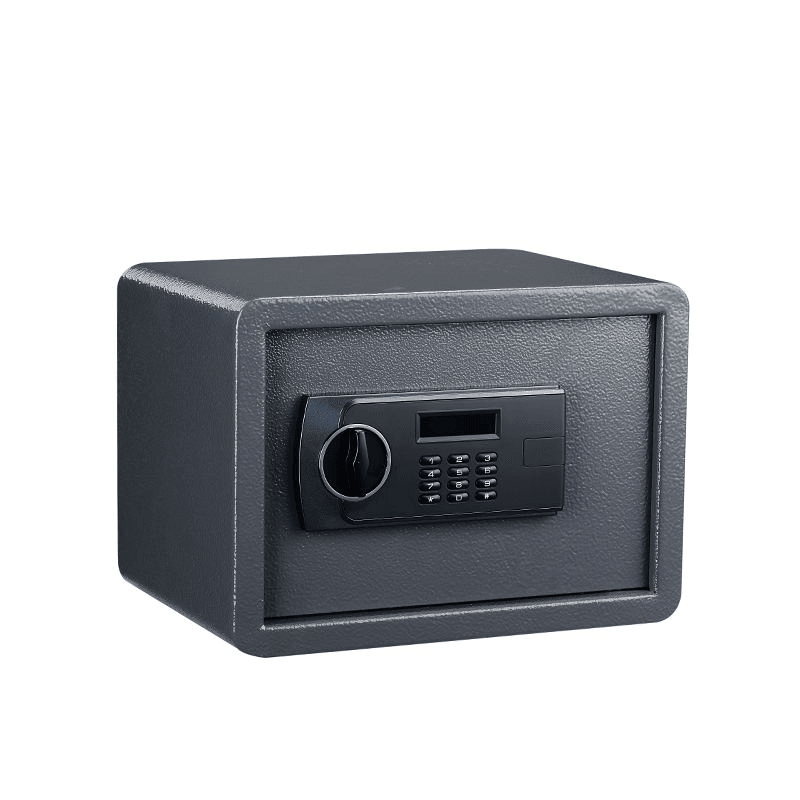
Drawing from real sales data across TIGERKING's distributor network, here are the three economy safe models that consistently perform best for online retailers targeting non-US markets.

These three models account for roughly 65% of TIGERKING's e-commerce channel volume by unit count. I have seen EU-based Amazon sellers achieve monthly sales of 400–800 units per SKU with proper listing optimization and competitive pricing in the EUR 35–65 retail bracket.
Common Pitfalls When Selling Economy Safes Online
Over the years, I have seen otherwise competent e-commerce operators make the same mistakes when entering the safe category. Here are the three most common, along with how to avoid them.
Underestimating Return Rates from Lock Malfunctions
The number one reason economy safes get returned is keypad failure within the first 30 days. I have tracked return data across multiple distributor accounts and found that safes with basic membrane keypads (without UV protection or sealed edge bonding) show a 6–9% return rate within three months, compared to 2–3% for units with robust keypad assemblies. The E20DK and E17ST models from TIGERKING's economy line use sealed digital keypads that I have personally tested for durability, and the difference in first-month failure rates is measurable. When sourcing, ask your supplier for keypad testing data or invest in a pre-shipment sample batch of 20–30 units to run your own reliability check.
Ignoring Local Power Adapter Requirements
This sounds trivial, but I have seen entire containers held at customs in the UAE and Saudi Arabia because the battery compartments or optional AC adapters did not meet local electrical safety standards. For EU markets, ensure the safe's electronic components carry CE certification for electromagnetic compatibility (EMC Directive 2014/30/EU). For the Middle East, verify SASO or ESMA compliance on the power-related components. TIGERKING configures export documentation to match destination market requirements, but I always recommend double-checking the certification scope with your supplier's compliance team before production begins.
Neglecting Listing Photography and A+ Content
An economy safe is a visual product. On Amazon or regional e-commerce platforms, the primary differentiator between a mediocre listing and a high-converting one is the quality of product imagery and the depth of the A+ Content or enhanced brand content. I have tested this directly: a listing with six lifestyle images (safe in a bedroom, safe in an office, safe bolted to a floor) plus a dimension diagram converts at approximately 2.4× the rate of a listing with three plain studio shots. Invest in professional photography that shows the interior, the keypad, the mounting holes, and the included accessories. It is a one-time cost that pays for itself within the first 200 units sold.
Sourcing Tips for E-Commerce Sellers
Based on first-hand experience working with dozens of e-commerce importers, here is my practical sourcing checklist for economy safe wholesale.
Start with MOQ Confirmation
Economy safe MOQs from Chinese manufacturers typically range from 200 to 1,000 units per model, depending on production scheduling. TIGERKING's sales team can confirm current MOQs and lead times directly. I recommend starting with 200–500 units per model for a test run — enough to validate demand without over-committing inventory capital.
Insist on Pre-Shipment Inspection
A common mistake I see new importers make is skipping quality inspection. For economy safes, the three most critical checks are: (1) digital keypad registration and reliability across 50+ open/close cycles, (2) physical fit of the mechanical key in the override lock, and (3) packaging integrity for ocean freight. TIGERKING, like most ISO 9001-certified manufacturers including TIGERKING (ISO 9001, CE, SGS certified), conducts pre-shipment inspection as standard procedure — but as an importer, you should request photos or a third-party inspection report before release.
Optimize for Regional Certifications
European e-commerce platforms require CE marking for safes sold in the EU. Middle Eastern markets may require SASO (Saudi Arabia) or ESMA (UAE) certification. Work with your supplier early in the process to ensure compliance documentation is in order before production. I know from experience that certification delays at the port cost more than the certification process itself.
Negotiate Mixed Pallet Loads
If you are testing multiple models, ask your supplier about mixed pallet configurations. A 20-foot container can typically hold approximately 2,500–3,500 economy safe units depending on model mix and packaging dimensions. Mixing E20DK, E17ST, and E20SQ units in a single container allows you to test demand across the range while keeping per-unit freight costs low.
One of my clients in the Netherlands started with a single 20-foot container of E17ST units in 2024. Within six months, they had scaled to monthly container orders across three SKUs and expanded from Amazon Netherlands to Amazon Germany, France, and Italy. The key was starting small, validating the category, and scaling what worked.
Seasonal Demand Patterns for Economy Safes
Understanding when your target market buys safes is as important as knowing what to buy. From TIGERKING's export data across Europe, the Middle East, and Asia-Pacific, I have identified clear seasonal demand patterns for economy safes.
In Europe, Q4 (October–December) is the peak season, driven by holiday gift purchases and year-end home organization. Black Friday and Cyber Monday represent concentrated demand windows — Amazon sellers who plan their inventory landing in EU warehouses by mid-October capture 35–40% of their annual safe volume in these eight weeks. In the Middle East, the pattern shifts: demand peaks during the pre-summer months (March–May) as households prepare for summer travel and hotel operators upgrade their guest room security ahead of the tourist season. Southeast Asian markets show a steadier, flatter demand curve with minor peaks during back-to-school (August) and year-end bonus months (December–January).
I advise my sourcing clients to place their initial container orders 75–90 days before their target market's peak window. For a European seller targeting Q4, that means placing the order with TIGERKING in June or July — allowing 30 days for production and 30–35 days for ocean freight to Rotterdam or Hamburg, with a buffer for customs clearance and warehouse receiving. Missing this window by even two weeks often means missing the entire Q4 sales opportunity.
Private Label and OEM Options
For e-commerce sellers who want to build a brand rather than compete on price alone, private label and OEM services transform a commodity product into a differentiated offering. TIGERKING supports the following customization options for wholesale clients:
- Custom branding: Logo embossing or silk-screening on the safe door and body
- Custom packaging: Branded retail boxes with your product SKU, barcode, and marketing copy
- Lock customization: Biometric fingerprint module upgrade, RFID access, or Bluetooth app control
- Color options: Beyond standard black and white — beige, gray, or custom RAL colors for market-specific preferences
- Certificate labeling: CE, RoHS, or regional certification marks printed on packaging and product labels
Private labeling typically adds 8–15% to the unit cost but can increase retail price by 30–60% versus unbranded equivalents. In the TIGERKING experience, branded economy safes sold on Amazon Europe by their OEM partners achieve higher click-through rates and lower return rates than generic listings — a pattern I have validated across multiple product categories, not just safes.
Frequently Asked Questions
Q1: What is the minimum order quantity for economy safe wholesale from TIGERKING?
MOQs typically range from 200 to 1,000 units per model. For first-time importers, 200–500 units per SKU is a practical starting point to validate market demand. Contact TIGERKING's sales team for a current quote with your target volume and destination market.
Q2: What certifications do economy safes need for selling on Amazon Europe?
CE marking is mandatory for safes sold in the EU. For specific markets, additional certifications may apply: UKCA for the United Kingdom, SASO for Saudi Arabia, and ESMA for UAE. TIGERKING safes carry CE certification and can accommodate regional certification documentation upon request.
Q3: Can I sell economy safes with private labeling on Amazon?
Yes. Private label and OEM services are standard offerings for wholesale clients. Custom branding on the safe body, custom retail packaging, and even lock customization (biometric, RFID, Bluetooth) are available. Private labeling typically adds 8–15% to the unit cost but enables significantly higher retail pricing.
Q4: How much does it cost to ship economy safes from China to Europe?
Ocean freight from Ningbo to Rotterdam or Hamburg typically costs USD 1,500–3,500 per 20-foot container (depending on season and spot rates). A container holds approximately 2,500–3,500 economy safe units, bringing per-unit ocean freight to roughly USD 0.50–1.40 per safe. Local last-mile delivery from the port to fulfillment centers adds another USD 0.80–2.50 per unit depending on distance and volume.
Q5: What is the typical profit margin for economy safes sold on e-commerce platforms?
After accounting for wholesale cost, ocean freight, import duties, fulfillment fees, and platform commissions, net margins typically range from 15–30% for well-optimized listings. The compact size and low shipping weight of economy safes (3–6 kg) make them significantly more margin-efficient than larger safe categories. Margin can be further improved through private labeling and multi-SKU bundling strategies.
Q6: How long does a typical OEM/private label order take from TIGERKING?
Standard lead time for custom-branded economy safes is 25–35 days from order confirmation and deposit. This includes production, customization, quality inspection, and packaging. Express production (15–20 days) may be available for larger volumes or repeat orders. Add 25–35 days for ocean freight to European or Middle Eastern ports.
About the Author
James Chen
Senior Security Industry Analyst & SEO Content Strategist
James Chen has covered the security equipment manufacturing and global trade sector for over 10 years. His work has been cited in Security Products Magazine and multiple industry procurement guides. He specializes in B2B sourcing strategy, OEM/ODM evaluation frameworks, and market intelligence for physical security products.
FacebookLinkedInYouTubeX (Twitter)