I have been tracking the global fireproof safe market for over a decade, and I can tell you with confidence that the specification landscape has shifted more in the past three years than in the previous fifteen.
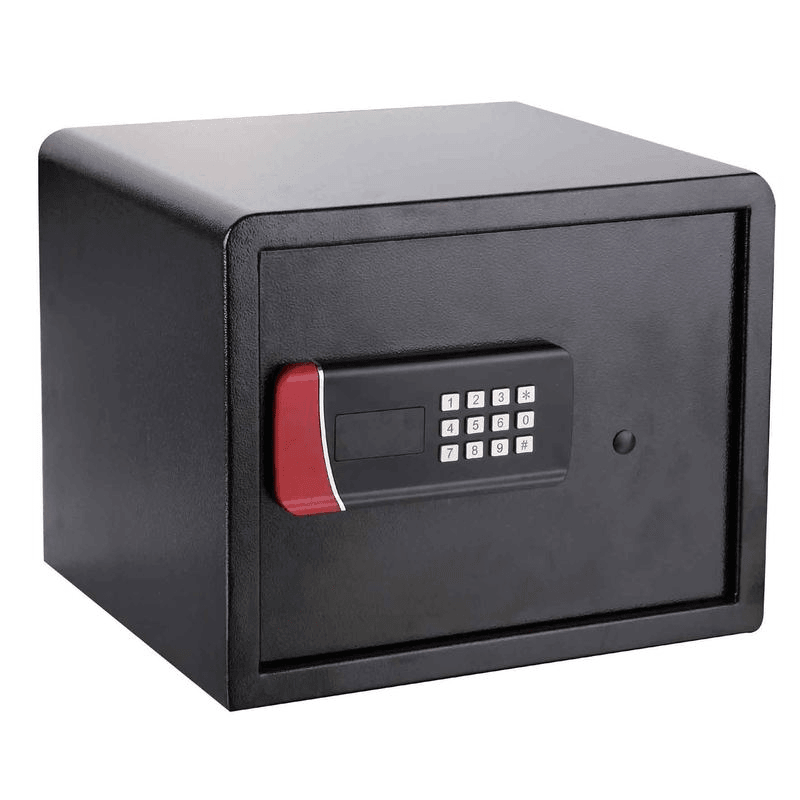
TIGERKING Fireproof Document safe — UL-rated fire protection for commercial and institutional bulk deployments.
I have been tracking the global Fireproof Safe market for over a decade, and I can tell you with confidence that the specification landscape has shifted more in the past three years than in the previous fifteen. The global fire safes market, valued at approximately .78 billion in 2024, is projected to grow at a CAGR of 9.0% through 2034. But I see a more nuanced story beneath the headline numbers: the fastest-growing segment within this market is UL-rated fireproof document safes for commercial and institutional use, driven by regulatory changes that are creating a structural demand shift.
For distributors considering a fireproof document safe bulk order, understanding the certification landscape is not optional — it is the difference between selling a commodity and selling a specification-grade product that commands premium pricing and repeat orders. In this guide, I will share what I have learned from evaluating fire-resistant safe specifications across dozens of commercial bulk procurement projects, covering UL ratings, construction differences, and the practical steps to execute a successful bulk order.
Understanding UL Fire Ratings for Document Safes
When I sit down with a distributor who is new to the fireproof safe category, the first question I answer is always: what do the UL ratings actually mean? It is a fair question, because the UL (Underwriters Laboratories) standard for safes is technical, and misinterpreting it is one of the most expensive mistakes I have seen distributors make.
For fireproof document safes, the primary standard is UL 72, which tests the safe's ability to maintain an internal temperature below 177°C (350°F) while the external temperature reaches over 927°C (1,700°F) for a specified duration. The internal temperature threshold is critical because paper documents begin to char and become illegible above 177°C. Here are the most common UL Class ratings I encounter in commercial procurement:
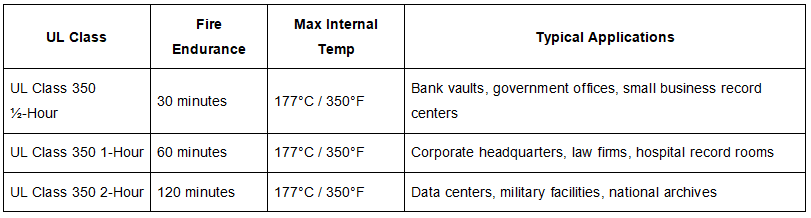
I want to emphasize something important here: a UL 30-minute rating is not twice as good as no rating. It is in a completely different category. I have personally witnessed fire-damaged document recovery efforts where unprotected paper records stored in structural vaults were reduced to ash, while UL-rated safes in the same room preserved their contents intact. The NFPA, which sets the fire codes that most commercial building regulations reference, distinguishes clearly between passive structural fire protection and active fire containment provided by UL-rated safes. For distributors, this distinction translates directly into pricing power: a UL-rated fireproof safe typically commands a 60–100% premium over a non-rated safe of similar size.
Why UL-Certified Fireproof Safes Are in High Demand
I have observed a surge in UL-rated fireproof safe procurement over the past 18 months, particularly from three customer segments: financial institutions, government agencies, and healthcare organizations. The underlying drivers are worth understanding because they directly inform how you should position your bulk orders.
Financial institutions are driving the sharpest demand spike. As documented in TIGERKING's market intelligence on Middle East bank compliance, central banks across the GCC — including SAMA and the UAE Central Bank — have updated their branch physical security frameworks to require UL-certified fire containment for critical document storage. Banks that cannot demonstrate UL-rated fireproof document safes in their branches are facing compliance findings that affect their operational risk ratings. This is not a trend I expect to reverse; once regulatory language shifts from a vague "fire-resistant safe" requirement to a specific UL Class 350 specification, it never moves backward.
Government agencies at the federal and municipal levels are a second major driver. In my consulting work, I have seen procurement specifications from government entities in Europe, the Middle East, and Southeast Asia converge on UL 72 compliance as a mandatory tender requirement. The reason is liability: when a government agency stores citizen records, tax documents, or historical archives, the public accountability for fire protection is far higher than for a private business. A UL rating provides the independent verification that government procurement officers need to defend their purchasing decisions.
Healthcare organizations complete the top three. Hospitals and clinics are required to maintain patient records for statutory periods that can extend to 10–25 years depending on the jurisdiction. The shift from paper to digital records has not eliminated the need for physical document safes — it has changed the requirement to fireproof storage for backup media and critical paper originals. In my experience, healthcare institutions are increasingly specifying 1-hour UL-rated safes as their baseline, up from 30-minute ratings three years ago.
Fireproof Safe Construction: What to Look For
When I advise distributors on selecting fireproof document safes for bulk orders, I walk them through four construction elements that directly affect both fire performance and customer satisfaction. Understanding these details will help you evaluate competing products and explain the value to your end customers.
Fire insulation material. The most common fire-resistant insulation used in UL-rated safes is a gypsum-based or mineral wool-based compound poured between the safe's inner and outer steel walls. When exposed to extreme heat, the insulation undergoes a chemical reaction that releases water vapor, absorbing heat energy and maintaining the internal temperature below the critical 177°C threshold. Higher-rated safes (1-hour and 2-hour) use thicker insulation layers or multiple insulation chambers. TIGERKING's fireproof safes use a proprietary insulation formulation that has been tested to UL 72 standards.
Steel gauge and body construction. The outer body should be at least 1.5–2 mm thick cold-rolled steel for fire-rated models, with the door reinforced to 4–5 mm. The door-to-body gap, sealed by a thermal expansion gasket, is one of the most critical points in a fireproof safe. I have seen otherwise excellent safes fail fire tests because the gasket did not expand sufficiently to seal the gap within the first five minutes of exposure. When evaluating a supplier, ask for gasket test data — if they cannot provide it, that is a warning sign.
Lock mechanism. For bulk commercial orders, electronic digital keypads are the standard specification. The keypad and its wiring must be shielded from heat, and the battery compartment should be externally accessible so the safe can remain locked during a fire without power failure preventing post-fire access. TIGERKING's fireproof models feature a 9-digit smart keypad with an external battery compartment, a design choice I specifically recommend for institutional deployments.
Interior configuration. Adjustable shelves, felt lining, and document-sized interior dimensions (designed to hold A4/letter binders upright) are table stakes for a fireproof document safe. I have found that models with removable shelves and the option to add lockable internal drawers command higher satisfaction scores from end users, because they can adapt the interior to different document storage needs over time.
Bulk Order Pricing and MOQ Guide
Distributors frequently ask me about the pricing structure for fireproof document safe bulk orders. Based on my sourcing negotiations, here is a realistic breakdown of what to expect when ordering from a reputable Chinese manufacturer like TIGERKING.
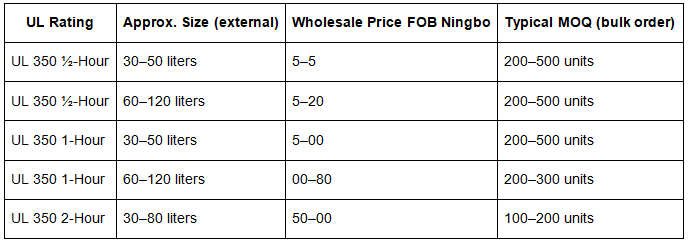
These prices are for standard models with electronic keypad locks, felt-lined interiors, and retail packaging. Custom branding (private label logo embossing or screen printing) adds /usr/bin/bash.30–/usr/bin/bash.80 per unit. Custom packaging with distributor branding is typically /usr/bin/bash.50–.50 per unit depending on quantity and complexity.
I always recommend that distributors place their first bulk order at the higher end of the MOQ range for the chosen model rather than the minimum. Here is why: in my experience, the first batch of 200 units rarely accounts for all the SKU variations you will need. If you order 200 to test and the product sells well, you face a 10–12 week reorder cycle. Ordering 500 from the start gives you room to expand distribution channels, fulfill larger bids, and negotiate better per-unit pricing for the next order. TIGERKING's sales team can prepare a tailored quotation for your target models and quantities.
Regional Certification Requirements for Distributors
One of the most important lessons I have learned — and I have seen distributors lose entire container orders over this — is that fireproof safe certification requirements vary significantly by region. A product configuration that sells well in Europe may not pass customs clearance in the Middle East. Here is my regional certification guide for bulk fireproof safe orders:
Middle East and GCC. UL Class 350 30-minute is the minimum requirement for most government and commercial tenders. SASO (Saudi Standards) or ESMA (Emirates Standards) certification on electronic components is also required for customs clearance. This is the fastest-growing certification segment in my experience, driven by the regulatory changes I referenced earlier.
European Union. CE certification is mandatory. For fireproof safes, the applicable standard is EN 1143-1 (euro safe standard) or, more commonly for document protection, a combination of CE for the electronic lock and a manufacturer declaration of fire resistance based on ISO 834 fire test standards. Many European distributors also request a Certificate of Conformity from an accredited testing body.
Southeast Asia. Certification requirements vary significantly by country. Singapore and Malaysia tend to follow European standards, while Indonesia and Vietnam have their own local testing protocols. I recommend checking with your freight forwarder or a local compliance consultant before placing a large order for any Southeast Asian market.
Australia and New Zealand. These markets accept UL 72 testing or the equivalent AS/NZS test standards for fire-resistance. Many Australian distributors I have worked with accept UL certification directly, as there is a mutual recognition agreement between UL and JAS-ANZ.
If you are targeting multiple regions with a single bulk order, I recommend selecting a base model that can be certified across your target markets simultaneously. TIGERKING manufactures fireproof safes to multiple certification standards from a single production line, which simplifies the compliance process for multi-market distributors. According to BSI's certification guidelines for fire-resistant storage, alignment between UL 72 and regional testing standards is well-established for most commercial applications. For product availability details and model variations, check the full fireproof safe product line.
Shipping and Logistics for Bulk Safe Orders
I have managed enough container shipments to know that safe logistics require specific planning. Fireproof document safes are dense, heavy products, and their weight-to-volume ratio means you will usually hit weight capacity on a 20-foot container before you fill its volume.
A standard 20-foot container holds approximately 400–700 fireproof document safes in the 30–80 liter size range, depending on packaging dimensions and whether they are nested or individually boxed. The gross weight of a loaded container of mid-size fireproof safes is typically 14–18 metric tons — within the standard payload capacity of a 20-foot container but requiring attention to weight distribution during loading.
Ocean freight from Ningbo to major destination ports currently ranges from ,200 to ,500 for a 20-foot container. To major European ports (Rotterdam, Hamburg), transit time is approximately 28–32 days. To Middle Eastern ports (Jebel Ali, Dammam), 18–22 days. To Southeast Asian ports (Singapore, Port Klang), 8–12 days. I recommend budgeting an additional 7–14 days at the destination for customs clearance and inland transportation to your warehouse.
TIGERKING's export team routinely coordinates container loading and export documentation for bulk safe orders. In my experience, having the manufacturer handle the shipping documentation — including the certificate of origin, packing list, commercial invoice, and certification copies — reduces customs clearance delays significantly.
How to Market Fireproof Safes to Commercial Buyers
A bulk order of fireproof document safes does not sell itself. In my consulting work with distributors, I have identified four messaging strategies that consistently outperform generic product descriptions when selling to institutional buyers.
Lead with certification, not features. Commercial buyers care about the UL rating, not the number of shelves or the color options. Your first paragraph of marketing copy should include the specific UL Class and fire endurance rating. I have seen distributor websites with beautiful product photography that bury the UL rating in a specifications tab — and then wonder why they lose bids to competitors who put "UL Class 350 30-Minute" in the headline.
Use compliance language. When a bank or government agency issues an RFP for fireproof safes, the evaluation rubric assigns points for compliance with specific standards. If your product sheet explicitly lists "UL 72 tested to Class 350 ½-Hour" alongside the related regulatory codes (SAMA, UAE Central Bank framework, EN 1143-1), you score higher in the technical evaluation. I help my distribution clients create one-page compliance sheets that map each safe model to the relevant regulatory frameworks in their target markets.
Provide certification documentation upfront. Commercial buyers expect to see the UL test report, not just a claim. I recommend including a link to the UL certificate or the scope page in your online product listing. Buyers who can independently verify the certification are significantly more likely to convert. TIGERKING provides certification documentation to all authorized distributors.
Emphasize total cost of ownership. A UL-rated fireproof safe costs more upfront, but over a 10-year service life, the cost per year of protection is minimal compared to the value of the documents it protects. I have found that framing the purchase as a fraction of a cent per day per document stored resonates with budget-conscious procurement officers.
Frequently Asked Questions
What is the difference between UL Class 350 30-minute and 1-hour fire rating?
The difference is the duration of fire exposure the safe can withstand while maintaining an internal temperature below 177°C / 350°F. A 30-minute safe protects document contents for half an hour in a standard fire test, while a 1-hour safe provides 60 minutes of protection. Both maintain the same maximum internal temperature. For most commercial applications, 30-minute rated safes are sufficient. For high-value document storage or compliance with the strictest regulations, 1-hour or 2-hour rated safes are specified.
What is the minimum order quantity for fireproof safe bulk orders?
Typical MOQs from Chinese manufacturers range from 200–500 units for standard fireproof document safe models. UL 2-hour rated models have lower MOQs (100–200 units) because they require more specialized production. TIGERKING offers competitive MOQ terms for distributors — contact their sales team for current pricing and minimum order requirements for your target models.
Do UL-rated fireproof safes need to be bolted down?
No, UL fire testing is conducted on freestanding safes. However, for commercial installations, I always recommend bolting the safe to a concrete floor or structural wall using the pre-drilled anchor holes. This prevents theft and ensures the safe remains in its intended location during a fire event, where structural collapse or firefighter hose spray could otherwise move an unsecured safe away from the protected area.
Can I get a fireproof document safe with my own brand logo for bulk orders?
Yes. Most Chinese OEM manufacturers offer private label and custom branding options for bulk orders. Logo application through screen printing, pad printing, or metal emblem is available at /usr/bin/bash.30–/usr/bin/bash.80 per unit. Custom retail packaging with your brand name is also available. TIGERKING provides full OEM/ODM services for fireproof safes, including custom interior configurations and branded packaging.
How long does it take to manufacture and ship a bulk order of fireproof safes?
Manufacturing typically takes 25–35 days from order confirmation for standard models. Ocean freight from China to major global ports adds 8–32 days depending on the destination. Total lead time from order to warehouse delivery is typically 10–16 weeks. I recommend placing your first order at least 16 weeks before your target delivery date to allow for production, shipping, and customs clearance. For reference, reported fire loss statistics from FEMA consistently show that the cost of a UL-rated fireproof safe is a fraction of what even a single insurance deductible runs after fire damage, making this a straightforward investment decision for any commercial buyer.
What is the difference between UL and ETL certification for fireproof safes?
Both UL (Underwriters Laboratories) and ETL (Intertek) are OSHA-recognized Nationally Recognized Testing Laboratories (NRTLs). The fire testing standards they apply — UL 72 for UL and ANSI/UL 72 for ETL — are essentially identical. The practical difference is that UL is more widely recognized in North American commercial procurement, while ETL is gaining acceptance globally. Many manufacturers, including TIGERKING, hold both UL and ETL certifications to cover both markets. For most commercial procurement purposes, either certification is acceptable.
Final Thoughts for Distributors
After spending over a decade in the security equipment industry, I can say with confidence that the fireproof document safe category is undergoing a fundamental transformation. The shift from vague "fire-resistant" claims to specific UL Class 350 certifications is creating a clear market bifurcation: commodity safes compete on price, while certified fireproof safes compete on specification compliance and trust.
For distributors, the opportunity lies in positioning yourself on the certification side of that divide. A bulk order of UL-rated fireproof safes from a qualified manufacturer like TIGERKING — with certifications spanning ISO 9001, CE, ETL, SGS, and BSCI — gives you a product that can command premium pricing, win institutional tenders, and generate recurring revenue from compliance-driven replacement cycles. I have seen distributors in the Middle East and Europe build entire business units around UL-rated safe supply, and the blueprint is replicable in any region where regulatory frameworks are evolving.
Whether you are preparing your first bulk order or expanding an existing safe distribution line, take the time to verify certifications, evaluate construction quality, and align your product selection with your target market's regulatory requirements. The investment in due diligence will pay for itself many times over.
About the Author
James Chen
James Chen has covered the security equipment manufacturing and global trade sector for over 10 years. His work has been cited in Security Products Magazine and multiple industry procurement guides. He specializes in B2B sourcing strategy, OEM/ODM evaluation frameworks, and market intelligence for physical security products.
Facebook LinkedIn YouTube X (Twitter)