
Every year, businesses across North America and Europe suffer preventable losses when fires destroy critical documents—corporate charters, tax records, insurance policies, and legal contracts—stored in inadequate filing systems. The average commercial fire generates temperatures exceeding 1,000°F within minutes, and standard filing cabinets offer zero protection against this thermal exposure. For office suppliers and business equipment distributors, fireproof safe manufacturing has become a priority category as organizations of every size confront the operational risk of document loss through fire, water damage from fire suppression systems, and theft of sensitive records.
The B2B Fireproof Document safe market serves a distinct segment from residential consumer safes. Commercial buyers require validated fire ratings, organized A4 and letter-size filing compartments, and locking mechanisms suitable for multi-user office environments. This article provides office suppliers and business equipment distributors with a comprehensive framework for evaluating, sourcing, and selling fireproof document safes at wholesale volumes.
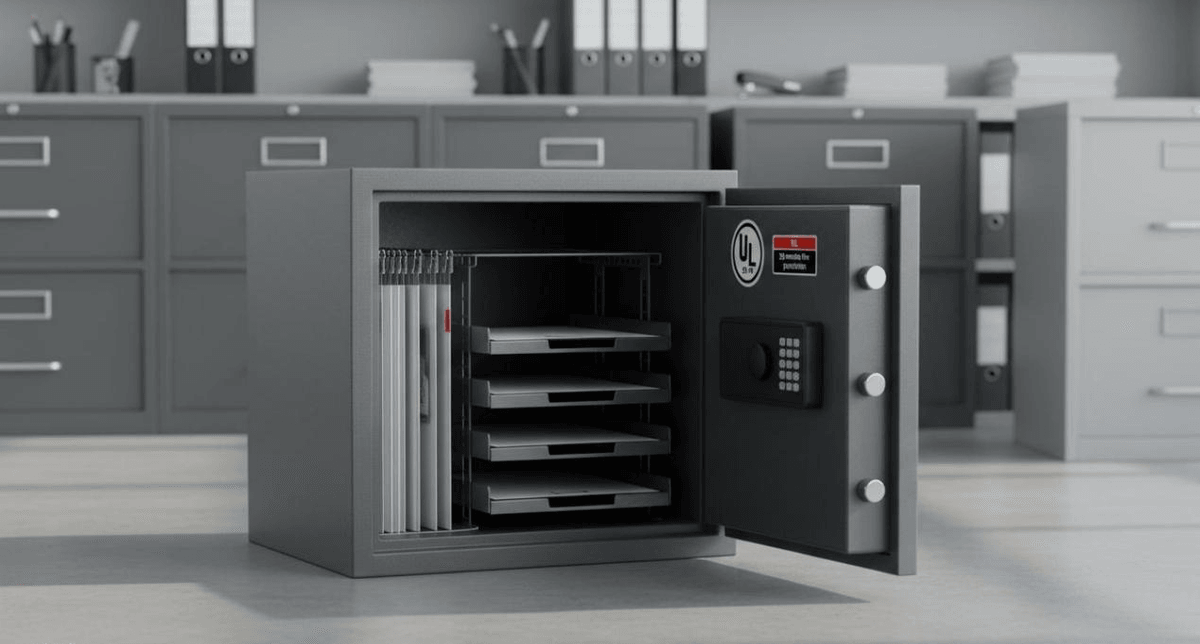
Understanding the Fireproof Document Safe Market Opportunity
The commercial document storage market intersects multiple regulatory and insurance drivers that create consistent wholesale demand. Financial institutions operating under Sarbanes-Oxley (SOX) compliance requirements must retain financial records for defined periods with protections against unauthorized access and environmental damage. Healthcare organizations subject to HIPAA must safeguard patient records with both physical security and disaster recovery provisions. Insurance agencies, law firms, and real estate companies maintain client files that often represent years of billable work and critical contractual evidence.
From a business equipment distribution perspective, fireproof document safes represent a high-margin, recurring opportunity. Unlike many office products that wear out and require replacement on fixed cycles, safes enjoy long product lifecycles while generating consistent demand from new business formation, office relocations, regulatory compliance changes, and end-of-life replacement cycles. The market does not experience the dramatic seasonal swings that characterize consumer electronics or seasonal sporting goods categories.
Types of Fireproof Document Safes: A Comparative Overview
The fireproof document safe market encompasses three primary product categories, each addressing different storage needs, capacity requirements, and price points. Understanding these categories helps office suppliers match product selection to their customer profiles.
filing Cabinet Safes: High-Capacity Document Storage
Cabinet-style Fireproof Safes represent the largest capacity category, designed to accommodate standard A4 or US letter-size hanging files in organized drawer configurations. These units resemble commercial filing cabinets in exterior footprint but incorporate fire-resistant insulation between double-wall steel construction. Capacities range from compact 2-drawer models holding approximately 4,000 documents to full-scale 4-drawer models accommodating 15,000+ documents.
Cabinet safes serve law firms, accounting practices, and insurance agencies where large volumes of active client files require organized, accessible storage. Their vertical orientation and drawer-based access prioritize file retrieval speed over compact storage, making them ideal for high-volume professional environments where documents are accessed daily.
Chest-Type Fireproof Safes: Compact Document and Valuable Protection
Chest-type or box-style fireproof safes offer smaller footprint solutions for businesses with moderate document storage needs or locations where full filing cabinets cannot be accommodated. These units typically feature a top-opening lid with gas strut-assisted operation, interior compartmentalization for media, documents, and small valuables, and fire ratings ranging from 30 minutes to 60 minutes.
These compact configurations serve small business owners, home office professionals, and branch locations of larger organizations. Their portable handle configurations occasionally enable emergency evacuation of critical documents during fire events—a feature particularly valued in areas with high wildfire risk such as California, Colorado, and the western United States.
Media and Data Safes: Specialized Protection for Electronic Media
A specialized subcategory addresses the storage needs for electronic media including backup tapes, hard drives, optical disks, and server components. Media safes require humidity control features in addition to fire protection, as magnetic and electronic media are susceptible to data degradation at humidity levels above 80%. These units typically carry specific UL 72 media ratings confirming protection for magnetic media at temperatures up to 125°F interior with 85% maximum humidity during standard fire test conditions.
For office suppliers serving technology-forward customers in financial services, healthcare IT, and legal technology practices, media safes represent a natural category extension that complements document storage offerings.
Key Specifications: Decoding Fire Ratings, Capacity, and Security Features
Fireproof document safe specifications require careful interpretation, as manufacturer rating claims vary in rigor and testing methodology. The following framework helps office suppliers evaluate product specifications accurately and communicate them effectively to business customers.
Fire Rating Standards and What They Actually Mean
The most commonly referenced fire rating standard is UL 72, developed by Underwriters Laboratories for safe storage containers. The standard tests safes by placing them in a furnace that follows a prescribed temperature curve—representing the progression of a real structure fire—and verifies that interior temperatures remain below levels that would damage the stored contents. Key UL 72 classifications include:
Class 350: Interior temperatures must not exceed 350°F, suitable for paper documents which auto-ignite at approximately 450°F. Most document safes carry Class 350 ratings.
Class 125: Interior temperatures must not exceed 125°F, required for magnetic media and electronic storage media. Media safes typically carry Class 125 ratings in addition to Class 350.
Class 150: Interior temperatures must not exceed 150°F, addressing film-based media including microfilm and certain photographic materials.
A 30-minute UL 72 Class 350 rating means the safe successfully maintained interior temperatures below 350°F for 30 minutes under standard furnace test conditions. This provides meaningful protection for typical office fire scenarios, where fire department response times in urban areas average 6–10 minutes and room flashover occurs within 10–20 minutes of fire origin. For higher-value document collections or remote locations with longer response times, 60-minute and 90-minute rated models offer additional margin of protection.
Interior Capacity: Understanding Cubic Footage and Document Counts
Interior capacity specifications for document safes typically reference cubic footage or estimated paper document counts. To translate these specifications into practical planning guidance for business customers, office suppliers should reference the standard capacity of a standard 4-drawer filing cabinet as approximately 3.2 cubic feet holding roughly 10,000–12,000 letter-size documents, or 8,000–10,000 A4 documents due to the slightly larger European format.
A mid-size document safe with 1.5 cubic feet of interior space accommodates approximately 4,000–5,000 letter-size documents—roughly equivalent to two standard filing drawers. This capacity suits small businesses, medical practices, and financial advisors managing active client files for 50–200 clients.
A4 File Compartment Considerations for International Markets
For office suppliers serving international markets outside North America, A4 file compartment configuration becomes essential. A4 paper dimensions (210mm × 297mm) differ from US letter (8.5" × 11"), and proper file compartment sizing ensures efficient document storage without wasted space or documents protruding from compartment slots. Premium manufacturers offer dual-format compartments accommodating both A4 and letter-size files, providing flexibility for distributors serving multi-format markets.
European and Asian Pacific distributors should confirm that their sourced safes feature appropriately sized file frames and hanging folder bars. The dimensional difference between A4 and letter formats—approximately 5mm width and 12mm height—creates meaningful capacity and accessibility differences when file volumes are substantial.
Locking Mechanisms for Multi-User Office Environments
Commercial document safes support several locking mechanism types, each suited to different access patterns and security requirements:
Key locks: Traditional and cost-effective, suitable for single-user or low-access-frequency environments. Key management represents a practical security consideration in multi-employee offices.
Electronic combination keypads: The most common commercial office safe lock type, offering code-based access without key management complexity. Many models support multiple user codes for audit trail capability.
Dual verification locks: Require two authorized codes entered in sequence, providing enhanced access control for high-sensitivity document storage.
Audit trail electronic locks: Maintain internal logs of lock access events including user codes and timestamps, supporting compliance requirements for regulated industries.
For wholesale procurement, electronic keypad locks represent the dominant specification request from business customers, offering the best balance of security, convenience, and cost. Office suppliers should stock models across all lock types but prioritize electronic keypad configurations as their core wholesale SKU.
Procurement Considerations for Office Suppliers and Business Equipment Distributors
Sourcing fireproof document safes at wholesale volumes requires attention to several categories of evaluation that differ from general office supply procurement.
Manufacturer Production Consistency and Quality Control
Unlike commodity office products where specification variation is tolerated, fireproof safes require manufacturing precision to achieve consistent fire ratings and security performance. Wholesale buyers should request production samples before committing to full container orders, conducting visual inspection of weld quality, door seal integrity, and lock mechanism smooth operation. Samples also enable physical testing of document capacity using actual customer file types.
Third-Party Testing Validation
Every credible fireproof safe manufacturer can provide third-party test reports from accredited laboratories. These reports confirm that production samples were tested under the referenced standard and achieved the stated ratings. Wholesale buyers should verify that test reports reference specific model numbers matching their purchase orders, as some manufacturers test one configuration and generalize ratings across multiple models without equivalent construction.
Freight, Import Duty, and Landed Cost Calculation
For North American distributors importing from Chinese manufacturers, accurate landed cost calculation requires including: FOB or EXW factory price, ocean freight from Chinese port to destination port (typically $3,000–$6,000 for a 20-foot container), insurance (approximately 0.2–0.5% of cargo value), customs duties (H.S. Code 8303.00.0000, currently 0% under most-favored-nation treatment for Chinese imports to the US), port handling and drayage fees, and inland freight to distribution warehouse.
These cost components can add 25–40% to factory pricing, depending on product density (heavier safes incur higher freight per unit) and current shipping market conditions. Wholesale buyers should incorporate all landed cost components before establishing retail pricing to ensure adequate margin coverage.
Packaging and Palletization for Distribution Efficiency
Document safes ship as heavy, dense freight requiring appropriate packaging for distribution center handling. Standard export packaging includes foam corner protection, double-wall corrugated outer packaging, and steel strapping. For LTL (less-than-truckload) distribution within North America, buyers should confirm that product dimensions and weights are compatible with standard pallet configurations (48" × 40" GMA pallets) and that packaging can withstand the compression forces of multi-level pallet stacking during warehouse storage.
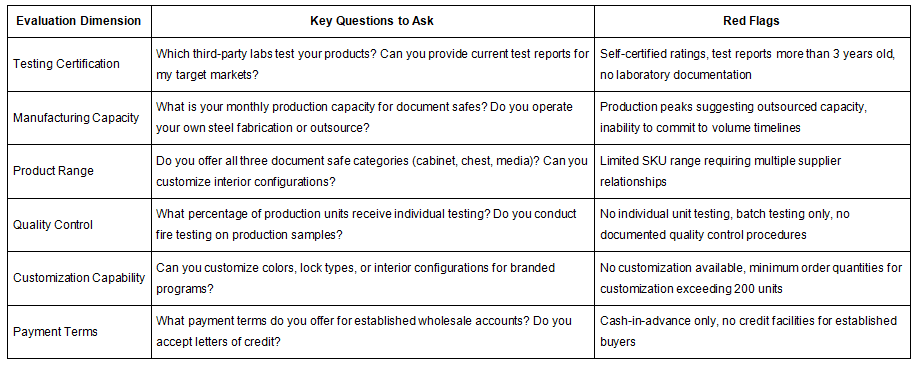
Supplier Selection Framework for Fireproof Document Safe Wholesale
Selecting the right manufacturing partner for fireproof document safe wholesale programs requires evaluating manufacturers across multiple dimensions that extend beyond unit pricing.
Market Positioning and Competitive Pricing for Office Supply Distributors
Office suppliers entering or expanding fireproof document safe wholesale programs must establish pricing strategies that balance margin requirements against competitive market conditions. The document safe category competes against several alternative solutions that businesses consider for disaster preparedness:
- Off-site document storage: Commercial records management companies offer fireproof off-site storage for monthly per-cubic-foot fees. This solution eliminates hardware investment but creates ongoing operational costs and retrieval delays.
- Fireproof filing cabinets: Non-portable fireproof cabinets provide fire protection without the higher cost of insulated safes. These suit environments where mobility is unnecessary.
- Digital document scanning: Document digitization eliminates physical storage concerns for many paper records, though regulatory requirements often mandate physical retention of original documents for specific record types.
- Cloud-based document management: Enterprise content management platforms provide disaster recovery through data redundancy, but again, legal requirements frequently mandate physical document retention.
Each competitive alternative has limitations that reinforce the value proposition of physical fireproof safes: off-site storage introduces retrieval latency, digital solutions face regulatory retention requirements, and fireproof cabinets lack the mobility and verified fire rating of purpose-built document safes. Wholesale sales conversations should address these competitive alternatives to help customers understand why fireproof document safes remain the most practical solution for immediate-access, regulated, physical document storage.
For distributors seeking high-security home safe and domestic fireproof safe options, expanding into business-grade document safes creates a natural upsell pathway as residential customers grow their businesses and require higher-capacity commercial solutions.
Addressing Regulatory and Insurance Requirements in Your Sales Approach
Business customers frequently face regulatory mandates or insurance requirements that specify fireproof storage for particular document categories. Savvy wholesale distributors leverage these requirements in their sales approach, positioning fireproof document safe purchases as compliance investments rather than optional equipment purchases.
For healthcare customers, HIPAA requires "physical safeguards" for protected health information that may include paper records, creating documented need for fireproof storage. Financial advisors managing customer records under FINRA Rule 17a-4 require storage media that protects records from "damage by fire and other casualties." Real estate brokerages, insurance agencies, and law firms face similar sector-specific retention requirements that translate to concrete product demand.
Office suppliers who understand their customers' regulatory environment and can speak to specific compliance requirements become trusted advisors rather than transactional product resellers. This positioning supports premium pricing, stronger customer relationships, and reduced price sensitivity in competitive bid situations.
The complete B2B guide to sourcing fireproof safes from China provides additional procurement frameworks and supplier evaluation criteria relevant to fireproof document safe wholesale programs.
Conclusion: Building a Sustainable Fireproof Document Safe Wholesale Category
Fireproof document safes represent a compelling wholesale category for office suppliers and business equipment distributors seeking predictable margins, regulatory-driven demand, and limited direct e-commerce competition. Success in this category requires understanding the technical distinctions between fire rating standards, the operational requirements of business customers across regulated industries, and the supply chain logistics of importing heavy steel products from international manufacturers.
Distributors who invest in product knowledge, maintain appropriate inventory buffers, and develop strong supplier relationships position themselves as indispensable partners to business customers navigating document security and compliance requirements. As regulatory environments continue to evolve and businesses increasingly recognize the operational risk of document loss, the fireproof document safe wholesale category offers sustained growth opportunities for well-positioned office supply partners.
James Chen
Senior Security Industry Analyst & SEO Content Strategist
James Chen has covered the security equipment manufacturing and global trade sector for over 10 years. His work has been cited in Security Products Magazine and multiple industry procurement guides. He specializes in B2B sourcing strategy, OEM/ODM evaluation frameworks, and market intelligence for physical security products.
Facebook | LinkedIn | YouTube | X