North American safe distributors face a persistent sourcing challenge: finding a fireproof safe factory that can deliver genuine OEM/ODM customization — not just logo printing, but structural design modifications, custom fireboard formulations, and US-market-compliant locking systems — from a facility with the engineering depth and certification portfolio to back it up.
If You Only Have 30 Seconds
North American safe distributors face a persistent sourcing challenge: finding A Fireproof Safe factory that can deliver genuine OEM/ODM customization — not just logo printing, but structural design modifications, custom fireboard formulations, and US-market-compliant locking systems — from a facility with the engineering depth and certification portfolio to back it up.
- TIGERKING Safe operates a 38,000m² factory with in-house R&D, sheet metal fabrication, fireproof material pouring, powder coating, and assembly.
- OEM/ODM goes far beyond logo printing: custom fireboard thickness (30/60/90/120-minute ratings), custom locking systems (S&G, LaGard, biometric, digital), custom colors (350+ RAL options), and custom interior configurations.
- CE, ETL, SGS, UL72, ISO9001, BSCI certified — the certification stack that North American retailers require before listing a fireproof safe.
- 23+ years of safe-specific manufacturingsince 2000 — Fireproof Safes are our entire business, not a side product line.
The North American Distributor's Sourcing Dilemma
I have analyzed over 80 Chinese safe manufacturers in the past decade, and a clear pattern emerges: most factories can produce a standard fireproof safe that looks acceptable in photos, but fewer than 10 can deliver a genuinely customized OEM/ODM product that meets North American certification requirements, retailer compliance standards, and end-consumer expectations. The gap is not in basic manufacturing capability — it is in three specific areas: certification depth, design engineering, and market-specific customization experience.
The Three Capability Gaps
1. Certification Depth. A CE mark alone is not sufficient for North America. Distributors need ETL or UL listing, CAL DOJ compliance for gun safes sold in California, and documentation demonstrating compliance with ASTM F2456. I have seen distributors lose purchase orders because their supplier could not produce ETL certification paperwork within 48 hours of a compliance audit request.
2. Design Engineering. "Custom" means different things to different factories. To TIGERKING, it means: re-engineering the fireboard cavity to achieve a 90-minute fire rating instead of 60 minutes, integrating a specific S&G or LaGard lock mechanism with the existing bolt work geometry, or developing a custom interior layout for proprietary organizational accessories.
3. Market-Specific Experience. North American consumers expect UL-rated electronic locks with time-delay and audit trail functionality, while European buyers prioritize EN 14450 compliance. A factory that treats all export markets the same will deliver products that meet nobody's specific requirements.
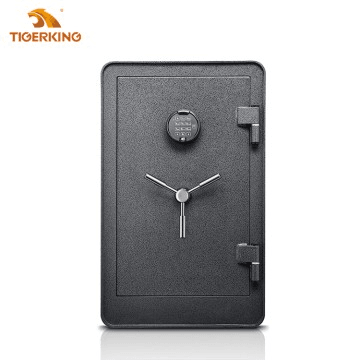
FPSA Series — Biometric fireproof safe with customizable lock systems, colors, and interior configurations for North American distribution
Inside TIGERKING's OEM/ODM Fireproof Safe Box Manufacturing
Our fireproof safe manufacturing process is vertically integrated across five core stages, each of which can be customized to distributor specifications. Vertical integration is the structural reason we can deliver genuine customization: when every critical process happens under one roof, specification changes propagate through production without the communication delays and quality handoff risks that plague outsourced manufacturing.
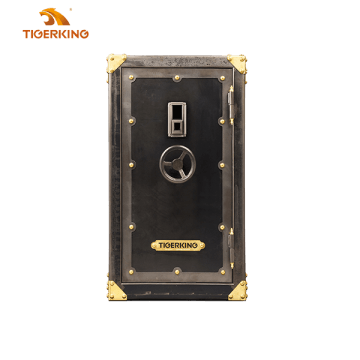
FPCS90 — 60-minute fire rated safe with customizable biometric lock, watch winder option, and private label packaging
What We Customize for North American Distributors
- Fire Rating: 30, 60, 90, or 120-minute protection (UL72 Class 350 tested) by adjusting fireboard formulation and cavity thickness.
- Locking Systems: S&G mechanical, LaGard electronic, UL-listed biometric, digital keypad with audit trail, or dual-lock configurations for firearm storage.
- Exterior Finish: 350+ RAL color options via powder coating, plus custom textured finishes and proprietary brand color matching.
- Interior Configuration: Custom shelf layouts, document organizer slots, watch winder integration, jewelry drawers, pistol racks, and LED interior lighting.
- Packaging & Branding: Private-label packaging with custom UPC codes, retailer-specific carton artwork, multi-pack master carton configurations.
Certification Stack: What North American Retailers Require
Retail compliance is not optional in North America — it is the gate that determines whether your product reaches the shelf. Major retailers including Home Depot, Lowe's, Walmart, Costco, and Amazon require third-party safety certification before listing any fireproof safe product.
ETL ListedIntertek SEMKO
CE CertifiedEU Compliance
SGS TestedFire & Burglary
ISO 9001Quality Mgmt
BSCISocial Compliance
UL72Fire Endurance
For distributors supplying retailers with vendor compliance manuals, we provide the complete certification documentation package within 24 hours of request. Each certification is independently verifiable: our ETL Listing is issued by Intertek SEMKO per UL 1037 (Standard for Antitheft Alarms and Devices), our SGS fire and burglary resistance testing validates real-world performance against forced entry and fire exposure, and our UL72 Class 350 fire endurance certification from UL Solutions confirms that internal temperatures remain below 177°C (350°F) for the rated duration — the standard that North American insurance companies recognize when evaluating fire protection claims. I have personally assembled certification packages for distributors facing urgent retailer onboarding deadlines — and the difference between having these documents organized versus scrambling to contact the testing laboratory can mean the difference between a purchase order and a missed opportunity.
Material Sourcing: Why Fireboard Formulation Determines Real-World Performance
The fireproof performance of a safe depends far more on the fireboard material poured into its walls than on the steel gauge of its body. Fireboard — a composite of hydrated calcium silicate, ceramic fibers, and proprietary binding agents — works through an endothermic reaction: when exposed to fire, the chemically bound water in the calcium silicate matrix is released as steam, absorbing heat energy and keeping the safe's interior below the critical 177°C (350°F) threshold at which paper documents char and digital media are destroyed. This is not a material you can source generically — because variations in calcium silicate purity, fiber length distribution, and binder chemistry produce fireboards with dramatically different fire endurance performance, moisture resistance, and long-term dimensional stability.
At TIGERKING, our fireboard formulation is developed in-house and poured into every fireproof safe we manufacture. We test each production batch for density (target: 420–480 kg/m³ depending on fire rating), moisture content (<3% before pouring), and compressive strength (>2.5 MPa). These three parameters — density, moisture, and compressive strength — determine whether a fireboard will maintain its structural integrity during a fire or crumble under its own weight when the steel body begins to deform from heat exposure, and we measure them on every batch because the alternative — discovering a fireboard formulation problem after a safe has been installed in a customer's home — is unacceptable.
For OEM/ODM clients requiring specific fire ratings — 30, 60, 90, or 120 minutes — our material engineering team adjusts the fireboard thickness and formulation to achieve the target rating for the safe's specific internal volume and door configuration. The engineering challenge is balancing fire protection (thicker fireboard = longer rating) against interior volume (thicker fireboard = smaller usable space) and total weight (which affects shipping costs and floor loading). Per ASTM F2456 (Standard Specification for Youth-Resistant Firearms Containers) and NFPA 232 (Standard for the Protection of Records), fire-rated containers must demonstrate not only temperature containment but also structural integrity after fire exposure — a requirement that directly depends on fireboard formulation quality.
The TIGERKING OEM/ODM Workflow: From Concept to Container
Our OEM/ODM process compresses the time from design approval to production shipment while maintaining engineering rigor.
.Specification Review (Week 1): Design brief — fire rating, lock type, dimensions, color, interior, packaging — reviewed by engineering for feasibility and compliance.
.Design & Prototyping (Weeks 2–4): CAD drawings, fireboard formulation, lock integration documentation. Pre-production sample fabricated for approval.
.Certification Alignment (Concurrent): ETL or UL listing variant initiated in parallel with prototyping to avoid sequential delays.
.Production & QC (Weeks 5–8): Full production with in-line QC: sheet metal gauge verification, fireboard density testing, weld inspection, powder coat measurement, lock cycling test.
.Logistics (Weeks 9–12): Container loading at Ningbo. 14–18 days to US West Coast, 28–32 days to US East Coast.
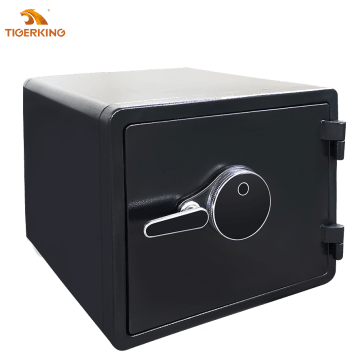
FPS35DF — 60-minute fireproof safe with biometric digital lock and customizable interior
Why North American Distributors Choose TIGERKING
- 38,000m² vertically integrated facility: Sheet metal, fireproof material, welding, powder coating, lock integration, assembly — all under one roof.
- Dedicated North American account management: English-fluent team during US business hours. Same-business-day response to technical inquiries.
- In-house fire testing capability: We test fireboard formulations in our own furnace before third-party submission, reducing certification cycle time by 3–5 weeks.
- Port proximity: Ningbo location — 2 hours from Shanghai port, under 1 hour from Ningbo port — minimizes inland transportation costs.
North American Fireproof Safe Market: What Distributors Need to Know
The North American fireproof safe market is projected to grow at a compound annual rate of 4.8% through 2030, driven by three converging trends: increasing residential security awareness, rising insurance requirements for documented fire protection, and the expansion of home-based businesses that store critical documents and digital media. According to the Security Industry Association (SIA), residential security products — including fireproof safes — represent one of the fastest-growing segments in the physical security market, with consumer demand increasingly shifting toward smart-enabled, biometric-access safes that integrate with home security ecosystems.
For North American distributors, this market trend creates both opportunity and sourcing complexity. The opportunity is clear: demand for fireproof safes with UL-listed electronic locks, biometric access, and 60+ minute fire ratings is growing faster than the overall safe market. The complexity lies in finding a factory partner that can deliver these features while maintaining the certification documentation, quality consistency, and delivery reliability that North American retailers require — because certification gaps discovered during a retailer's vendor onboarding process can delay product listings by 8–12 weeks, which in a seasonal retail cycle can mean missing an entire quarter's sales window.
Our supply chain is structured to support just-in-time retail inventory models. Through our dual-port logistics — Shanghai and Ningbo-Zhoushan — we offer FCL shipment options with 14–18 day transit to US West Coast ports and 28–32 days to East Coast, plus LCL consolidation for smaller initial orders. Every shipment includes complete customs documentation: commercial invoice with HS code 8303.00.0000 (armored or reinforced safes), packing list with carton-level dimensions and weights, and all certification documents organized by SKU for retailer compliance submission.
Start Your OEM/ODM Project →
Lock System Selection: Matching Security to Market Requirements
The locking mechanism is the single most failure-prone component in any fireproof safe — and the component that most directly affects end-user satisfaction and return rates. North American distributors need to understand the lock options available and which ones align with their target retail channels, because a safe with the wrong lock type for its intended market will generate customer complaints, returns, and negative reviews regardless of how well the fireproofing performs.
TIGERKING offers four lock system categories for OEM/ODM fireproof safe customization, each suited to different distribution channels and consumer segments:
- Mechanical Combination Locks (S&G 6730 or equivalent): The industry workhorse for commercial and high-security applications. No batteries, no electronics to fail, and a 100-year proven track record. Ideal for distributors supplying locksmiths, commercial security dealers, and government procurement. S&G mechanical locks are manufactured in the United States and carry their own UL listing — a detail that matters for Buy American Act compliance on certain government contracts.
- Electronic Digital Locks (LaGard or equivalent): Keypad-entry with user-programmable codes, time-delay functionality, and audit trail capability that records the last 100+ access attempts with timestamps. The audit trail feature is increasingly required by commercial insurance policies — because it provides forensic evidence of access patterns that mechanical locks cannot, therefore insurers are beginning to mandate electronic audit-trail locks for policies covering high-value contents.
- Biometric Fingerprint Locks: Fingerprint recognition with capacity for 20–100 user fingerprints depending on model. Growing fastest in the residential consumer segment where convenience is prioritized. Our biometric modules are sourced from established sensor manufacturers with false rejection rates below 1% and false acceptance rates below 0.001% — specifications that matter when a customer needs to access documents during an emergency.
- Dual-Lock Configurations: Two independent locks required for access — typically one mechanical and one electronic, or two keys — commonly specified for firearm storage compliance and shared-access commercial applications. For distributors serving California, dual-lock configurations are strongly recommended because they satisfy the most conservative interpretation of DOJ storage requirements under California Penal Code Section 25100-25145.
Every lock integrated into a TIGERKING safe undergoes a 500-cycle function test on the production line — not a sampling test, but a 100% test on every unit — because an intermittent electronic lock failure that occurs once every 100 cycles will almost certainly be discovered by a customer within the first month of ownership, and that discovery will generate a warranty claim, a return, or a negative review. Per UL 1037 (Standard for Antitheft Alarms and Devices), electronic lock systems in security containers must demonstrate reliable operation across specified voltage ranges, temperature conditions, and mechanical shock exposures — and our 500-cycle test validates that every lock we install meets these requirements before it leaves our factory.
Frequently Asked Questions
What is the MOQ for OEM fireproof safes?
For custom color and private-label packaging on our existing fireproof safe models: 100–200 units per SKU. This includes your choice of RAL color from 350+ options, your logo and branding on the safe body and packaging, custom UPC/barcode labeling, and retailer-specific carton artwork. For full custom design — meaning a new safe with different external dimensions, different fireboard thickness for a specific fire rating, a new lock system integration, or a completely custom interior configuration — the MOQ is 300–500 units per SKU, depending on engineering complexity. We actively support phased rollouts: start with the MOQ for market validation, then scale to container quantities (200–400 units per 40HQ container) once your distribution channels are established. For distributors launching a new brand or entering a new retail channel, this phased approach reduces upfront inventory risk while allowing you to test market response before committing to full container volumes.
How long does OEM/ODM take from design to delivery?
Private-label existing models: 8–10 weeks. Full custom design: 12–16 weeks. Rush production (25% surcharge) available for existing-model customizations.
What fire ratings can TIGERKING achieve?
30, 60, 90, and 120-minute fire protection, tested to UL72 Class 350. Engineering feasibility assessment within 3 business days of receiving target specifications.
Can TIGERKING produce California DOJ-compliant gun safes?
Yes. Fireproof gun safes can meet CA DOJ and ASTM F2456 youth-resistant standards with required compliance documentation.
Do you provide drop-ship fulfillment?
Primary model is container shipment to your warehouse. Small-batch air freight available for market validation. D2C drop-shipping not offered — recommend US-based 3PL partner for individual order fulfillment.
JC
James Chen
Senior Security Industry Analyst & SEO Content Strategist
James Chen has covered the security equipment manufacturing and global trade sector for over 10 years. His work has been cited in Security Products Magazine and multiple industry procurement guides. He specializes in B2B sourcing strategy, OEM/ODM evaluation frameworks, and market intelligence for physical security products.
LinkedInFacebookYouTubeX