Why "fireproof" is misleading, what fire-resistant ratings mean, and how to choose the right safe.
Key Takeaways
No safe is truly fireproof. The industry-correct term is fire-resistant, meaning the safe can withstand a specific temperature for a rated duration.
UL 72 defines three protection classes: Class 350 for paper, Class 150 for magnetic media, and Class 125 for digital media.
ETL verification by Intertek provides independent, third-party confirmation of a safe's fire-resistance claims.
Testing temperatures range from 1,200 degrees F for basic ratings to 1,700 degrees F for extended-duration certifications.
Fire insulation and theft resistance require different engineering approaches; the best safes address both.
Always match the fire-resistance class to the type of contents you are protecting, not just the time rating.
Verify that your safe's rating aligns with your insurance policy requirements for coverage eligibility.
Why the Word "Fireproof" Is Technically Misleading
In the safe industry, the word fireproof is one of the most widely used and least understood terms. Consumers searching for protection against fire damage almost always type "Fireproof Safe" into search engines, and most manufacturers, including Tiger King Safe, use the term in product listings because it matches buyer intent. However, from a technical and engineering standpoint, no safe is truly fireproof. Every safe has a finite tolerance for heat and a limited duration of protection. Given enough time or a high enough temperature, the internal environment of any safe will eventually exceed the threshold at which its contents are destroyed.
This distinction is not merely academic. It has real consequences for procurement decisions, insurance claims, and business continuity planning. When a facility manager reads the word fireproof on a product brochure, they may assume the safe will protect its contents indefinitely during a fire. In reality, the safe is rated to maintain an internal temperature below a specific threshold for a specific period, typically 20, 30, or 60 minutes. After that period, insulation degrades, door seals fail, and internal temperatures rise toward the ambient fire temperature.
The National Fire Protection Association (NFPA) data consistently shows that commercial fires can reach temperatures between 1,200 and 1,800 degrees Fahrenheit. No consumer or commercial safe can withstand those temperatures indefinitely. The industry has therefore adopted fire-resistant as the accurate descriptor, and standards bodies such as Underwriters Laboratories (UL) and Intertek test and certify safes based on their fire-resistance performance, not on any claim of being fireproof. Understanding this terminology is the first step toward making an informed procurement decision.
What "Fire-Resistant" Actually Means in the Safe Industry
Fire-resistant is the industry-standard term that describes a safe's verified ability to protect its contents from heat damage for a defined period under controlled test conditions. Unlike the vague consumer term fireproof, fire-resistant carries a precise, testable meaning. A fire-resistant safe has been subjected to a standardized furnace test in which the safe is exposed to a specified external temperature while sensors monitor the internal temperature throughout the test duration. The safe passes if the internal temperature remains below the threshold defined by its class rating for the full rated period.
This testing methodology is governed by UL 72, the Standard for Tests for Fire Resistance of Record Protection Equipment. UL 72 is the benchmark standard recognized by insurers, fire marshals, and facility managers across North America and increasingly in international markets. The standard defines three protection classes, each with a different maximum internal temperature, tailored to the type of content being protected. A safe that earns a UL 72 Class 350 rating, for example, has been tested to ensure that paper documents stored inside will not reach their charring or ignition temperature during the rated fire exposure.
For B2B buyers, the practical implication is straightforward: always look for a specific class rating and a certified duration. A product described only as "fire-resistant" without a class and time specification provides no actionable information. A product listed as "UL 72 Class 350, 1-hour rated" tells you exactly what protection level you are getting. This specificity is what separates a procurement-grade fire-resistant safe from a consumer-grade product that relies on marketing language alone. Manufacturers like Tiger King Safe that submit products for independent testing and certification demonstrate a commitment to transparency that procurement teams should prioritize.
UL 72 Class Ratings Explained: 350, 150, and 125
The UL 72 standard defines three distinct fire-resistance classes, each designed to protect a different category of contents. Understanding these classes is essential for anyone specifying safes in a commercial or institutional environment, because selecting the wrong class can result in catastrophic data or document loss even when the safe itself performs exactly as rated.
Class 350 is the most common rating and is designed for paper document protection. The number 350 refers to the maximum allowable internal temperature in degrees Fahrenheit. Paper begins to char at approximately 400 degrees F and ignites at around 451 degrees F. By capping the internal temperature at 350 degrees F, a Class 350 safe provides a meaningful safety margin below the damage threshold. This class is suitable for contracts, legal documents, financial records, and other paper-based business assets.
Class 150 is rated for magnetic media protection, including magnetic tapes, floppy disks, and older backup media. Magnetic media is far more sensitive to heat than paper, with data corruption beginning at temperatures as low as 150 degrees F. The stricter temperature cap reflects this vulnerability. Class 125 is the most stringent class, rated for digital media such as hard drives, USB storage devices, and optical discs. Digital media can sustain damage at temperatures well below those that affect paper, making Class 125 the appropriate choice for organizations that store critical digital backups on physical media.
Each class can be certified for different durations, commonly 30 minutes or 60 minutes, depending on the test protocol. The UL 72 vs ETL verification framework explains how these tests are conducted and how to interpret the results for your specific procurement needs.
ETL Verification: Independent Testing That Builds Trust
While UL 72 defines the testing standard, ETL verification provides the independent, third-party certification that confirms a safe actually meets the claimed rating. ETL, a service mark of Intertek, is one of the most widely recognized testing and certification bodies in the world. When a safe carries an ETL mark, it means that Intertek's engineers have witnessed the furnace test, monitored the internal temperature data, and verified that the safe performed within the parameters of its claimed class and duration.
The ETL verification process subjects safes to furnace temperatures that simulate real fire conditions. For standard ratings, safes are typically exposed to 1,200 degrees Fahrenheit for 20 to 30 minutes. For higher-tier ratings, the furnace temperature is elevated to 1,700 degrees F for 60 minutes. Thermocouples placed inside the safe continuously record internal temperatures, and the data is compared against the class threshold. If the internal temperature exceeds the allowable maximum at any point during the test, the safe fails.
For B2B procurement teams, ETL verification eliminates the guesswork and risk associated with manufacturer self-reported data. A safe that claims 60-minute fire protection but has not been independently tested may or may not perform as advertised. A safe that carries an ETL mark for 60-minute Class 350 protection has been proven to deliver that performance under controlled, repeatable conditions. This distinction matters enormously when specifying safes for environments that house irreplaceable records, regulated data, or high-value assets. The Intertek certification program provides a searchable database of certified products, allowing procurement teams to verify claims before placing orders. Tiger King Safe products such as the FPS35DF carry ETL certification, providing documented proof of fire-resistance performance for international buyers.
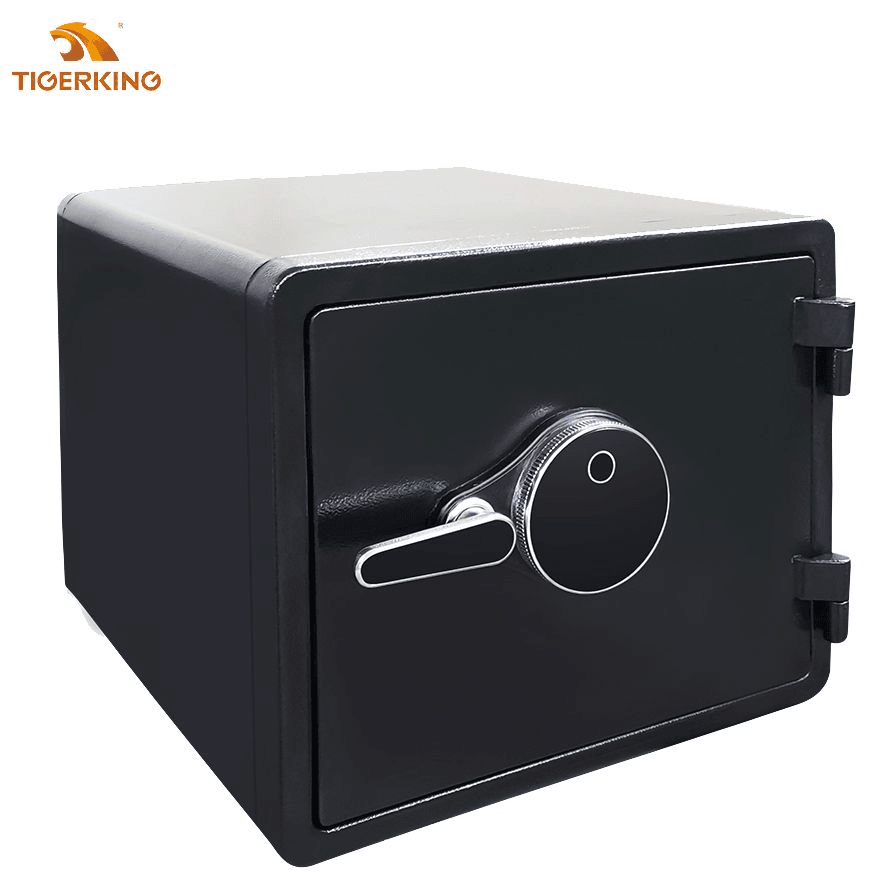
The Tiger King FPS35DF biometric fire-resistant safe, rated for 60 minutes of ETL-certified fire protection.
Testing Temperatures: What 1,200F to 1,700F Means for Your Contents
The temperatures used in fire-resistance testing directly reflect the conditions that safes face in real-world fire scenarios. According to fire safety research, a typical commercial structure fire can reach 1,200 degrees Fahrenheit within the first few minutes and can exceed 1,700 degrees F in fully developed conditions. The testing protocols used by UL and ETL are designed to simulate these extreme environments, which is why the results carry practical significance for buyers.
A safe rated at 1,200 degrees F for 20 minutes, such as the Tiger King FPCS90, provides protection against a moderate-duration fire event. This rating is appropriate for environments where fire department response times are short and sprinkler systems are present. The safe's insulation absorbs and delays heat transfer, keeping the internal environment below the critical threshold long enough for the fire to be suppressed or for contents to be evacuated. For many small and medium businesses, this level of protection represents a practical balance between cost and coverage.
A safe rated at 1,700 degrees F for 60 minutes, such as the Tiger King FPS35DF, provides substantially greater protection. This higher-tier rating is tested under more severe conditions, with the furnace maintained at 1,700 degrees F for a full hour. The safe must maintain its class-rated internal temperature throughout the entire 60-minute exposure. This level of protection is recommended for environments that house irreplaceable documents, high-value assets, or data that is subject to regulatory retention requirements. The difference between a 20-minute rating at 1,200 degrees F and a 60-minute rating at 1,700 degrees F is not incremental; it represents a fundamentally different level of engineering, insulation thickness, and seal integrity. B2B buyers should match the testing temperature and duration to their specific risk profile rather than defaulting to the lowest-cost option.
Comparing Two Approaches: The FPS35DF and FPCS90
Tiger King Safe offers two distinct fire-resistant safe models that illustrate the range of protection options available to commercial buyers. Understanding the differences between these models helps procurement teams select the right product for their specific application and risk tolerance.
The FPS35DF biometric fire-resistant safe represents the premium tier. It carries a 60-minute ETL-certified fire rating and uses foam cement insulation, a material that provides excellent thermal resistance while maintaining structural integrity under prolonged heat exposure. The safe features a triple-authentication locking system combining biometric fingerprint recognition, a digital password keypad, and an emergency backup key. The solid steel body incorporates anti-drilling and anti-prying reinforcements, and an external battery box ensures lock access even if the internal power source is compromised during a fire event. This model is designed for businesses that require maximum fire protection combined with advanced access control.
The FPCS90 fire-resistant safe addresses a different set of requirements. Rated for 20 minutes at 1,200 degrees F, it uses solid anti-theft steel construction with an electronic 9-digit keypad lock. The interior includes an adjustable shelf and soft felt lining to protect contents from scratching. This model is well-suited for businesses that need verified fire protection at a more accessible price point, particularly in facilities with sprinkler systems and short fire department response times. Both models undergo independent testing and are manufactured in Tiger King Safe's ISO 9001-certified, 38,000 square meter factory in Ningbo, ensuring consistent quality control across production runs.
For procurement teams evaluating these two models, the decision comes down to the specific risk profile of the installation site and the value of the contents. Organizations handling irreplaceable original documents, regulated records, or high-value assets should consider the FPS35DF with its extended 60-minute rating and advanced biometric access. Businesses seeking a cost-effective solution for general document protection in well-protected facilities may find the FPCS90 provides the right balance of verified fire resistance and affordability.
What to Look for When Sourcing Fire-Resistant Safes
For B2B buyers, distributors, and procurement professionals, selecting the right fire-resistant safe requires a systematic evaluation process that goes beyond comparing marketing claims. The following criteria provide a framework for making informed sourcing decisions that protect both your organization's assets and your professional credibility.
First, verify independent certification. A safe without third-party testing data from UL, ETL, or an equivalent accredited body should be treated with significant skepticism. Request copies of the test reports and confirm that the certification applies to the specific model you are purchasing, not to a different model in the manufacturer's lineup. Second, match the UL 72 class rating to your contents. If you are protecting paper documents, Class 350 is appropriate. If you are protecting magnetic or digital media, you need Class 150 or Class 125 respectively. Using a Class 350 safe to protect hard drives, for example, will almost certainly result in data loss because the internal temperature allowance far exceeds the damage threshold for digital media.
Third, evaluate the insulation material. Foam cement, gypsum composites, and vermiculite-based fills each have different thermal performance characteristics. Foam cement, as used in the FPS35DF, provides consistent thermal resistance and structural stability. Fourth, assess the locking mechanism in the context of your access control requirements. Biometric, electronic keypad, and key-based locks each have different implications for security, auditability, and emergency access. Fifth, request factory documentation including ISO 9001 certificates, third-party inspection reports from SGS or Bureau Veritas, and compliance certificates for your target market such as CE for Europe or ETL for North America. Finally, confirm that the safe's fire-resistance rating meets your insurance policy requirements. Many commercial insurance policies specify minimum fire-resistance ratings for safes and vaults, and failure to comply can void coverage for fire-related losses.
Conclusion: Demand the Correct Term and the Right Data
The distinction between fireproof and fire-resistant is not a matter of semantics. It reflects a fundamental difference between marketing language and engineering reality. No safe is fireproof, and any manufacturer or distributor that relies exclusively on the term fireproof without providing specific class ratings, testing temperatures, and independent certification is obscuring the information that buyers need to make sound procurement decisions.
As a B2B buyer, your role is to demand clarity. Ask for UL 72 class ratings. Verify ETL or equivalent third-party certification. Match the protection class to the type of contents you are storing. Evaluate the insulation material, locking mechanism, and build quality against your specific risk profile. Confirm alignment with insurance and regulatory requirements. Manufacturers that provide this level of transparency, such as Tiger King Safe with its ETL-certified FPS35DF and the accessible FPCS90, are the partners you can trust with your organization's most valuable physical assets.
The safe industry will likely continue to use the term fireproof in consumer-facing contexts because it matches how buyers search. But the informed buyer understands that what matters is not the label but the data behind it. Fire-resistant is the correct term, and the ratings, classes, and certifications that define it are what truly protect your business. By educating your procurement team on these distinctions and insisting on verified performance data, you build a foundation of asset protection that marketing language alone can never provide. The next time you evaluate a safe, start by asking for the fire-resistance class, the test duration, and the name of the independent laboratory that verified it.
Frequently Asked Questions
Is there really such a thing as a fireproof safe?
No safe is truly fireproof. Every safe has a finite tolerance for heat, and given enough time or high enough temperatures, any safe will eventually fail. The industry-correct term is fire-resistant, meaning the safe can withstand a specific temperature for a rated duration. Manufacturers who use the term fireproof are leveraging consumer shorthand, but the underlying test data always specifies a time and temperature limit. When evaluating safes for your organization, always look at the certified fire-resistance rating rather than relying on the word fireproof alone. Independent certification from bodies such as UL or ETL provides the documented proof that a safe performs as claimed under controlled test conditions.
What is the difference between UL 72 Class 350, Class 150, and Class 125 ratings?
UL 72 defines three fire-resistance classes based on the maximum internal temperature allowed during testing. Class 350 limits internal temperature to 350 degrees Fahrenheit and is designed for paper document protection, since paper begins to char around 400 degrees. Class 150 caps temperature at 150 degrees Fahrenheit and protects magnetic media such as tapes and floppy disks, which are far more heat-sensitive. Class 125 limits temperature to 125 degrees Fahrenheit and is rated for digital media including hard drives and optical discs. The lower the class number, the stricter the temperature requirement and the more specialized the protection. Always match the class to your specific contents to ensure adequate protection.
What does ETL verification mean for fire safes?
ETL verification means that a safe has been independently tested by Intertek, an accredited testing laboratory, to confirm the manufacturer's fire-resistance claims. ETL subjects safes to furnace tests at specified temperatures, typically 1,200 degrees Fahrenheit for 20 to 30 minutes or 1,700 degrees Fahrenheit for 60 minutes, and monitors internal temperatures with calibrated thermocouples throughout the test duration. An ETL-certified safe carries a mark that confirms it met the claimed rating under controlled laboratory conditions. This third-party verification is critical for procurement teams because it eliminates reliance on manufacturer self-reporting and provides a recognized benchmark for insurance and compliance documentation. Buyers can verify certification status through Intertek's online database.
How long should a fire-resistant safe protect documents?
The required protection duration depends on your risk assessment. For most small to medium businesses, a 30-minute rating at 1,200 degrees Fahrenheit provides reasonable protection for the average commercial fire, which NFPA data suggests typically reaches peak temperatures within 20 to 30 minutes. However, for high-value documents, irreplaceable records, or facilities with longer emergency response times, a 60-minute rating at higher temperatures offers substantially greater protection. Consider the fire department response time in your area, the building construction type, and the value of the contents when selecting a rated duration. Longer ratings always provide a wider safety margin and greater peace of mind.
Can a fire-resistant safe also protect against theft?
Some fire-resistant safes incorporate anti-theft features, but fire protection and theft resistance require different engineering approaches. Fire-resistant safes use insulating materials such as foam cement or gypsum composites, which are excellent at blocking heat but softer than solid steel. Many manufacturers, including Tiger King Safe, address this by combining fire insulation with solid steel bodies, anti-drilling plates, pry-resistant doors, and multi-point locking systems. Models like the FPS35DF integrate biometric locks with fire insulation to provide dual protection. When procurement requires both fire and theft resistance, verify that the safe carries independent certifications or test data for each protection type separately.
What should businesses look for when sourcing fire-resistant safes?
Business buyers should prioritize independently verified fire-resistance ratings from recognized testing bodies such as UL or ETL. Verify the specific UL 72 class rating that matches your contents, whether paper, magnetic media, or digital media. Inspect the insulation material type, door seal quality, and locking mechanism reliability. Request factory audit documentation, including ISO 9001 certification and third-party quality inspection reports. Evaluate the manufacturer's export experience, warranty terms, and after-sales support infrastructure. For OEM or ODM projects, confirm the factory's ability to customize lock types, dimensions, and branding. Finally, cross-reference the safe's fire rating with your insurance policy requirements to ensure coverage eligibility.
James Chen
Senior Security Industry Analyst and SEO Content Strategist
James Chen has covered the security equipment manufacturing and global trade sector for over 10 years. His work has been cited in Security Products Magazine and multiple industry procurement guides. He specializes in B2B sourcing strategy, OEM/ODM evaluation frameworks, and market intelligence for physical security products.
Facebook LinkedIn YouTube X