
TL;DR. Gun Safe maintenance is a structured four-cycle program (monthly, quarterly, semi-annual, annual) covering locks, hinges, dehumidifier, biometric sensor, battery, and UL 72 fire seal integrity. Skipping any cycle accelerates the failure of one or more protective systems: a dry graphite lock lasts 10 years, a petroleum-lubricated lock jams in 6 to 12 months; a recharged silica gel desiccant prevents rust for 6 to 12 months, a saturated one accelerates it; a torqued hinge set keeps the door aligned, a loose set compromises pry resistance. Biometric fireproof gun safes from TigerKing ship with a maintenance toolkit that includes a calibrated torque wrench, dry graphite lubricant, microfiber cloth, spare battery, and QR-linked maintenance video library. The full annual program takes approximately 6 hours per year spread across the four cycles and protects the safe's fire and burglary certifications. Maintenance actions must stay within the owner's manual procedures; any deviation (drilling holes, replacing insulation, repainting interior) can void the 3-gun biometric rifle safe fire rating and the manufacturer warranty.
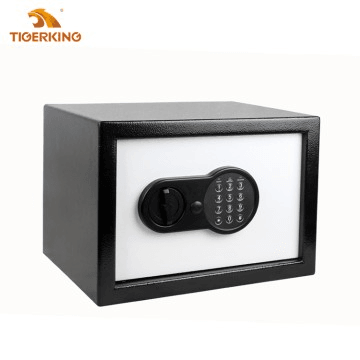
Why Annual Gun Safe Maintenance Matters More Than Most Owners Realize
A gun safe is one of the few consumer products that simultaneously provides burglary resistance, fire protection, child safety, and (for biometric models) fast authorized access. Each of these protective functions has a different failure mode, and each requires a different maintenance cycle. Burglary resistance depends on the lock mechanism staying functional and the door hinges staying aligned. Fire protection depends on the intumescent door gasket staying intact and the fire-resistive insulation staying undisturbed. Child safety depends on the lock staying engaged under any attempt to defeat it. Fast biometric access depends on the sensor window staying clean and the firmware staying current. When a gun safe fails on any of these dimensions, the failure is silent: a lock that has been slowly gumming up with petroleum residue does not announce itself until the day the owner tries to use it and the key turns in a paste of dust and oil.
The hidden cost of neglected gun safe maintenance is repair, not replacement. A typical service call to re-key a mechanical lock, replace a biometric sensor, or re-set a UL 72 fire seal costs $250 to $600 plus 2 to 4 hours of service time, and the safe is unavailable during the service. Across the 20-year service life of a typical gun safe, the cumulative cost of deferred maintenance averages $1,500 to $3,500 per safe, against an annual maintenance cost of approximately $80 to $120 in consumables (graphite, desiccant, batteries, microfiber cloth). The economic case for routine maintenance is overwhelming, and the safety case is even more so: a lock that fails on a gun safe at 2 a.m. during a home invasion response is a failure the owner cannot afford.
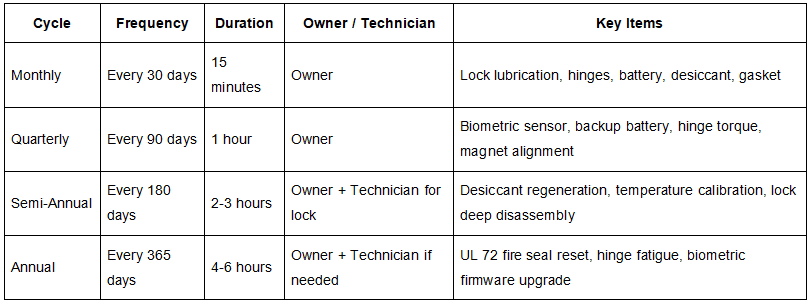
Industry surveys of gun safe owners conducted by the National Shooting Sports Foundation (NSSF) and cited in Security Products Magazine consistently show that 60 to 70% of owners do not perform any maintenance beyond changing the electronic lock battery, and 25 to 30% do not even do that. The same surveys show that owners who follow a structured annual maintenance program report 8 to 12 years of uninterrupted service from their safe, against 3 to 5 years for owners who skip maintenance. The TigerKing maintenance program is designed to fit within the actual capacity of a typical gun owner: 15 minutes per month, 1 hour per quarter, 2 hours per half-year, and 1 day per year, totaling approximately 6 hours per year of active work.
Owner Safety: Confirming the Safe Is Still Working Before Each Use
Before each opening of the safe, the owner should perform a 5-step safety check that takes approximately 60 seconds. First, confirm the lock indicator: the green LED on an electronic lock should illuminate steadily when the correct code is entered; a flashing or dim LED indicates battery depletion or keypad failure. Second, confirm the biometric sensor: the fingerprint should match on the first or second attempt; failure to match after 3 attempts indicates a dirty sensor or a damaged finger surface. Third, confirm the door swing: the door should open smoothly without binding, scraping, or sagging. Fourth, confirm the interior environment: the interior should feel dry to the touch and the desiccant indicator should show the dry color (blue for silica gel, no condensation for the electric rod type). Fifth, confirm the inventory: the firearms stored inside should be in their expected positions with no sign of disturbance from unauthorized access.
Safety at use time also includes confirming that no child or unauthorized person can defeat the lock. The TigerKing mechanical override key should be stored separately from the safe (not inside the safe, not on the safe top, not in the same room as the safe) — the standard practice is to keep the override key in a locked drawer in a different part of the house, with a trusted family member aware of its location. The electronic user code should not be written on the safe, on a sticky note on the safe, or in a wallet that is kept in the same room. The biometric enrollment should be limited to the owners who are authorized to access the safe; re-enrollment of additional users requires the master reset procedure and the factory master code, which is documented in the owner's manual and stored separately by TigerKing.
For Gun Safes with both an electronic lock and a biometric sensor, the redundant access system provides a useful diagnostic: if the electronic lock works but the biometric sensor fails, the lock is healthy and the sensor is the issue; if both fail, the problem is most likely the power supply (battery or wiring); if the electronic lock fails but the biometric works, the lock has an internal fault that requires service. The TigerKing technical support line is staffed to help owners diagnose these scenarios over the phone before the owner schedules a service call or ships the safe for repair. The TigerKing product range includesbiometric fireproof gun safes in 3-gun, 5-gun, and 10-gun capacities, with both mechanical lock and electronic lock configurations.
Monthly Maintenance Checklist (15 Minutes)
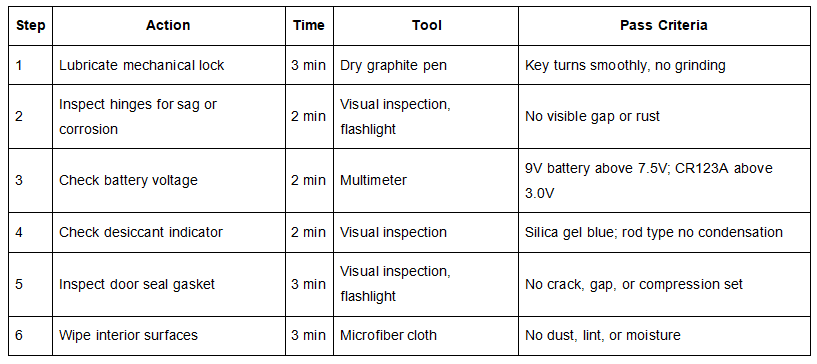
The monthly maintenance cycle takes approximately 15 minutes and covers 5 items: mechanical lock lubrication, hinge visual inspection, battery voltage check, desiccant status, and door seal gasket condition. The lock is lubricated with dry graphite applied by removing the lock cylinder face, blowing graphite powder into the keyway, inserting and removing the key 5 to 10 times to distribute the graphite, and wiping residual powder from the cylinder face. Petroleum-based oils (WD-40, 3-in-1, motor oil) should never be used because they attract dust and lint that mix into a paste that jams the lock pins within 6 to 12 months. The hinges are visually inspected for any sign of sag, looseness, or corrosion; any bolt that shows a 1 mm or larger gap should be flagged for re-torquing at the quarterly cycle.
The battery voltage check confirms that the electronic lock battery is above 7.5 V (for a 9 V battery) or above 3.0 V (for a CR123A lithium battery). The voltage is measured with a multimeter at the battery terminals, or alternatively by entering the user code 10 times in rapid succession and confirming that the lock response time remains under 1 second per entry. A battery that drops below the threshold voltage should be replaced immediately, not at the next scheduled cycle, because a depleted battery can leak and damage the battery contacts and the lock circuit board. The desiccant status is checked by looking at the color indicator on the silica gel canister (pink = saturated, blue = dry) or by checking the humidity indicator card on the electric dehumidifier rod. The door seal gasket is visually inspected for any crack, gap, or compression set; any gasket that does not return to its original shape after the door is closed should be flagged for replacement at the semi-annual cycle.
Monthly Maintenance Checklist (15 Minutes Total)
Quarterly Maintenance (1 Hour)
The quarterly maintenance cycle adds 4 deeper inspection items to the monthly baseline and takes approximately 1 hour. The first quarterly item is biometric sensor cleaning. The TigerKing biometric sensor window is a coated optical surface that should be cleaned with a microfiber cloth lightly dampened with isopropyl alcohol; abrasive cleaners, paper towels, and wet cloths can scratch the coating and degrade the matching accuracy. The cleaning motion should be a single linear wipe from top to bottom, not a circular motion that can leave residue in the sensor edges. After cleaning, the owner should enroll 2 to 3 test fingerprints on a temporary user account and confirm that the matching rate is above 95% on first attempt.
The second quarterly item is backup battery replacement. Even if the primary 9V battery is above the voltage threshold, the backup battery (typically a CR123A lithium) should be replaced every 3 months to ensure that the lock can operate during the 30 to 60 seconds required to replace the primary battery. The backup battery is in a separate compartment from the primary battery; the compartment is typically accessed by removing a small slide cover on the exterior of the door. The third quarterly item is hinge torque re-tightening. The interior hinge cover plate is removed (typically 4 Phillips screws), each bolt is torqued to 18 to 22 N·m with a calibrated torque wrench, and the cover plate is reinstalled. Any bolt that does not hold the specified torque should be inspected for thread damage and replaced if necessary.
The fourth quarterly item is door magnetic alignment verification. The TigerKing safe uses a magnetic gasket that engages when the door is closed; the magnetic force should be sufficient to hold the door closed against a 5 N push at any point along the gasket. If the magnetic force is weak, the door may not be fully closed, the gasket may be compressed, or the door may be sagging. The verification is done by closing the door and attempting to slide a 0.1 mm feeler gauge between the gasket and the door frame at 5 evenly spaced points along the gasket; any point that allows the gauge to enter more than 1 mm indicates a misalignment that requires adjustment. The TigerKing technical support team can walk owners through the alignment procedure over the phone in most cases, avoiding a service call.
Semi-Annual Maintenance (Half Day)
The semi-annual maintenance cycle takes approximately 2 to 3 hours and covers 3 deeper items: desiccant regeneration, internal temperature calibration, and lock mechanism deep disassembly. Desiccant regeneration is done by removing the silica gel canister from the safe, placing it on a baking sheet in a domestic oven at 120°C (250°F) for 2 to 3 hours, and returning it to the safe while it is still warm. The regeneration cycle restores the silica gel to its dry state and extends the canister life by 2 to 3 years before replacement is required. For high-humidity environments (coastal, lakeside, basement installations), the regeneration cycle may need to be shortened to every 4 months rather than every 6 months, or replaced entirely with an electric dehumidifier rod.
The internal temperature calibration is performed by placing a calibrated digital thermometer inside the safe and leaving the door closed for 24 hours. The thermometer reading should stabilize at the ambient room temperature plus or minus 2°C; a reading that is significantly higher or lower indicates either an insulation failure (heat leak from outside the safe) or a ventilation problem (the safe is in direct sunlight or against a heating duct). The TigerKing safe is designed for stable interior temperature in normal indoor environments; significant deviations are typically caused by installation location rather than by the safe itself. Owners who place the safe in an attic, garage, or unconditioned basement should expect larger temperature swings and may need to upgrade to an electric dehumidifier rod to compensate.
The lock mechanism deep disassembly is performed by a qualified service technician, not by the owner. The disassembly removes the lock cylinder, inspects the pins and springs for wear or contamination, replaces any worn components, and reassembles the lock with fresh graphite lubricant. The TigerKing service network includes regional service centers in the United States, Canada, the United Kingdom, Germany, and Australia; the owner can request a service appointment through the TigerKing website or the technical support line. The typical service interval for the lock mechanism is every 5 years under normal use, or every 2 to 3 years if the safe is in a high-humidity or dusty environment. The deep disassembly is also the opportunity to upgrade the lock firmware (for electronic locks) and to replace any worn gaskets or seals.
Annual Maintenance (Half Day)
The annual maintenance cycle takes approximately 4 to 6 hours and covers 3 critical items: UL 72 fire seal reset, hinge metal fatigue inspection, and biometric firmware upgrade. The UL 72 fire seal is the intumescent material that swells when exposed to heat and seals the door against the frame during a fire. Over time, the seal can be disturbed by door cycling, vibration, or accidental impact, and the annual reset re-seats the seal and confirms that it is intact. The reset procedure is performed by the owner according to the instructions in the owner's manual; it does not require a service technician. The owner inspects each segment of the seal for any gap, crack, or compression set, and replaces any segment that shows damage. The replacement seal is shipped from the TigerKing factory as a kit with the original dimensions pre-cut; the owner removes the damaged segment, cleans the mounting surface, and presses the new segment into place.
The hinge metal fatigue inspection removes the hinge cover plates (typically 4 to 6 screws per hinge), inspects each hinge pin for wear marks, corrosion, or bending, and tests each hinge for smooth rotation under load. A hinge pin that shows visible wear marks should be replaced; a hinge pin that does not rotate smoothly should be cleaned and re-lubricated with white lithium grease. The TigerKing safe uses M8 stainless steel hinge bolts and a 6 mm diameter hinge pin rated for 100,000 door cycles; under normal use (5 to 10 openings per day), this corresponds to approximately 27 to 55 years of theoretical hinge life. The annual inspection catches any unexpected wear or fatigue before it compromises the door alignment.
The biometric firmware upgrade is performed by connecting the safe to a computer via the USB port (on TigerKing models that support field firmware upgrades) and downloading the latest firmware from the TigerKing support website. The firmware upgrade typically takes 5 to 10 minutes and improves the matching algorithm accuracy, adds new features (such as multi-finger enrollment or audit log export), and addresses any known security vulnerabilities. The owner should record the firmware version before and after the upgrade and keep a copy of the release notes from the TigerKing support website. The TigerKing technical support team can guide owners through the firmware upgrade process over the phone or via remote desktop sharing.
Annual Maintenance Schedule Summary
5 Common Maintenance Mistakes That Void Fire Ratings
The UL 72 fire rating on a gun safe is voided by any maintenance action that alters the safe's fire-resistive construction, and the manufacturer warranty is typically voided if the owner cannot produce the original configuration at warranty claim. The first mistake is drilling additional holes in the safe body for cable routing, shelving mounts, or ventilation. Any new penetration breaks the fire seal, because the intumescent material that seals the door against heat depends on a continuous unbroken wall. If the owner needs to route a cable into the safe (for example, for an electric dehumidifier rod or a USB charging port), the manufacturer can supply a fire-rated cable gland that maintains the UL 72 rating; the owner should never install a non-rated gland. The second mistake is using chemical cleaners on the door gasket; the gasket is an intumescent material that swells to seal against heat, and chemical cleaners (especially solvent-based cleaners) can degrade the intumescent material and reduce its effectiveness.
The third mistake is field-replacing the fire-rated insulation with non-rated material. The insulation inside a UL 72 safe is a proprietary fire-resistive material that is tested and certified as part of the safe design; replacing it with off-the-shelf fiberglass insulation or ceramic fiber reduces the fire rating to a lower value or eliminates it entirely. If the insulation is damaged or disturbed during maintenance, the owner should request replacement insulation from the manufacturer and document the replacement in the maintenance log. The fourth mistake is re-painting the interior with non-fire-rated paint; some intumescent paints are fire-rated, but most consumer paints are not, and the wrong paint can reduce the fire rating.
The fifth mistake is removing or modifying the door-mounted intumescent strips. These strips are visible on the door edge when the door is open; they look like thin foam or rubber strips and are easy to mistake for ordinary weather-stripping. The intumescent strips swell when exposed to heat and create the seal that contains the fire inside the safe; removing or modifying them eliminates the fire rating. The owner should never paint over the intumescent strips, glue additional material to them, or replace them with non-rated material. The TigerKing owner's manual includes detailed photographs of the strips and explicit warnings about not disturbing them during maintenance. Any maintenance action that involves the door edge should be performed with the strips fully visible and protected from damage.
The TigerKing Maintenance Toolkit: What Owners Receive With Every Safe
Every TigerKing gun safe ships with a maintenance toolkit that contains the consumables and tools needed for the first year of routine maintenance. The toolkit includes a printed owner's manual in English and Spanish with the maintenance schedule and torque specifications; a torque wrench pre-calibrated to 18 to 22 N·m for the hinge bolts; a dry graphite lubricant pen for the mechanical lock cylinders; a microfiber cleaning cloth for the biometric sensor window and the keypad; a spare 9V lithium battery for the electronic lock; a desiccant regeneration reference card; the master reset procedure card with the factory master code; and access to a QR code linking to the online maintenance video library. The TigerKing technical support line is staffed Mon-Fri 4pm to 2am Pacific and 1am to 11am Central European Time for live assistance with any maintenance step, and replacement parts (desiccant, batteries, biometric sensors, hinge kits) are stocked at the Ningbo factory and shippable worldwide within 5 to 10 business days.
The TigerKing 3-gun biometric rifle safe is the flagship model that ships with the complete toolkit. The 3-gun capacity is sized for typical home defense use (a home defense shotgun, a hunting rifle, and a sidearm), and the biometric fingerprint sensor provides 1 million rated touches with a 0.3 second recognition time. The safe is UL 72 rated for 30 minutes of fire protection at 1,010°C (1,850°F) external temperature, which corresponds to a typical residential house fire exposure before the fire department arrives. The safe is also CA DOJ certified for child safety compliance, and the electronic gun safe features include a silent mode, a low-battery indicator, and a USB charging port for the backup battery. The flagship model is shipped with a 1-year limited warranty that can be extended to 5 years with the TigerKing maintenance contract, which includes annual on-site service by a certified technician.
For owners who want a more automated maintenance workflow, TigerKing offers a digital maintenance log that can be accessed through the QR code on the inside of the door. The digital log records each maintenance action, the date, the technician (if applicable), and the consumables used. The log can be exported as a PDF for insurance documentation (some homeowner insurance policies require proof of safe maintenance for theft or fire claims), and it serves as a reminder for the next scheduled action. The TigerKing support team can review the digital log remotely and recommend adjustments to the maintenance schedule based on the safe's actual use pattern. The digital maintenance log is a free service included with every TigerKing safe, and it is accessible via any web browser without a separate app installation.
Need help with a specific maintenance step on your gun safe?
The TigerKing technical support line is staffed Mon-Fri 4pm to 2am Pacific and 1am to 11am Central European Time (sales@tigerkingsafe.com or +86 18989386680). The team can walk owners through lock lubrication, hinge re-torquing, desiccant regeneration, biometric sensor cleaning, firmware upgrades, and warranty service. Replacement parts ship from the Ningbo factory within 5 to 10 business days, with expedited shipping available for an additional charge. Browse the biometric fireproof gun safes catalog or visit the TigerKing product pages for the full maintenance video library and the digital maintenance log access.
Frequently Asked Questions
How often should a gun safe be maintained?
A gun safe should be maintained on a structured schedule: monthly (15 minutes), quarterly (1 hour), semi-annually (2 hours), and annually (1 day). The monthly check covers mechanical lock lubrication, hinge visual inspection, battery voltage check, desiccant status, and door seal gasket condition. The quarterly check adds biometric sensor cleaning, backup battery replacement, hinge torque re-tightening, and door magnetic alignment verification. The semi-annual check covers desiccant regeneration, internal temperature calibration, and lock mechanism deep disassembly. The annual check covers UL 72 fire seal reset, hinge metal fatigue inspection, biometric firmware upgrade, and a full audit of the inventory stored inside. Skipping any of these cycles accelerates the failure of one or more protective systems.
What lubricant should be used on a gun safe lock?
Gun safe locks should be lubricated with a dry graphite lubricant, never with petroleum-based oils such as WD-40 or 3-in-1 oil. Dry graphite is non-reactive with the lock pins and springs, does not attract dust, and does not gum up at low or high humidity. The graphite is applied by removing the lock cylinder face, blowing graphite powder into the keyway, inserting and removing the key 5 to 10 times to distribute the graphite, and then wiping the residual powder from the cylinder face. Petroleum oils attract dust and lint that mix into a paste that jams the lock pins within 6 to 12 months, especially in dry indoor environments. For electronic keypad locks, the buttons should be cleaned with a microfiber cloth lightly dampened with isopropyl alcohol; lubricant should never enter the keypad membrane or the biometric sensor window.
Do dehumidifiers in gun safes need to be recharged?
Yes. Silica gel desiccant dehumidifiers in gun safes need to be recharged every 6 to 12 months depending on the safe's interior humidity and how frequently the door is opened. Recharging is done by removing the desiccant canister from the safe, placing it on a baking sheet in a domestic oven at 120°C (250°F) for 2 to 3 hours until the indicator beads change from pink to blue (or from saturated orange to dry orange), and then returning the canister to the safe while it is still warm. Alternatively, electric dehumidifier rods (such as the Goldenrod or Lockdown models) draw 8 to 12 W continuously and do not require recharging but consume a small amount of electricity. For high-humidity climates (coastal, lakeside, basement installations), the rod type is recommended over silica gel because it does not saturate in continuous high humidity.
Can a gun safe's fire rating be voided by maintenance?
Yes. A UL 72 fire rating (30-minute, 60-minute, or 90-minute) can be voided by any maintenance action that alters the safe's fire-resistive construction. The five most common voiding actions are: (1) drilling additional holes in the safe body for cable routing, shelving mounts, or ventilation (the fire seal is broken by any new penetration); (2) using chemical cleaners on the door gasket (the gasket is a fire-rated intumescent material that swells to seal against heat); (3) field-replacing the fire-rated insulation with non-rated material; (4) re-painting the interior with non-fire-rated paint; (5) removing or modifying the door-mounted intumescent strips. Any of these actions invalidates the fire certification, and the manufacturer warranty is typically voided if the owner cannot produce the original configuration at warranty claim. Maintenance actions should be limited to the procedures listed in the owner's manual.
How long do biometric gun safe sensors last?
Biometric fingerprint sensors in gun safes typically last 7 to 10 years under normal household use before the sensor surface or the matching algorithm begins to fail. Failure modes include scratched sensor coating (especially with dirty fingers), degraded sensor glass (cracking under temperature cycling), and matching algorithm drift (more frequent false rejections). The TigerKing biometric gun safe uses a semiconductor fingerprint sensor rated for 1 million finger touches, which under typical household use (5 to 10 openings per day) corresponds to approximately 27 to 55 years of theoretical life. The TigerKing maintenance guide recommends cleaning the sensor window with a microfiber cloth every 3 months and avoiding the use of wet, oily, or chemically treated fingers at the sensor. Firmware upgrades from the manufacturer can also extend the matching algorithm accuracy over time.
What is the most common cause of gun safe lockout?
The most common cause of gun safe lockout is depleted electronic lock batteries. A 9V battery in an electronic keypad lock typically lasts 12 to 18 months under normal use, but can deplete in 6 months if the lock is in a high-humidity environment or if the batteries are alkaline instead of lithium. The TigerKing design avoids this failure mode by mounting the battery compartment on the exterior of the door (so it can be replaced without opening the safe) and by providing an emergency mechanical key override as standard. The second most common cause of lockout is forgotten user codes, which is mitigated by the manufacturer's master reset procedure (typically documented in the owner's manual and requiring a physical reset button on the interior of the door). The third most common cause is mechanical lock failure due to inadequate lubrication or contamination, which is prevented by the annual lubrication cycle described in this maintenance guide.
Should hinges on a gun safe be tightened annually?
Yes. Hidden hinges on a gun safe should be torque-checked annually because the door weight (typically 30 to 80 kg depending on the safe size) loads the hinges continuously, and small bolts can back out over time with door cycling. TigerKing uses 3 mm thick alloy pry-resistant steel doors with hidden hinges mounted on M8 stainless steel bolts torqued to 18 to 22 N·m at the factory. The annual maintenance cycle removes the interior hinge cover plate, re-torques each bolt to specification with a calibrated torque wrench, and inspects the hinge pin for wear. Visible external hinges (less common on modern gun safes) should be lubricated with white lithium grease annually. Failure to maintain hinges leads to door sag, which in turn leads to misalignment with the door frame and compromised pry resistance at the door edge.
What comes in the TigerKing maintenance toolkit?
The TigerKing maintenance toolkit (included in the owner's manual pack shipped with every safe) contains: (1) a printed owner's manual in English and Spanish with the maintenance schedule and torque specifications; (2) a torque wrench pre-calibrated to 18 to 22 N·m for hinge bolts; (3) a dry graphite lubricant pen for mechanical lock cylinders; (4) a microfiber cleaning cloth for the biometric sensor window and the keypad; (5) a spare 9V lithium battery for the electronic lock; (6) a desiccant regeneration reference card; (7) the master reset procedure card with the factory master code; (8) access to a QR code linking to the online maintenance video library. The TigerKing technical support line is staffed Mon-Fri 4pm to 2am Pacific and 1am to 11am Central European Time for live assistance with any maintenance step. Replacement parts (desiccant, batteries, biometric sensors) are stocked at the Ningbo factory and shippable worldwide within 5 to 10 business days.
About the author. James Chen is a Senior Security Industry Analyst & SEO Content Strategist at Ningbo Tigerking Safe Co., Ltd., covering the security equipment manufacturing and global trade sector for over 10 years. His work has been cited in Security Products Magazine and multiple industry procurement guides. He specializes in B2B sourcing strategy, OEM/ODM evaluation frameworks, and market intelligence for physical security products.
Bio signature: Senior Security Industry Analyst & SEO Content Strategist at Ningbo Tigerking Safe Co., Ltd. Specializing in B2B sourcing strategy, OEM/ODM evaluation frameworks, and market intelligence for physical security products.
Follow TigerKing Safe: Facebook · LinkedIn · YouTube · X