
TL;DR - Key Takeaways
- RFID Hotel Safe Boxes eliminate forgotten PIN codes, reducing front-desk interventions by an estimated 15-20% - guests use the same room card they already carry.
- Digital keypad Hotel Safes cost 25-40% less upfront and remain the dominant choice for mid-market properties, but require guests to memorize or record a 4-6 digit PIN.
- Both access methods can achieve comparable physical security (UL 1037 or equivalent) when sourced from a certified hotel safe box supplier; the choice hinges on guest experience goals and 5-year TCO.
- For properties with a mix of room card types or older RFID systems, dual-access models (RFID + keypad) offer the most flexibility at a ~15% premium over single-access.
- The global hotel safe market is projected to grow at a 6.8% CAGR through 2032 (MarketsandMarkets, 2026), driven by heightened guest security expectations and smart hotel integrations.
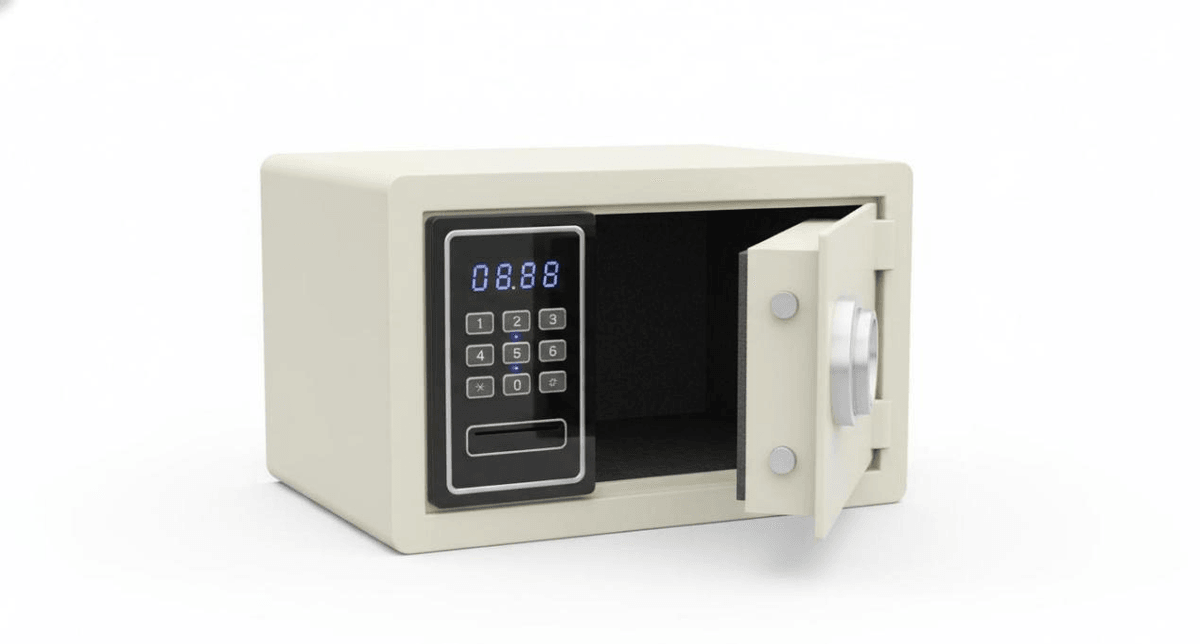
When I started evaluating hotel safe technology in the mid-2000s, the choice was relatively simple: a keypad, a metal box, and a mechanical override key. Today, a procurement manager walking into a property with 200 rooms has a fundamentally different decision to make. RFID hotel safe box systems and digital keypad models each have distinct technical profiles, cost trajectories, and guest experience implications - and picking the wrong one for your property type can cost tens of thousands of dollars over a 5-year horizon.
As a hotel safe box supplier with more than two decades of manufacturing experience supplying properties across North America, Europe, the Middle East, and Southeast Asia, we have helped hundreds of procurement teams navigate this decision. Our company has been at the forefront of hotel safe innovation since 2000, with ISO9001, CSP, CE, SGS, BSCI, and ETL certifications underpinning our global supply chain. Our company has been at the forefront of hotel safe innovation since 2000, with ISO9001, CSP, CE, SGS, BSCI, and ETL certifications underpinning our global supply chain. This guide is built to give you a definitive framework - not a sales pitch - for choosing the right access technology in 2026.
What Is an RFID Hotel Safe Box, and How Does It Work?
An RFID (Radio Frequency Identification) hotel safe box uses the same proximity card that opens a guest room door as its authentication mechanism. When the guest holds the card within 3-8 centimeters of the safe reader panel, the system verifies the card unique ID against the property PMS (Property Management System) or a standalone RFID programmer. If authorized, the lock disengages within 0.3-0.8 seconds.
The core appeal is straightforward: because guests already carry their room card, they face zero friction at the safe. No PIN to forget. No trip back to the front desk. For boutique and luxury properties where every touchpoint shapes the guest perception, this friction reduction is not a luxury - it is a measurable NPS driver.
Most RFID hotel safe boxes currently deployed in international hotels operate at 13.56 MHz (HF band), compliant with standards such as ISO/IEC 14443 Type A and Type B, and ISO/IEC 15693 for vicinity cards. This is the same frequency used by most hotel room card systems globally, which means compatibility is rarely an issue when the safe is sourced from a hotel safe box supplier that offers proper frequency configuration.
Common RFID Standards in Hotel Safe Applications
Not all RFID hotel safe boxes are alike. The three most prevalent standards you will encounter as a procurement manager:
- ISO/IEC 14443 Type A - Used by NXP MIFARE (including MIFARE Classic and MIFARE DESFire). This is the dominant standard in European and Asian hotel chains, including properties throughout France, Germany, and the Benelux region. MIFARE DESFire EV2, in particular, supports AES-128 encryption and mutual authentication, making it resistant to card cloning.
- ISO/IEC 14443 Type B - Used by government IDs, some U.S. corporate access systems, and certain hospitality groups. Less common in hotels but worth checking if your property hosts a lot of corporate/government clientele.
- iCLASS (HID Global) - A proprietary but widely-deployed RFID standard in North American hotels. iCLASS cards operate at 13.56 MHz with 64-bit authentication keys and are commonly found in Marriott, Hilton, and IHG properties in the U.S.
Before selecting any RFID hotel safe box, confirm the standard with your PMS vendor and with the hotel safe box supplier technical documentation. Mismatched RFID standards result in complete non-function - not partial operation.
What Is a Digital Keypad Hotel Safe Box?
A digital keypad hotel safe box requires guests to manually enter a 4-to-6-digit PIN code on a physical or capacitive-touch keypad to operate the lock. The PIN is typically set by the guest at check-in (or assigned by the front desk) and confirmed by pressing an # (enter) key. If the PIN is incorrect after three attempts, the safe locks temporarily - typically for 5-30 minutes - before allowing another attempt.
The digital keypad hotel safe is the workhorse of the hospitality industry. As a hotel safe box supplier serving budget to mid-market properties worldwide, we estimate that digital keypad models still outsell RFID models by approximately 3:1 globally, largely because of their lower acquisition cost and simpler maintenance philosophy. Our digital hotel safe ODM solutions are engineered with a sleek digital interface, programmable keypad, high-quality steel construction, and tamper-proof design to meet the demands of high-turnover hospitality environments. Our digital hotel safe ODM solutions are engineered with a sleek digital interface, programmable keypad, high-quality steel construction, and tamper-proof design to meet the demands of high-turnover hospitality environments.
Modern digital keypad hotel safes feature movable PIN technology - the safe automatically randomizes the guest PIN after each opening, so a guest who opened their safe on Tuesday afternoon leaves no traceable code behind. Some models also support check-in PIN injection from the PMS, where the front desk system pushes the guest check-out date as the auto-vacate PIN, eliminating manual PIN setting entirely.
Key Technical Specifications to Demand from a Hotel Safe Box Supplier
Whether you are evaluating RFID or keypad models, hold your hotel safe box supplier to these non-negotiable specifications:
- Anti-tamper mechanism: Spring-loaded steel bolts (minimum 18mm throw) that extend on lockdown. Demand test data per UL 1037 or equivalent regional standard, validated by an accredited third-party testing body such as TUV Rheinland or SGS.
- Override system: Physical mechanical override key (should be stored by management, never left in-room). Some properties now use digital override via PMS-linked master PIN.
- Battery life: Alkaline AA batteries - minimum 12-month life under normal use. Lithium backup to retain lock memory during battery changes.
- Audit trail: Internal event log storing last 200-500 openings with timestamp, card ID or PIN used, and open/close status. Downloadable via USB or RS232.
- Low-battery warning: Audio beep plus visual indicator when battery falls below 20% remaining capacity.
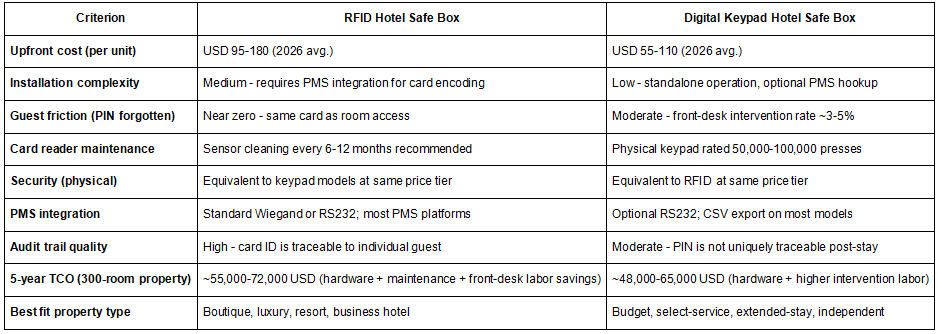
Head-to-Head Comparison: RFID vs. Digital Keypad Hotel Safe Boxes
The table below is based on aggregated data from hotel safe box supplier product specifications, property management system integration records, and operational feedback from hotel clients across three continents. All figures are representative of standard mid-tier-to-premium models available in 2026.
Why RFID Hotel Safe Boxes Cost More - and Whether the Premium Pays Off
Let us talk numbers honestly, because I have seen too many procurement specs that ignore the full financial picture.
An RFID hotel safe box typically carries a 25-40% upfront cost premium over an equivalent digital keypad model from the same hotel safe box supplier. On a 300-room property, that is roughly USD 12,000-21,000 more in capital expenditure. However, the operating cost story is more nuanced.
Based on operational data from hotel clients we work with, a 300-room mid-range hotel experiences approximately 15-25 PIN forgotten events per month, each requiring an average of 8-12 minutes of front-desk staff time (greeting, ID verification, override process, guest follow-up). At an average front-desk hourly cost of USD 14-18, that is 2,800-5,400 USD in annual labor overhead that RFID systems virtually eliminate.
Over a 5-year horizon, the TCO gap narrows significantly - and for properties with high guest turnover (urban business hotels, resorts with short-stay guests), RFID systems can reach TCO parity with digital keypad models in 2.5-3.5 years. For a luxury property where guest experience scores directly impact repeat booking rates, the ROI calculus often tips in RFID favor well before year three.
When we switched to RFID safes at our 180-room property in Barcelona, our front-desk team immediately noticed the drop in safe-related help calls. It was not a dramatic change in percentage terms - maybe 3 or 4 fewer interventions per week - but front-desk staff noticed, and more importantly, the guests noticed. We had fewer please help me with the safe moments during our peak 3 PM check-in rush. - Regional Operations Manager, independent boutique hotel group (client case study, 2025)
Key Decision Criteria for Procurement Managers
Not every property should choose RFID, and not every property should stick with keypad. Here is the framework I use when consulting with procurement teams:
Choose RFID When:
- Your property operates at above-average occupancy rates with high guest turnover - every PIN-remembering interaction becomes a volume problem.
- Your brand standards require RFID integration (common for international chain properties).
- Your guest demographic skews toward business travelers and frequent guests who value frictionless self-service.
- Your property has smart room integration (IoT-connected safes that log events to a central dashboard).
- You are undergoing a renovation or new-build where the incremental RFID cost can be baked into the project budget.
Choose Digital Keypad When:
- Your property is budget or select-service tier where minimizing upfront capex is the primary constraint.
- Your guest demographic includes older adults or first-time hotel guests who may be more comfortable with a physical keypad interface they have seen before.
- Your property runs older RFID systems (pre-2015 room card infrastructure) that would require a full card system upgrade before RFID safes can be integrated.
- Maintenance staff have limited technical capacity for PMS integration troubleshooting.
- The property has a mixed card environment - multiple room card types across different room categories - where RFID compatibility is uncertain.
Consider Dual-Access Models (RFID + Keypad)
If you find yourself torn between both options, dual-access hotel safe boxes are worth a closer look. These models accept both an RFID card and a digital keypad code, giving guests their choice of access method. As a hotel safe box supplier, we have seen dual-access models increasingly specified by properties that are migrating from keypad to RFID over a phased rollout - they can deploy keypad-first now while enabling RFID activation building-by-building without replacing hardware.
The premium for dual-access over single-access keypad models is approximately 12-18%, and model availability is expanding rapidly in 2026 as major manufacturers respond to procurement manager demand.
Technical Integration: What Your Hotel Safe Box Supplier Should Provide
I have seen too many hotel safe box installations fail not because of the hardware, but because of integration shortcuts. Here is what your hotel safe box supplier must provide - in writing - before you sign a purchase order:
1. PMS Compatibility Documentation
Any hotel safe box supplier worth your time will provide a compatibility matrix listing tested PMS platforms (Opera, Fidelio, Cloudbeds, Mews, etc.), the integration method (Wiegand, RS232, TCP/IP), and the expected setup time. If the supplier cannot produce this documentation, that is a red flag.
2. Audit Trail Export Format
Hotel auditors and security teams need audit trail data in a standard format. Most modern hotel safe boxes export to CSV or JSON via USB or serial interface. Confirm that the export includes: timestamp (ISO 8601 format preferred), card ID or keypad session ID, open/close events, and low-battery alerts. Avoid any hotel safe box supplier model that only offers proprietary software for audit log retrieval.
3. Battery and Maintenance Schedule
Ask for a written maintenance schedule from the hotel safe box supplier covering battery replacement intervals, card reader cleaning procedures, and keypad stress test results. The manufacturer stated battery life should be backed by test data - not just a marketing figure.
4. Mounting and Door-Frame Clearance Specifications
This sounds obvious, but in our experience as a hotel safe box supplier, improper mounting is one of the top causes of premature safe failure. The safe must be anchored into a structural wall element with a minimum of four bolts (M8 or equivalent). Confirm that the cabinet depth accommodates the mounting surface and that door swing clearance is accounted for - particularly in compact Asian hotel room designs where space is at a premium.
Security Standards Your Hotel Safe Box Supplier Must Meet
Hotel safe security is regulated differently by region. A credible hotel safe box supplier will have their products tested against the following standards (or their regional equivalents):
- UL 1037 (Underwriters Laboratories) - The primary U.S. standard for electronic safe locks, testing for resistance to attack by mechanical and electronic means. Any model sold into the North American market should have a UL 1037 test report available on request. You can verify current UL certifications through the UL Product Directory.
- EN 14450 - The European standard for secure storage units, with Grades S1 and S2. Required for hotel safe specifications across EU member states.
- SII (Standards Institution of Israel) and SASO - Required for hotel safe imports into Israel and Saudi Arabia respectively. Many manufacturers skip these certifications, which can create customs delays at port.
- CE marking + RoHS - Required for all electrical products sold in the EU. CE alone is not a security standard - it is an electromagnetic compatibility and safety declaration. Do not confuse CE marking with physical security certification.
When you are evaluating a hotel safe box supplier, ask specifically for test certificates from accredited third-party testing labs - not just a self-declaration of conformity. Labs such as TUV Rheinland, SGS, Bureau Veritas, and Intertek are widely recognized in the hospitality industry, and certifications from these bodies carry significant weight with hotel procurement teams and property owners alike.
Common Procurement Mistakes - and How to Avoid Them
In our two decades as a hotel safe box supplier, we have seen procurement teams make the same recurring mistakes. Here is how to sidestep them:
Mistake 1: Buying Safes That Do Not Match Your Room Card Standard
This is the single most costly procurement error we observe. A property orders 200 RFID safes optimized for MIFARE DESFire cards, but their existing room cards are HID iCLASS. Result: USD 28,000 in hardware that does not work, a rushed reorder of keypad safes at premium expedited shipping cost, and a 6-week installation delay.
Fix: Always confirm your existing room card RFID standard with your PMS vendor or card system manufacturer before requesting quotes from any hotel safe box supplier.
Mistake 2: Ignoring the TCO Calculation
Procurement teams under pressure to meet annual capex targets often optimize for the lowest unit price. But when you factor in front-desk labor for PIN resets, keypad replacement costs (~15-30 USD per keypad panel), and potential guest satisfaction impacts, the unit price difference between RFID and keypad models often disappears within 24-36 months.
Fix: Request a 5-year TCO analysis from your hotel safe box supplier. A confident manufacturer will provide this as a standard part of the sales process.
Mistake 3: Skipping the PMS Integration Test
Some procurement teams specify the technical requirements correctly, receive compliant hardware, and then discover during installation that the PMS integration does not work as documented. This typically surfaces at the worst possible moment - during a pre-opening or a property renovation that happens during operational hours.
Fix: Require a factory acceptance test (FAT) report from the hotel safe box supplier demonstrating successful PMS communication before the equipment ships. Any reputable hotel safe box supplier will accommodate this request.
Looking Ahead: Hotel Safe Technology in 2026 and Beyond
The hotel safe category is evolving rapidly. Three technology trends are worth watching as you plan your 2026 procurement:
1.Mobile key integration- As mobile room keys (NFC-based) proliferate through brands like Hilton and Marriott, the distinction between RFID and keypad access is blurring. Several manufacturers, including our own Digital Hotel Safe line atTiger King Safe ODM program, are developing BLE (Bluetooth Low Energy) and NFC models that integrate with mobile key platforms. If you are mid-specification on a new build or renovation, this is worth discussing with your hotel safe box supplier now.
2.Cloud-connected audit dashboards - Standalone safes that log to an onboard memory chip are being superseded by safes that transmit access events to a cloud dashboard in real time. This enables security teams to monitor safe status across an entire portfolio from a single interface - a capability that large managed hotel groups are increasingly specifying.
3.Biometric hotel safes - Fingerprint and facial-recognition hotel safes have entered the market, but adoption remains limited by cost (typically 2-3x the price of RFID models), reliability concerns in high-humidity environments, and guest reluctance. I recommend treating biometric safes as a future-specification consideration rather than a current procurement priority.
FAQ - Hotel Safe Box Supplier Selection and Technology
Q: What is the main difference between RFID and digital keypad hotel safe boxes?
RFID hotel safe boxes use proximity card authentication - the same card guests already use to access their rooms. Digital keypad models require guests to manually enter a 4-to-6 digit PIN code. Because RFID eliminates the need to remember or record a PIN, front-desk intervention rates for lockouts are significantly reduced. Digital keypad models are generally less expensive and remain the standard choice for budget and select-service properties.
Q: Which access method is more secure - RFID or digital keypad hotel safe boxes?
Both methods offer strong physical security when implemented in certified products. RFID safes eliminate the risk of guests writing down PINs, while digital keypad safes prevent tailgating where one guest watches another code. Physical security (steel thickness, bolt throw, anti-tamper mechanisms) matters more than the access method. Always source from a hotel safe box supplier whose products carry independent third-party certification such as UL 1037, EN 14450, or equivalent.
Q: How much more does an RFID hotel safe cost compared to a digital keypad model?
RFID hotel safe boxes typically cost 25-40% more upfront than comparable digital keypad models. However, RFID systems reduce front-desk intervention rates by an estimated 15-20% because guests cannot lock themselves out with a forgotten PIN. Over a 5-year TCO horizon for a 300-room property, the total cost difference often narrows to near parity once labor savings are factored in.
Q: Can both access types be integrated with hotel PMS systems?
Yes. Most modern RFID hotel safe boxes use standard Wiegand or RS232 interfaces that are compatible with major PMS platforms including Opera, Fidelio, Cloudbeds, and Mews. Digital keypad safes with internal memory can log access events and export to CSV for audit purposes. A reputable hotel safe box supplier will provide integration documentation and compatibility matrices before purchase.
Q: What maintenance do RFID hotel safe boxes require compared to digital keypad safes?
RFID hotel safe boxes have no physical contact points, which reduces mechanical wear on the lock mechanism. However, the card reader sensors require periodic cleaning (every 6-12 months) to maintain reliable read performance. Digital keypad safes have physical buttons that may wear out after 50,000-100,000 presses, so keypad replacement should be factored into maintenance planning. Both types require battery replacement every 12-18 months under normal use.
About the Author
James Chen
Senior Security Industry Analyst & SEO Content Strategist
James Chen has covered the security equipment manufacturing and global trade sector for over 10 years. His work has been cited in Security Products Magazine and multiple industry procurement guides. He specializes in B2B sourcing strategy, OEM/ODM evaluation frameworks, and market intelligence for physical security products.
Contact Us - TIGERKING