
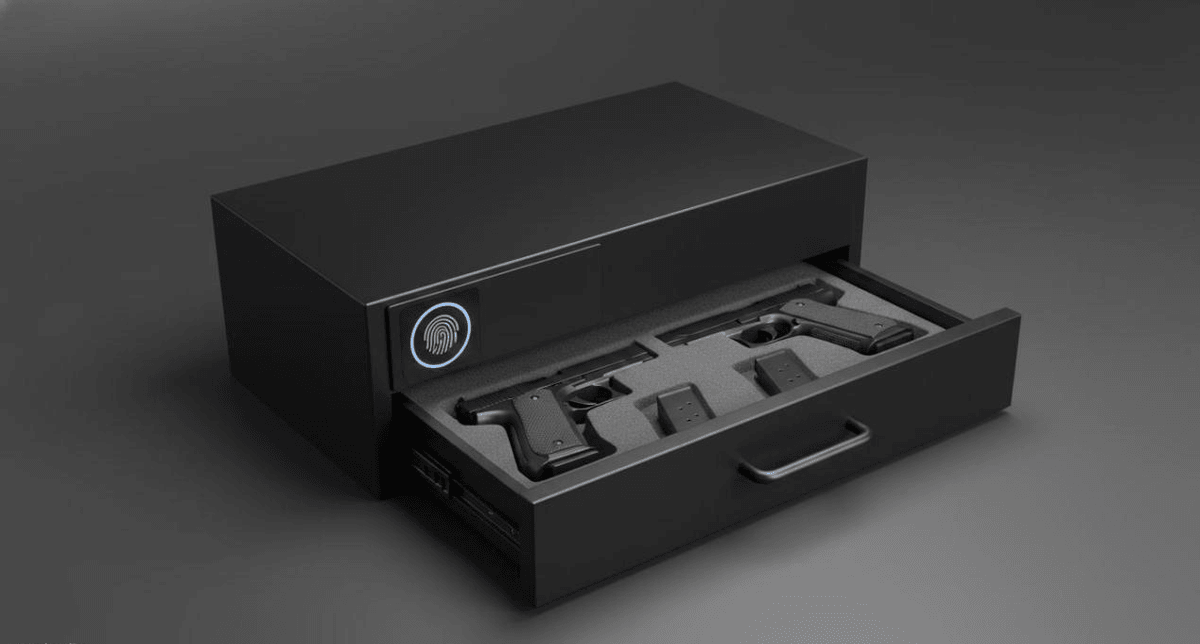
Why Fingerprint Gun Safe OEM Matters Right Now
If you distribute Pistol Safes to sporting goods retailers, FFL dealers, or shooting range operators across the United States, you have already seen the shift. Biometric locks have moved from a premium feature to the baseline expectation. Buyers no longer want a key-only box. They expect sub-second fingerprint recognition, silent-mode access, and the ability to enroll multiple users — all at a wholesale cost that leaves room for healthy retail margins.
That is exactly what TigerKing's fingerprint Gun Safe OEM program delivers. We are a Ningbo-based ISO 9001 and ETL-certified manufacturer with over a decade of safe-box production experience. Our biometric drawer safes — purpose-built for pistol distributors and range operators — combine semiconductor fingerprint sensors (500 DPI, FAR <1/50,000), solid alloy steel construction, and fully customizable branding, packaging, and firmware. This is not a repackaged consumer product. It is an OEM platform designed specifically for B2B buyers who need consistency, compliance, and volume pricing.
In this article I will walk through the market opportunity, the biometric technology that matters, our OEM service structure, MOQs, lead times, and the specific models that fit pistol-distribution and shooting-range workflows. By the end you will have a clear picture of how a fingerprint gun safe OEM partnership with TigerKing strengthens your product line and your bottom line.
The Numbers Driving the Demand for Biometric Pistol Safes
I have been in the safe industry long enough to watch the category evolve from mechanical key locks to digital keypads to full biometric integration. What is happening now is different. The adoption curve has steepened because the end user — the individual gun owner — has been conditioned by smartphone biometrics. They expect touch-to-open. They also expect security, because the stakes are higher than a phone screen.
Let me share some figures that inform our product roadmap:
- The global gun safe market was valued at approximately $3.2 billion in 2025 and is projected to reach $5.6 billion by 2034, expanding at a CAGR of 6.4% (Dataintelo, 2025).
- Biometric gun safes commanded the largest product-type share at 38.5% in 2025, driven by demand for rapid, keyless access (Dataintelo).
- The broader biometric system market is growing at 12.3% CAGR, reaching an estimated $95.14 billion by 2030 (MarketsandMarkets, 2025).
- North America remains the single largest regional market for gun safes, while Asia-Pacific is the fastest-growing supply region — a dynamic that directly benefits China-based OEM manufacturers like TigerKing.
What these figures tell me is that the downstream pull is real. Distributors who add a fingerprint gun safe OEM line today are entering a segment that already accounts for nearly 40 cents of every dollar spent on gun safes. And because the technology barrier (reliable biometrics at a low BOM cost) has only recently been crossed at scale, the window for early OEM positioning is still open.
What Makes a Biometric Drawer Safe Work — The Engineering View
I want to go a level deeper than the typical spec sheet because, in my experience, distributors who understand the hardware can sell it more effectively to procurement managers at shooting ranges and retail chains.
Semiconductor vs. Optical Fingerprint Sensors
There are two main fingerprint sensor technologies in the safe market today: optical and semiconductor (capacitive). Optical sensors use a camera to image the fingerprint. They are cheaper, but they can be fooled by printed replicas and perform poorly when the finger is wet, oily, or dusty — which is exactly the condition of a shooter's hands after a range session.
Semiconductor sensors, by contrast, read the electrical capacitance differences between the ridges and valleys of your fingerprint. They are significantly harder to spoof, they work through light moisture and grime, and they offer FAR (False Acceptance Rate) and FRR (False Rejection Rate) below 1/10,000 under normal conditions.
All TigerKing biometric drawer safes use semiconductor sensors at 500 DPI or higher. This is not an upcharge option; it is the baseline. I consider optical sensors unsuitable for a firearm storage application where lives and liability are on the line.
Recognition Speed and the 0.1-Second Standard
Speed matters in a self-defense scenario. Industry benchmarks for quick-access pistol safes target a total unlock time — from finger placement to latch release — of under one second. TigerKing's biometric modules consistently achieve 0.3 to 0.5 seconds in our internal testing, with the sensor scanning at 508 DPI and the algorithm processing the match in roughly 120 ms.
To put that in context: a traditional digital keypad entry requires you to recall (or look up) a 4–6 digit code, key it in accurately, and wait for the solenoid to fire. Biometric access eliminates the recall step entirely. For a shooting range operator managing 20 rental pistols, that time saving per transaction compounds into real operational efficiency.
FAR, FRR, and What They Mean for Your Liability
When I talk to pistol distributors, the question always comes up: "What happens when the safe doesn't recognize the owner's fingerprint in an emergency?" That is the FRR question. The flip side — "Could someone else's fingerprint open the safe?" — is the FAR question.
Our target specifications are:
- FAR (False Acceptance Rate): < 1/50,000 (0.002%)
- FRR (False Rejection Rate): < 3/100 (3%) under normal conditions
- Enrolled fingerprint capacity: 20–50 fingerprints per unit, depending on the model
- Touch lifetime: >1,000,000 actuations per sensor
These are not theoretical numbers. We verify them during production via sampling inspection. For the full OEM batch, we can share test certificates from our ISO 9001 quality management system.
TigerKing's Fingerprint Gun Safe OEM Product Line for 2026
Our current OEM lineup includes three form factors that map directly to distributor and range-operator needs:
Model A — Multi-Functional Jewelry Pistol Safe (Biometric Drawer)
This is our flagship quick-access drawer safe. It features a top-opening or front-sliding biometric lid, high-strength alloy steel body (door plate 5 mm, body plate 3 mm), and a leather-upholstered interior. The biometric lock supports fingerprint + PIN code + backup key (three methods). Exterior dimensions are compact enough for desk, nightstand, or countertop mounting, yet the interior accommodates 2 full-size pistols plus magazines.
Best for: Retail distribution to home-defense buyers, and range operators who need desk-side quick-access units for rental weapon storage.
Model B — Brand-New Economy Box Safe with Semiconductor Fingerprint
Designed for volume wholesale. Same semiconductor sensor as Model A, but with a simplified exterior (no leather upholstery, matte powder-coat finish) and a lower BOM cost. Includes wireless networking alarm function (optional), anti-slam door panel, and solid latch bolts.
Best for: Big-box retail distribution, value-tier SKUs, and shooting ranges that need 50+ units per location at a competitive price point.
Model C — Biometric Home Safe Box (LSA25FED / LSA30FED / LSA45FED)
A larger vertical safe with biometric + PIN + key entry, adjustable interior shelving, vibration alarm, and floor/wall mounting. Exterior dimensions range from 250×350×250 mm (LSA25FED) to 450×350×350 mm (LSA45FED). Door thickness 5 mm, body 3 mm, alloy steel.
Best for: Distributors who need to offer a "one-safe-for-all" solution: pistols upstairs, documents and jewelry downstairs, all with the same fingerprint enrollment.
All three models support private labeling (your brand on the front panel and packaging), custom color options (white, black, or custom RAL), and firmware customization for language, unlock modes, and alarm thresholds.
How Our Fingerprint Gun Safe OEM Program Works
I have structured the TigerKing OEM program around the buying patterns I see from North American distributors. Here is the workflow:
Step 1: Sample Evaluation
We ship stock samples (Model A, B, or C) within 3–5 business days. You test the biometric speed, build quality, and tamper resistance. No commitment required. Sample cost is deducted from the first production order.
Step 2: Specification Lock
You choose the model, color, logo placement, packaging design, and any firmware modifications. We produce a pre-production sample (usually 10–20 units) for your final sign-off.
Step 3: Production
Lead time: 25–35 days for standard OEM orders of 500–2,000 units. Larger volumes (5,000+) reduce per-unit cost and can ship in 40–45 days.
MOQ: 500 units per SKU for full private-label OEM. For existing TigerKing models with your logo only, MOQ may drop to 200 units.
Step 4: Quality Verification
Every production batch is inspected per ISO 9001 procedures. We test: biometric recognition accuracy (50-sample check per 500 units), lock solenoid function, key override operation, finish/coating adhesion, and packaging integrity. A lot inspection report is issued before shipment.
Step 5: Shipping & Compliance
We ship FOB Ningbo or CIF to your designated US port. All units carry CE, RoHS, and — where applicable — ETL certification. For California DOJ compliance requirements, we work with your legal team to confirm the lock mechanism meets state-specific safe storage criteria.
Why Shooting Range Operators Need Biometric Drawer Safes (Not Just Lock Boxes)
I have visited enough ranges — both indoor and outdoor — to know that the operational reality is different from the home user's. A range operator managing 15–40 rental pistols faces a specific set of challenges that a fingerprint gun safe OEM solution solves directly:
- Multiple users, one safe: Each rental pistol needs to be accessible by multiple staff members (counter staff, range safety officers, cleaning crew). With biometric enrollment capacity of 20–50 fingerprints per safe, each staff member can be enrolled on every unit. No key handoff. No code-sharing.
- Audit trail: Several of our OEM partners request an optional electronic log that records the fingerprint ID and timestamp of each access. This is not a standard feature on retail pistol safes, but we can enable it in firmware for range operators who need usage tracking.
- Speed of access during busy hours: When a customer checks in for a range session, the counter staff needs the corresponding rental pistol in under 30 seconds. A biometric drawer safe — unlocked in 0.3 seconds — means the staff member's hand goes from the sensor to the grip almost instantly.
- Secure storage during non-operating hours: Biometric access logs plus vibration alarm (standard on our LSA series) provide tamper alerts if a unit is disturbed after hours. Combined with CCTV, this gives range owners documented chain of custody.
- Compliance with local ordinances: Several US states and municipalities now require commercial shooting ranges to store rental firearms in locked containers when not under direct staff supervision. Our OEM units meet or exceed the structural requirements for commercial-grade storage.
A Real Scenario
One of our distributor partners in the Midwest supplies 120 biometric drawer safes to a 25-lane indoor range that operates 16 hours a day. The range manager told me that before switching to biometric safes, his team was spending roughly 45 minutes per shift on key management — tracking which keys were with which staff member, replacing lost keys, and re-keying locks after staff turnover. After deploying TigerKing OEM units with biometric-only access (no key option, for the primary lock), key management time dropped to nearly zero. That is a direct labor cost saving of roughly 2–3 hours per day across the operation.
What Pistol Distributors Should Evaluate Before Signing an OEM Agreement
If you are evaluating fingerprint gun safe OEM suppliers — whether from China or domestic — here are the criteria I recommend prioritizing:
1. Sensor Sourcing and Consistency
Not all semiconductor sensors are equal. Ask your OEM partner: Who manufactures the sensor module? What is the confirmed FAR/FRR from that supplier's datasheet? How do you screen for sensor quality during incoming inspection? At TigerKing we source our modules from tier-1 Chinese semiconductor fabs and run 100% functional testing on every module before assembly.
2. Steel Grade and Thickness
A biometric lock is only as good as the box it protects. Our door plates are 5 mm cold-rolled steel (SPCC), bodies are 3 mm, and the lid-to-body seam is continuously welded — not spot-welded. These are the same specs we use for our ETL-certified fireproof models. In my opinion, anything below 3 mm body thickness for a commercial pistol safe is insufficient.
3. Certification Portfolio
ISO 9001 is table stakes. For the US market, ETL or UL listing adds significant retail credibility. TigerKing holds ISO 9001, CE, SGS, BSCI, and ETL certifications. If you are targeting California DOJ-approved safe lists, we can engineer the lock mechanism to meet the specific requirements.
4. After-Sales Support and Warranty
A common pain point for distributors is warranty service. We offer a 1-year warranty on all biometric components and a 5-year structural warranty on the steel body. For North American distributors, we maintain a spare-parts buffer that can ship replacement biometric modules or lock solenoids within 72 hours via express courier.
5. Packaging and Retail Readiness
Our OEM packaging service includes retail-ready color boxes with your brand, product photography, spec callouts, and multilingual manuals (English/Spanish/French default). We also offer ship-in-own-container (SIOC) packaging for Amazon FBA and big-box fulfillment, which reduces overpackaging costs by roughly 15–20%.
Understanding the Cost Structure of Fingerprint Gun Safe OEM
Let me be direct about pricing because I believe transparency builds better partnerships. The BOM (Bill of Materials) for a fingerprint gun safe breaks down roughly as follows:
- Biometric module (sensor + PCB + algorithm): 25–30% of total BOM
- Steel body and door fabrication: 30–35%
- Solenoid lock mechanism: 8–10%
- Surface treatment (powder coat / leather / foam): 8–12%
- Packaging and accessories: 8–10%
- Assembly, testing, and overhead: 10–15%
The largest cost variable is the biometric module. As semiconductor sensor prices have dropped over the past three years (roughly 18–22% decrease since 2023), the wholesale gap between a biometric safe and a keypad-only safe has narrowed to approximately $6–9 per unit at OEM pricing. That delta is small enough that most distributors find the retail price uplift (typically $30–50 at POS) yields a significantly better margin percentage on biometric SKUs than on keypad-only ones.
For a typical distribution scenario — 1,000 units of Model B per quarter at an OEM unit price of $28–45 (depending on steel gauge, finish, and packaging complexity) — the annual program delivers a landed cost that supports retail pricing of $79–129. That is a healthy 45–55% gross margin for the distributor, with 30%+ margin for the retailer.
Industry Standards and Third-Party Validation
The safe storage ecosystem is supported by several organizations whose guidelines shape our design decisions:
- The National Shooting Sports Foundation (NSSF) promotes secure firearm storage through initiatives like Gun Storage Check Week and publishes best practices for commercial range operators. Their guidelines emphasize that rental firearms should be stored in locked, monitored containers when not actively supervised. Our biometric drawer safes align with these operational recommendations. (Source: NSSF Secure Storage)
- The FBI's annual Crime in the United States reports consistently show that residential burglaries involving firearm theft are a significant public safety concern. Project ChildSafe, administered by the NSSF, distributes firearm safety kits that include cable locks and storage guidance — but operators of multiple firearms benefit more from biometric safes that provide both security and rapid access.
- Industry review platforms such as Gun University have tested biometric safes across price tiers and found that units with semiconductor sensors (500 DPI+) and solid steel construction reliably outperform optical-sensor alternatives in both speed and accuracy. (Source: Gun University Biometric Safe Review)
- MarketsandMarkets projects the biometric system market at $95.14 billion by 2030, confirming that fingerprint authentication is not a niche feature but a mainstream expectation that spans consumer electronics, finance, and firearm safety. (Source: MRFR Gun Safe Market Report)
Starting Your Fingerprint Gun Safe OEM Partnership with TigerKing
I have written this to be actionable, not theoretical. If the scenario I described matches your distribution or range-operation needs, here is how to move forward:
1.Request samples: Contact our OEM team via the TigerKing product page to specify which biometric models you want to evaluate. We ship samples within 5 business days.
2.Review our biometric fingerprint safe product page for full specs on the LSA series and the economy box safe.
3.Share your requirements: Target retail price point, preferred form factor, desired MOQ, and any state-specific certification needs. We will prepare a quotation and a sample modification plan within 1 week.
4.Approve pre-production: We build pre-production units for your final sign-off before mass production begins.
5.Scale with confidence: Production runs at 25–35 days, with ongoing quality control and warranty support.
I personally review every OEM proposal that comes through our Ningbo factory. If you reach out, you will hear from me or a member of my engineering team — not an automated sales funnel. That is the level of support a fingerprint gun safe OEM program requires to be successful for both sides.
About the Author
James Chen — Senior Product Manager, TigerKing Safe (Ningbo, China). James oversees the OEM/ODM biometric safe product line for North American and European distributors. He has 11 years of experience in the security products industry, with a focus on biometric access control and steel fabrication quality systems. He holds a B.Eng. in Mechanical Engineering from Zhejiang University.
📧 kutter2026@163.com | 🔗 LinkedIn | 🌐 TigerKing Safe