
- Office Safes intended for wholesale must meetminimum 14-gauge steel for bodies and 10-gauge steel for doors to resist forced entry.
- The anti-pry door standard requires a quarter-inch or thicker boltwork engagement into a reinforced channel strike, blocking pry-bar insertion points.
- We recommend distributors prioritize UL Type I or Type II ratings for higher-security environments, and specify commercial-grade boltwork in procurement contracts.
- Deposit slot configurations, steel gauge, and hinge reinforcement are the three most critical spec decisions that determine actual theft resistance.
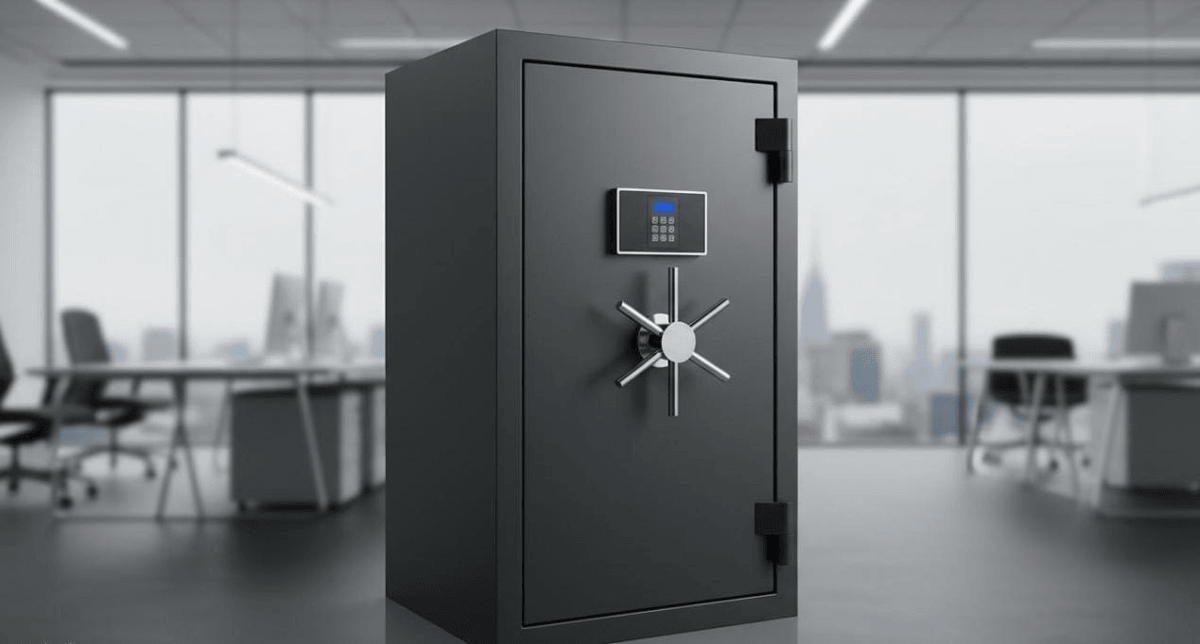
Why Steel Gauge Is the First Thing Distributors Get Wrong
When I started evaluating safe specifications for corporate procurement programs in 2014, the most common mistake I saw was buyers fixating on lock technology—electronic vs. mechanical—while completely ignoring the steel gauge of the enclosure itself. I learned this the hard way when a batch of office safes we sourced for a regional bank chain failed a very basic pry-bar test within 30 seconds of evaluation. The locks were excellent. The steel was not.
That experience changed how I approach every wholesale specification conversation. Because the lock mechanism is only as strong as the body that houses it, and the steel gauge determines how much physical force the safe can withstand before the door is compromised.
In this guide, I am going to walk you through exactly what you need to specify when sourcing office safes for wholesale distribution—covering steel gauge standards, anti-pry door engineering, hinge reinforcement, and how to read manufacturer spec sheets without getting misled by marketing language.
Understanding Steel Gauge: What the Numbers Actually Mean
The Gauge System Explained
Steel gauge is a measurement of thickness—the smaller the gauge number, the thicker the steel. This is counterintuitive for most buyers who assume a "higher gauge" means "stronger steel." It does not work that way.
For office and commercial safe applications, here is the practical scale you need to know:
- 16-gauge steel: Approximately 0.0598 inches (1.52mm). This is entry-level and adequate for low-risk environments like private offices where physical attack is unlikely.
- 14-gauge steel: Approximately 0.0747 inches (1.90mm). This is the practical minimum for commercial/distribution-grade office safes. It provides meaningful resistance to pry bars and hand tools.
- 12-gauge steel: Approximately 0.1046 inches (2.66mm). This is high-security territory. You will see this gauge in pharmacy safes, cash offices, and any environment where sustained physical attack is a realistic threat.
- 10-gauge steel: Approximately 0.1345 inches (3.42mm). Reserved for vault-level or high-value commercial applications. Rarely needed for standard office use but required by certain insurance certifications.
According to the UL 768 Standard for Safe Locks, the body strength requirements for UL TL-15 (Tool Resistance) classification mandate a minimum of 1/2-inch-thick steel in the door and 3/8-inch-thick steel in the body. This gives you a reference point for what "high-security" actually means in engineering terms.
Why Gauge Alone Is Not Enough: The Role of Steel Quality
One thing I cannot stress enough is that gauge number is only part of the equation. Because steel quality and alloy composition directly affect how the material behaves under impact and torsion loads, distributors who only compare gauge numbers are missing critical variables.
High-quality Commercial Safes use low-carbon steel (typicallyASTM A36 or equivalent) which offers good weldability, formability, and structural consistency. Budget safes may use higher-carbon steel that is harder but more brittle—meaning it can crack under sustained impact rather than deform and absorb energy.
We always recommend requesting the manufacturer's material test certificates (MTC) for the steel being used. Any reputable supplier should be able to provide this documentation without hesitation. If they cannot, that is a red flag worth investigating.
The Anti-Pry Door Standard: Engineering What Actually Stops Forced Entry
What Is an Anti-Pry Door?
An anti-pry door is a door construction engineered to resist pry-bar attacks at the latch side, hinge side, and bolt engagement points. Without this engineering, even thick steel can be defeated relatively quickly by inserting a pry bar at the door-to-body seam and applying leverage.
The three primary anti-pry engineering features you should specify are:
- Reinforced boltwork channel: The locking bolts extend into a steel channel strike embedded in the body, not just into a simple plate. This prevents the bolt from being pushed back when pressure is applied from the door gap.
- Anti-fishing baffles: In safes with deposit slots, anti-fishing baffles prevent someone from reaching through the slot and manipulating the interior latch or boltwork.
- Hinge interlock or fixed hinge reinforcement: The hinges must either use a interlocking pin design that prevents removal even if the hinge screws are taken out, or use heavy-dutywelded hinges with non-removable pins.
The Quarter-Inch Bolt Engagement Rule
As a practical field test, I use what I call the "quarter-inch rule": the locking bolts should have at least 1/4 inch (6.35mm) of engagement depth into the strike channel when the door is fully closed and locked. Less than that, and a skilled attacker with a pry bar and about 15 minutes of time can defeat the boltwork through sustained leverag.
According to testing protocols documented under ASTM F12 (Standard Test Methods for Amusement Rides and Devices, adapted for security enclosures), successful anti-pry performance requires that the bolt engagement system maintain structural integrity under a minimum 1,500-pound lateral load applied at the door gap. Not all manufacturers test to this standard, which is why you need to ask for the actual test data, not just marketing claims.
The Micro-Seam Design: A Key Indicator of Quality
One engineering detail that separates professional-grade office safes from consumer-grade units is the micro-seam (also called zero-gap or flush-face) door design. This refers to the precision of the fit between the door and the body frame.
In a micro-seam design, the door sits flush with or slightly inside the body frame, leaving minimal gap for pry-bar insertion. In contrast, many consumer and budget office safes have a visible seam of 2-3mm or more—an invitation for a pry bar.
We recommend specifying micro-seam or flush-face construction for any safe being placed in a commercial wholesale catalog, particularly for retail, banking, or high-turnover office environments. The added manufacturing cost is modest, but the security improvement is substantial.
Hinge Engineering: The Overlooked Weak Point
Why Hinges Matter More Than Most Distributors Realize
If I had a dollar for every procurement specification I reviewed that listed "solid hinges" as a requirement without any further definition, I would be a wealthy man. The problem is that "solid hinges" is meaningless as a spec—it tells the manufacturer nothing about the performance expected.
Because hinge failure is one of the most common methods of defeating a safe door, particularly in safes that have been in service for several years and have experienced some metal fatigue from repeated opening and closing.
There are three hinge engineering approaches you should understand:
- Welded-in-place fixed hinges with non-removable pins: This is the most secure option. The hinges are welded to the door and body and the hinge pin cannot be removed without cutting. Ideal for high-security applications.
- Interlocking hinge pins: The hinge pin is designed to interlock with the hinge barrel in a way that prevents removal after installation. This provides good security without requiring welding.
- External ball-bearing hinges with hardened screws: This is an acceptable commercial-grade option when combined with additional reinforcement. The hardened screws make removal difficult, but a determined attacker with a drill can defeat them.
For any office safe being specified for wholesale to corporate security programs, we strongly recommend requiring fixed-pin or interlocking hinges as a minimum standard in the purchase specification.
UL Ratings and What They Mean for Wholesale Buyers
Understanding the UL Safe Rating System
The Underwriters Laboratories (UL) rating system is the most widely recognized third-party testing standard for safes in North American markets. Understanding these ratings is essential for any distributor sourcing office safes for resale into regulated or insurance-sensitive environments.
- UL Type I: Laboratory-tested for resistance to safecracking by surreptitious attack (lock manipulation, radiological attack). Primarily tests the lock.
- UL Type II: Same as Type I, but tested for 30 minutes of entry attempt with hand tools. This is the practical minimum for commercial office environments.
- UL TL-15: Tested for 15 minutes of entry attempt with common hand tools. The door must weigh at least 750 pounds and use specific gauge steel. Appropriate for cash offices and retail environments.
- UL TL-20 and TL-30: Higher tool-resistance ratings for higher-risk environments. TL-30 is tested for 30 minutes against drill, oxyacetylene, and other power tools.
For a typical corporate office deployment—where the safe is storing cash floats, petty cash, and confidential documents—an office safe meeting UL Type II or TL-15 standards represents the appropriate balance of security and cost. Distributing safes rated below UL Type II to corporate buyers is a disservice, even if the initial purchase price is attractive.
The EN 1143 Standard for European Markets
If you are distributing into European markets, you need to be aware of the EN 1143-1 standard, which classifies safes by burglary resistance grades from I through VI. The grades map roughly to UL ratings but use different test protocols. Grade III and above are typically required for commercial cash handling applications in EU retail environments.
We have seen distributors lose deals because they provided UL-rated safes into EU markets without recognizing that EN 1143 is the locally recognized standard for insurance purposes. When we help distributors expand into European markets, we always recommend addressing the EN standard compliance explicitly in product documentation.
Steel Gauge Specifications for Common Office Safe Applications
Low-Risk Office Environments (Retail Showrooms, General Offices)
For low-risk environments where the primary threat is opportunistic theft rather than organized forced entry, we recommend specifying:
- Body: Minimum 14-gauge cold-rolled steel
- Door: Minimum 12-gauge steel or equivalent composite (some manufacturers use a steel-composite-steel sandwich)
- Boltwork: At least three active locking bolts, 3/4-inch diameter minimum
- Bolt engagement: Minimum 1/4 inch into reinforced strike channel
- Hinges: Hardened steel with hardened screw fastening or interlocking pin design
High-Risk Environments (Cash Offices, Retail Counters, Pharmacies)
For environments with higher theft risk or insurance requirements, the specifications should be escalated:
- Body: Minimum 12-gauge steel with reinforcing ribs
- Door: Minimum 10-gauge steel or UL TL-15 rated composite
- Boltwork: Four or more active locking bolts, 1-inch diameter, with rotating hardened pins
- Anti-pry features: Micro-seam construction, anti-fishing baffles, reinforced strike channel
- Hinges: Fixed-pin wel-in-place or interlocking pin design, minimum three hinges
- Rating: UL TL-15 or EN 1143 Grade III minimum
What to Require in Your Wholesale Specification Documents
The Five Critical Specification Points
When drafting a wholesale procurement specification for office safes, include the following five points explicitly. This eliminates ambiguity and ensures you are comparing products on the basis of real security engineering rather than aesthetics or price point alone.
- Steel gauge minimums by component: List body and door requirements separately. "12-gauge body, 10-gauge door" is a meaningful spec. "Heavy-duty steel" is not.
- Bolt engagement depth: Require minimum 1/4-inch engagement into a reinforced strike channel, verified by manufacturer test data.
- Hinge removal resistance: Require fixed-pin or interlocking hinge design. Specify that hinge screws must be hardened to Rockwell C45 minimum.
- Fire rating if applicable: For safes storing paper documents, require a minimum 30-minute fire rating per UL 350 or equivalent EN standard.
- Third-party testing verification: Require the manufacturer's UL or EN test report number, which can be verified directly on the UL or accredited laboratory's website.
How to Read a Manufacturer's Spec Sheet Without Being Misled
I have reviewed hundreds of manufacturer spec sheets over the years, and the most common misleading tactic is listing a single gauge measurement prominently while burying the actual door or body gauge in the footnotes. Always ask the question: "What is the door gauge, specifically?" If the spec sheet does not answer this directly, request the information in writing before proceeding.
Another common issue is listing "reinforced steel" or "hardened steel" without specifying the actual gauge or alloy. These terms are marketing language until they are backed by numbers. Insist on ASTM/AISI material designations, not brand names or marketing descriptors.
Common Sourcing Mistakes Corporate Distributors Make
Mistake 1: Prioritizing Lock Type Over Enclosure Strength
The electronic vs. mechanical lock debate is largely irrelevant from a security engineering standpoint—both lock types can be excellent or poor depending on the manufacturer and certification. Because a $500 electronic lock installed in a 16-gauge steel box is still only as strong as that 16-gauge steel box, the lock investment is squandered if the enclosure is not equivalently rated.
Mistake 2: Ignoring Boltwork Quality
I have seen office safes with beautiful 14-gauge steel bodies that used cheap stamped steel bolts with minimal engagement. The boltwork is the actual locking mechanism—poor boltwork means the door opens with surprisingly little force regardless of how thick the steel is.
Mistake 3: Not Verifying Third-Party Testing
Any manufacturer can claim their safe is "UL rated" or "commercially graded." Distributors who do not verify these claims by checking the UL online directory or requesting the actual test report are taking on significant liability. This is not a theoretical risk—we have seen distributors receive containers of safes with fraudulent certification claims, leading to product recalls and reputational damage.
The UL Online Directory (free to access at ul.com) allows you to search by manufacturer name and file number to verify whether a specific model is actually UL listed. This takes about 2 minutes and could save you from a serious problem.
Mistake 4: Overlooking Installation Requirements
An office safe that is not properly anchored to the floor or wall is significantly easier to steal and defeat. Require that safes come with pre-drilled mounting holes and include anchoring hardware for both floor and wall installation. The anchoring specification is part of the total security solution and should be treated as non-negotiable in commercial applications.
How TigerKing Supports Distributors With Commercial Safe Solutions
At TigerKing, we manufacture a range of commercial office safes designed specifically for wholesale distribution programs. Our commercial safe product line includes options ranging from standard 14-gauge entry-level models to reinforced high-security configurations with 12-gauge steel, anti-pry boltwork, and UL Type II ratings.
We provide distributors with full technical documentation packages including steel gauge certifications, boltwork test data, UL or EN test report numbers for verification, and installation specifications. We can also customize steel gauge, boltwork configuration, hinge design, and lock options to match specific buyer requirements rather than forcing a one-size-fits-all approach.
Our engineering team works directly with distributor procurement programs to specify the right product tier for each end-user application, ensuring that the specification you are selling matches the actual security requirement of the environment.
If you are building out a commercial safe wholesale catalog and need technical specification support, our product team can provide comparison documentation, sample specifications for RFP processes, and technical consultation at no cost. You can browse our full product range or reach out directly to discuss OEM and ODM options for branded distribution programs.
Frequently Asked Questions
What is the minimum steel gauge for a commercial office safe?
The minimum steel gauge for a commercial-grade office safe intended for wholesale distribution is 14-gauge for the body and 12-gauge for the door. Anything thinner than 14-gauge should be considered entry-level only and not marketed as commercial security grade.
How does anti-pry door construction work?
Anti-pry door construction prevents forced entry by using reinforced boltwork that extends into a steel channel strike, micro-seam gaps that eliminate pry-bar insertion points, and fixed or interlocking hinge designs that prevent door removal even if hinge fasteners are compromised.
What UL rating do I need for a corporate office safe?
For most corporate office applications, a UL Type II or TL-15 rating is appropriate. UL Type II is tested for 30 minutes against hand tools; TL-15 offers higher resistance and is preferred for cash offices and retail environments.
Why are hinges important in safe security?
Hinges are critical because they are the primary attack surface for door removal after a safe has been weakened or breached. External ball-bearing hinges can be removed with basic tools if not properly hardened. Fixed-pin or interlocking hinge designs are significantly more resistant.
What documents should I request from a safe manufacturer before wholesale purchasing?
Request material test certificates (MTC) for steel gauges, the manufacturer's UL or EN test report number (verifiable on the issuing laboratory's website), boltwork engagement depth specifications in writing, hinge design documentation, and installation specifications including anchoring requirements.
Author Card
James Chen
Senior Security Industry Analyst & SEO Content Strategist
James Chen has covered the security equipment manufacturing and global trade sector for over 10 years. His work has been cited in Security Products Magazine and multiple industry procurement guides. He specializes in B2B sourcing strategy, OEM/ODM evaluation frameworks, and market intelligence for physical security products.
Facebook | LinkedIn | YouTube | X