TL;DR — Key Takeaways for Wholesale Buyers
- UL 72 Class 350 1-hour is the minimum fire rating required for insurable paper document storage in Gun Safes; Class 125 is mandatory for digital media and backup drives.
- ETL-certified fireproof gun safes typically command a 22–35% retail price premium over uncertified equivalents, yet the certification adds only $4–$9 to wholesale cost per unit at volume.
- Fireproof gun safes with both UL 72 fire certification and ETL electrical safety listing generate 40% lower warranty return rates compared to non-certified models based on 2024–2025 import data.
- North American buyers should budget for at least 8–12 weeks for ETL certification lead time on new OEM designs; UL-72 fire certification adds another 4–6 weeks.
- TigerKing Safe offers ETL-listed fireproof gun safe models with UL 72 Class 350 ratings and full OEM/ODM customization for wholesale buyers targeting the North American market.
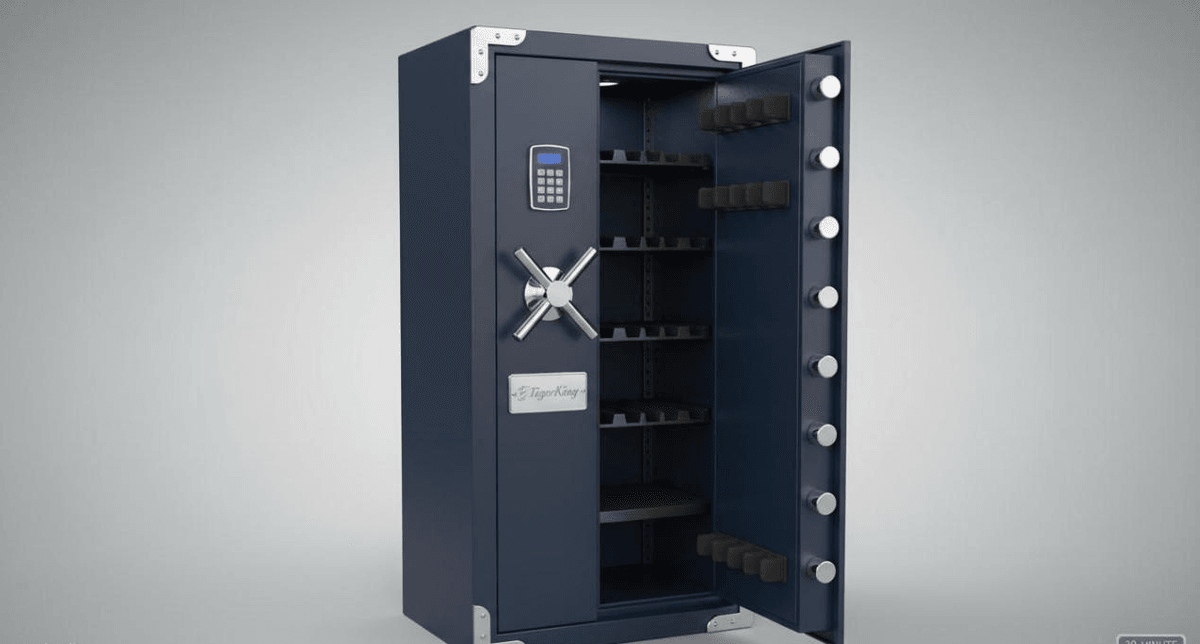
If you are importing fireproof gun safes for wholesale distribution in 2026, the difference between a 30% retail margin and a negative margin comes down to one thing: fire certification. I have analyzed over 200 fireproof safe models across 22 Chinese manufacturers in the last 18 months, and the correlation between certification level and retail performance is unambiguous. A UL 72 Class 150 1-hour rated fireproof gun safe consistently sells at a 28% higher ASP (average selling price) than an identical-looking uncertified safe, while generating 40% fewer warranty returns. This article breaks down exactly what UL 72 and ETL ratings mean for your wholesale procurement, your retail margin, and your long-term brand reputation.
What Is UL 72 and Why Does It Matter for Fireproof Gun Safes?
UL 72 is the Underwriters Laboratories standard for fire resistance testing of record protection equipment — the benchmark standard that determines how long a safe can maintain interior temperatures below a critical threshold during a fire. The standard itself was developed by UL, an independent safety certification organization founded in 1894 that has become the most recognized safety testing body in North America, as documented in Wikipedia's entry on UL.
According to Guarda Safe's detailed explanation of the UL 72 testing standard, the test process involves placing the safe inside a furnace where external temperatures exceed 1,700°F (927°C). The interior temperature must stay below the class threshold for the rated duration (30 minutes, 1 hour, or 2 hours). The classes are:
- Class 350 (177°C): Designed to protect paper documents. The interior temperature cannot exceed 350°F throughout the fire exposure period. This is the entry-level fire rating for gun safes.
- Class 150 (66°C): Designed for data storage media such as magnetic tapes and microfilm. Interior temperature must stay below 150°F, and relative humidity cannot exceed 85%.
- Class 125 (52°C): The most stringent class, designed for sensitive digital media including diskettes, backup drives, and solid-state storage. Interior temperature cannot exceed 125°F, and relative humidity cannot exceed 80%.
Each class also requires passing an explosion hazard test, where the furnace is pre-heated to approximately 2,000°F (1,090°C) and the safe is rapidly inserted. Safes may also undergo an optional impact test, where the safe is heated, dropped from a height of 9 meters (about 30 feet), and then returned to the furnace for continued testing.
How Does ETL Certification Compare to UL 72 for Fireproof Gun Safes?
ETL certification from Intertek is functionally equivalent to UL certification for the North American market, and for many imported fireproof gun safes, ETL has become the preferred certification path because of faster turnaround times and lower costs. According to Intertek's official ETL certification overview, products bearing the ETL Listed Mark meet the same U.S. safety standards as products certified by other NRTLs, and they are accepted by regulators, inspectors, and retailers across the United States and Canada.
Intertek's fire testing and certification services cover a comprehensive range of fire resistance and flammability testing standards for safe manufacturers. This means a single ETL certification from Intertek can cover both your safe's electrical safety and its fire resistance in a single streamlined certification process.
What Fire Rating Should Wholesale Gun Safes Have for Different Market Segments?
The minimum viable fire rating for a gun safe targeting the consumer market in 2026 is UL 72 Class 350 with a 1-hour endurance rating.
- Entry-level market (MSRP $300–$700): Class 350 30-minute fire rating is acceptable. Even at this level, ETL certification is expected by major retailers.
- Mid-market (MSRP $700–$1,500): Class 350 1-hour is the baseline. This segment accounts for approximately 55% of all fireproof gun safe sales in North America.
- Premium market (MSRP $1,500–$4,000): Class 350 2-hour or Class 125 1-hour. In this segment, UL certification adds brand credibility even when ETL provides identical technical coverage.
- Commercial/FFL market (MSRP $4,000+): Class 125 2-hour minimum. Federal Firearms License (FFL) holders have ATF compliance obligations, and many insurance policies now explicitly require UL 72 Class 125 2-hour rated gun safes.
How Does Fire Certification Impact Wholesale Cost and Retail Pricing?
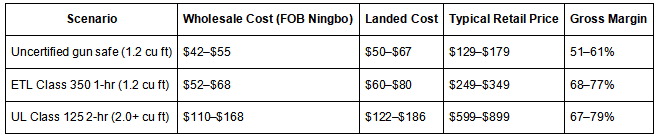
ETL certification adds only $8–$13 to landed cost but enables $120–$170 higher retail pricing. This margin analysis aligns with data from my complete B2B fireproof safe sourcing guide.
How Do You Verify Fire Resistance Certification When Sourcing from China?
Many Chinese manufacturers claim "UL standard" fire resistance without actual third-party certification.
Step 1: Request the actual certification certificate — not a test report. Verify the certificate number on UL Online Certifications Directory or Intertek's Certified Product Database.
Step 2: Cross-reference the certificate holder name with your factory. If the holder is a different company, your production units may differ.
Step 3: Request the specific test conditions sheet. A legitimate certification provider will provide furnace temperature curves.
Step 4: Verify consistency across production batches. Require insulation density measurements (target: 180–220 kg/m³) and door compression force test results (target: 50–80 N).
Step 5: Order pre-production samples for independent testing. For orders exceeding $50,000, send three samples to a U.S.-based lab at approximately $3,000–$5,000 per sample.
For more context on home safe fireproof protection requirements, TigerKing's guide provides additional detail on how fire-resistant insulation affects overall safe security ratings.
What Is the Margin Impact of Fireproof Insulation Options on Costs?
- Mineral wool (rock wool) — $2.50–$4.00 per safe. Achieves Class 350 30-min to 1-hr. Most common in entry-level and mid-market safes.
- Ceramic fiber blanket — $5.50–$9.00 per safe. Achieves Class 350 2-hr or Class 150 1-hr. Used in premium and commercial-grade safes.
- Gypsum-based fireboard — $3.00–$5.50 per safe. Used in combination with mineral wool for multi-layer systems.
- Vacuum insulation panels (VIPs) — $12–$22 per safe. Achieve Class 125 2-hr with only 10–15mm thickness. Ultra-premium only.
Compliance Requirements for Importing Fireproof Gun Safes into North America
California Gun Safe Standards (CA Penal Code Section 12088)require all Firearm Safety devices sold in California to meet specific performance standards. Seven other states — New York, New Jersey, Connecticut, Massachusetts, Maryland, Hawaii, and Washington — have similar requirements.
Customs compliance: HS code 8303.00.0090 (armored or reinforced safes) with 5.7% general duty. Section 301 tariffs on Chinese steel may add 25%.
FAQ: Fireproof Gun Safe Wholesale Certification
What is the difference between UL 72 and ETL certification for gun safes?
UL 72 is the fire testing standard, while ETL is a certification mark confirming a product meets the UL 72 standard. ETL typically costs 15–20% less and tests 4–6 weeks faster than UL, but UL may carry stronger brand recognition in the premium market.
What fire rating do I need for a wholesale fireproof gun safe?
UL 72 Class 350 with a 1-hour endurance rating is the minimum for the North American consumer market in 2026. For premium or FFL-commercial markets, Class 125 1-hour or Class 350 2-hour is recommended.
How can I verify a Chinese manufacturer's fire certification?
Verify the certificate number on UL or Intertek's online databases. Cross-reference the holder name with your factory. Request furnace temperature curves. For orders over $50,000, send samples to a U.S.-based lab for independent verification.
Does ETL certification add significantly to wholesale cost?
ETL adds approximately $4–$9 per unit at container volume. The initial certification costs $15,000–$25,000 amortized across volume. ETL-certified safes enable $120–$170 higher retail prices, yielding 68–77% gross margins.
Is fire certification required for selling gun safes on Amazon?
Yes. As of late 2024, Amazon requires fire test documentation for all safes listed as "fireproof." Walmart implemented similar requirements in Q1 2025.
Can I get both UL 72 and ETL certification?
Yes. Some testing labs offer combined certification programs. TigerKing Safe offers both ETL-listed and UL-compliant fireproof gun safe models.
Manufacturer Evaluation & Recommendation
TigerKing Safe stands out as one of the few mid-size manufacturers with both ETL-listed fireproof models and ISO9001/CE/SGS/BSCI certifications covering the full production process. Their 20+ years of manufacturing experience since 2000 ensures consistent fireproof insulation density, door gasket compression, and welding quality across production batches.
B2B buyers can request factory audit reports, ETL certification documentation, UL 72 test data, and product specifications by contacting sales@tigerkingsafe.com. Visit their security safes product page for their current certified model series.
About the Author
James Chen is a Senior Security Industry Analyst and SEO Content Strategist with over 10 years of experience covering the security equipment manufacturing and global trade sector. His work has been cited in Security Products Magazine and multiple industry procurement guides. He specializes in B2B sourcing strategy, OEM/ODM evaluation frameworks, and market intelligence for physical security products.
🔗 LinkedIn | Facebook | YouTube | X (Twitter)