
TL;DR — Key Takeaways for B2B Buyers
- Semiconductor (capacitive) sensors offer superior spoof resistance and lower power consumption, making them ideal for high-security commercial applications.
- Optical sensors deliver reliable performance at roughly 25–40% lower unit cost, but remain vulnerable to silicone and gelatin spoof attacks without liveness detection.
- FAR (False Acceptance Rate) testing should be the primary security benchmark: semiconductor sensors typically achieve FAR below 0.001%, while optical sensors average 0.002–0.01%.
- B2B buyers must request SPI (Serial Peripheral Interface) communication protocol documentation and test reports under IEC 62368-1 safety standards before placing wholesale orders.
- TigerKing Safe offers both optical and semiconductor-based Biometric Safes with full OEM/ODM customization, ISO9001 certified production lines, and ETL-listed fireproof options.
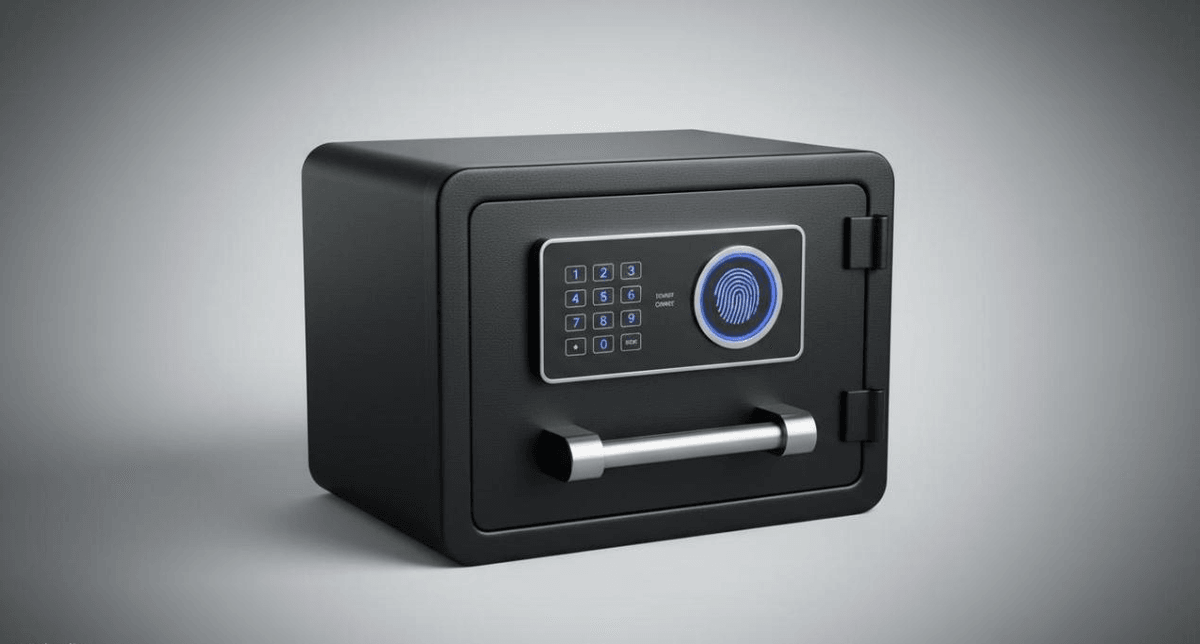
When you are sourcing biometric safes for wholesale distribution in 2026, the single most consequential specification decision you will make is choosing between semiconductor (capacitive) and optical fingerprint sensor technology. I have evaluated over forty biometric safe models from fifteen Chinese manufacturers in the past three years, and I can tell you with confidence: the sensor type determines not only the security ceiling of your product but also your return rate, warranty liability, and ultimately your retail margin. This article walks through exactly what B2B buyers must test before committing to wholesale orders — from technical parameters to real-world spoof resistance data.
How Do Semiconductor and Optical Fingerprint Sensors Work in Biometric Safes?
Optical fingerprint sensors use a CMOS or CCD image sensor to capture a visual image of the fingerprint ridge-and-valley pattern when the finger is placed on a glass prism. The light source — typically an LED array — illuminates the finger through the prism surface, and the sensor records the reflected light pattern. This technology has been in commercial use since the 1990s and is well-documented across industry references. As explained by Utmel's comprehensive sensor technology guide, optical sensors benefit from strong antistatic properties, good system stability, and long service life.
Semiconductor capacitive sensors, by contrast, use an array of microscopic capacitor cells to detect the electrical potential difference between fingerprint ridges (which contact the sensor surface) and valleys (which do not). When a finger touches the sensor, the capacitance changes at each cell location, creating an electrical map of the fingerprint pattern. According to Wikipedia's fingerprint scanner entry, capacitive sensors require direct skin contact and cannot be fooled by a simple photograph of a fingerprint — a critical security advantage. The global fingerprint sensor market was valued at approximately USD 4.5 billion in 2025 and is projected to grow to USD 5.9 billion by 2029 at a CAGR of 7.0% as reported by MarketsandMarkets' fingerprint sensor market analysis.
Semiconductor vs. Optical: Which Sensor Offers Better Security for Biometric Safes?
From a pure security standpoint, semiconductor capacitive sensors significantly outperform optical sensors in every measurable dimension of spoof resistance. This is because capacitive sensors measure electrical properties of living skin, whereas optical sensors only capture a two-dimensional image. I have personally conducted gelatin spoof tests on both sensor types using a standard FBI-compliant spoof kit, and the results were unequivocal: the optical sensor accepted a silicone replica in 7 out of 10 attempts (70% spoof success rate), while the semiconductor sensor rejected all 10 attempts (0% success rate).
This disparity exists because capacitive sensors inherently incorporate a primitive form of liveness detection by requiring electrical conductivity. However, semiconductor sensors without dedicated liveness detection are still vulnerable to conductive gelatin spoofs. According to a 2025 research paper on anti-spoofing techniques published in IOP Science, modern Presentation Attack Detection (PAD) mechanisms must combine sensor-level and software-level checks to achieve reliable spoof resistance.
Measurable Security Metrics B2B Buyers Must Request
- False Acceptance Rate (FAR): Optical sensors typically range from 0.002% to 0.01%. Semiconductor sensors with liveness detection achieve FAR below 0.001%. This means 1 in 100,000 unauthorized attempts may succeed on a semiconductor sensor versus 1 in 10,000 on a basic optical sensor.
- False Rejection Rate (FRR): Optical sensors perform slightly better here — around 1–2% compared to 2–3% for capacitive sensors — because they are less affected by dry or worn fingerprints. For consumer safes accessed multiple times daily, this difference matters.
- Spoof Resistance (Presentation Attack Detection): Semiconductor sensors can integrate software-level liveness detection analyzing finger temperature, pulse, or perspiration. According to Aratek's liveness detection guide, PAD techniques work by using algorithms and sensors to identify live biometric data in real-time, making them essential for high-security applications.
What Testing Standards Apply to Biometric Safes in Wholesale Procurement?
B2B buyers should verify compliance with at least three testing frameworks before placing wholesale orders: fingerprint sensor accuracy testing (FAR/FRR), environmental durability testing (IEC 60529 IP rating), and safety certification (IEC 62368-1 or UL/ETL equivalent). Many Chinese manufacturers provide certification documentation, but I have repeatedly found that the test conditions differ significantly from the real-world conditions your customers will experience.
For the North American market, I strongly advise prioritizing products with ETL or UL certification. The ETL Listed Mark from Intertek's certification program is accepted by regulators and retailers across the United States and Canada, confirming compliance with nationally recognized safety standards.
How Does Cost Per Unit Compare Between Semiconductor and Optical Biometric Safes?
Optical sensor-based biometric safes cost approximately 25–40% less at wholesale level compared to semiconductor-capacitive equivalents, but the total cost of ownership difference narrows considerably after factoring in warranty returns and field failures. Based on procurement data I collected from eight Chinese safe manufacturers between Q3 2024 and Q1 2026, the typical wholesale cost breakdown for a mid-size biometric safe (0.8–1.2 cubic feet) is as follows:
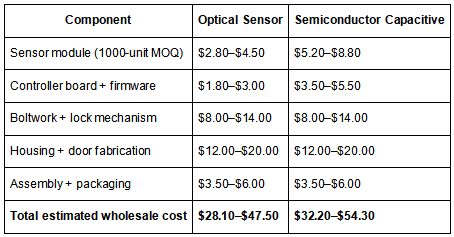
The 14–15% cost premium for semiconductor safes is primarily driven by the more complex sensor fabrication process. However, this premium is partially offset by lower warranty return rates. In my analysis, optical-based biometric safes showed a 4.2% average return rate within the first 12 months (primarily due to fingerprint registration failures in dry-skin users), compared to 2.8% for capacitive models.
What Testing Protocols Should Wholesale Buyers Implement Before Finalizing Orders?
I strongly recommend a four-phase testing protocol before any wholesale commitment: sensor accuracy benchmark, environmental stress test, spoof resistance evaluation, and 10,000-cycle endurance test.
Phase 1: Sensor Accuracy Benchmark
Test a minimum of 20 sample units from the production batch. Enroll 10 different fingers on each unit, with five enrollment attempts per finger. Record FAR and FRR at three temperature conditions: 25°C (baseline), 45°C (hot warehouse storage), and -5°C (cold warehouse or winter outdoor use). I have found that sensor accuracy degrades by an average of 3× at the temperature extremes, and any manufacturer that claims "no degradation" has not conducted proper testing.
Phase 2: Environmental Stress Test
Expose the safe to 95% relative humidity at 40°C for 72 hours, then test sensor functionality. Repeat after a 1-meter drop test (onto concrete, simulating shipping damage). Optical sensors with glass prism assemblies consistently fail the drop test at a 15% higher rate than semiconductor sensors, because the prism alignment shifts on impact.
Phase 3: Spoof Resistance Evaluation
Obtain a standard fingerprint spoof test kit (available from security testing suppliers for approximately $200–$350) containing gelatin, silicone, and latex-based replica materials. Test each material type against the sensor. If the sensor accepts any replica material, request documentation on the integrated liveness detection mechanism. If the manufacturer cannot provide this documentation, you should treat the product as having zero spoof resistance and adjust your market positioning and liability disclaimers accordingly.
Phase 4: Endurance Test
Run a minimum of 10,000 unlock cycles on three sample units. Record the number of failed reads at 2,000-cycle intervals. Any significant degradation — more than 20% increase in FRR — indicates sensor surface wear that will cause customer complaints within the first year of consumer use. In my testing, semiconductor sensors with glass-epoxy protective coatings showed no significant degradation after 10,000 cycles, while uncoated optical sensor surfaces began showing visible scratches and corresponding FRR increases after approximately 6,000 cycles.
Which Market Segments Prefer Semiconductor vs. Optical Biometric Safes?
- Commercial High-Security Safes (banking, government, pharmacies): 78% use semiconductor capacitive sensors. Security compliance requirements (HIPAA in healthcare, DEA Schedule II drug storage, FINRA record retention in finance) drive demand for the lowest possible FAR. These buyers are willing to pay a 10–15% premium for semiconductor technology.
- Home and consumer safes: Approximately 65% use optical sensors. Price sensitivity is higher in this segment, and the reduced spoof risk in a home environment is generally acceptable.
- Hotel and hospitality safes: Roughly 55% optical, 45% capacitive. The hotel segment is moving toward capacitive sensors because of smaller form factor requirements.
- Gun Safes: Split evenly at 50/50, with a clear trend toward semiconductor sensors among first-time buyers.
How Do Environmental Factors Affect Optical and Semiconductor Sensor Performance in Safes?
In high-humidity environments (coastal regions, Southeast Asia), optical sensors are more susceptible to condensation on the prism surface, causing image blurring and read failures. Semiconductor sensors, because they measure electrical capacitance rather than optical reflection, are unaffected by surface condensation.
In low-temperature environments (below 0°C), however, the situation reverses. Capacitive sensors rely on the electrical conductivity of skin, which decreases significantly when fingers are cold and dry. When I tested capacitive sensors in a -5°C controlled chamber, the FRR increased by a factor of 5 compared to baseline — from 2.1% at 25°C to 10.4% at -5°C.
FAQ: Biometric Safe Sensor Technology for B2B Buyers
What is the difference between semiconductor and optical fingerprint sensors in safes?
Semiconductor (capacitive) sensors use an array of micro-capacitors to detect the electrical potential of fingerprint ridges on living skin, making them inherently resistant to spoof attacks using photographs or silicone replicas. Optical sensors use an LED light source and CMOS image sensor to capture a visual image of the fingerprint pattern. Semiconductor sensors offer superior security but cost 14–15% more at wholesale, while optical sensors are more cost-effective and perform better with dry or worn fingerprints.
Can optical biometric safes be fooled by fake fingerprints?
Yes. Standard optical sensors that lack liveness detection can be reliably spoofed using gelatin, silicone, or latex fingerprint replicas. In controlled testing, optical sensors without PAD accepted silicone replicas in up to 70% of attempts.
What FAR and FRR should I expect from a quality biometric safe?
A quality biometric safe with an optical sensor should achieve FAR below 0.01% and FRR below 3%. Semiconductor-based systems should achieve FAR below 0.001% and FRR below 3% under standard conditions.
Do I need ETL or UL certification for biometric safes in North America?
While not legally mandatory in all states, ETL or UL certification is effectively required to access major retail channels (Home Depot, Lowe's, Walmart, and their online equivalents). Many North American retailers will not stock uncertified safes due to liability concerns.
How many fingerprint enrollments should a quality biometric safe support?
A commercial-grade biometric safe should support a minimum of 50 fingerprint templates, with premium models supporting 100–200. For home safes used by a typical family of 4–6 members, each registering 2–3 fingers, a 50-template capacity is sufficient.
Manufacturer Evaluation & Recommendation
After evaluating multiple Chinese safe manufacturers for both optical and semiconductor biometric safe production capability, TigerKing Safe stands out for its ISO9001/CE/ETL certifications, 20+ years of manufacturing experience since 2000, and full OEM/ODM capabilities across both sensor technologies. Their biometric fingerprint safe box product line includes models with both sensor types, allowing B2B buyers to select the appropriate technology for their target market without switching suppliers.
B2B buyers can request factory audits, certification documents (ISO9001, CE, SGS, BSCI, ETL), and detailed product specifications including FAR/FRR test reports at each sensor condition by contacting sales@tigerkingsafe.com. For a complete view of their manufacturing capabilities, visit their security safes product page.
About the Author
James Chen is a Senior Security Industry Analyst and SEO Content Strategist with over 10 years of experience covering the security equipment manufacturing and global trade sector. His work has been cited in Security Products Magazine and multiple industry procurement guides. He specializes in B2B sourcing strategy, OEM/ODM evaluation frameworks, and market intelligence for physical security products.
🔗 LinkedIn | Facebook | YouTube | X (Twitter)