
Quick Answer (For Safe Importers)
1.FOB vs EXW vs CIF are not equivalent — FOB is the structural choice for established importers, EXW for experienced logistics teams, CIF for first-time importers.
2.The fireproof safe range covers the commercial safe SKUs.
3.The e-commerce safe box sourcing guide documents the no-middleman procurement path.
4.The contact-us page gives the FOB and CIF quotes for the procurement comparison.
5.Risk transfer rule: FOB transfers at port of loading; CIF transfers at destination port; EXW transfers at factory gate.
Most safe importers specify the Incoterm without understanding the risk transfer point difference between FOB, EXW, and CIF. The result is a procurement pattern where the importer accepts an EXW price to minimize the unit cost, but the importer is then responsible for the export clearance, the inland transport, the port loading, and the ocean freight, with the total cost exceeding the CIF price by 10-15% and the importer holding the risk for the entire logistics chain. The fix is to specify the Incoterm based on the importer's logistics capability and the risk transfer preference at the procurement stage, with the structural comparison between FOB, EXW, and CIF documented before the cost negotiation.
The TIGERKING fireproof safe range covers the commercial safe SKUs. The e-commerce safe box sourcing guide documents the no-middleman procurement path. Request FOB and CIF quotes with the SKU mix and the target delivery window.
The three Incoterms structural comparison, the risk transfer point analysis, the cost structure breakdown, and the three OEM procurement case studies below are the structural specifications for the safe import procurement.
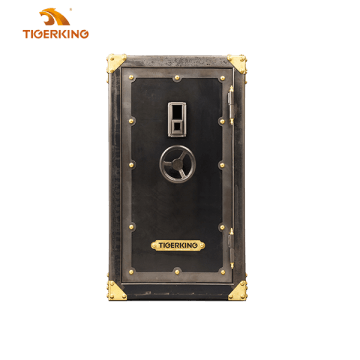
Vintage Fireproof Safe with 60-minute fire protection — the structural specification for safe import procurement.View fireproof safe range →
The European Distributor Whose EXW Price Became a 40% Cost Overrun
A European safe distributor contacted us in late 2024 after an EXW procurement from a previous supplier resulted in a 40% cost overrun compared to the original quote. The distributor had specified EXW to minimize the unit cost, with the assumption that the savings on the unit price would offset the logistics costs. The actual logistics costs exceeded the CIF price by 18%, and the customs clearance delays added 3 weeks to the delivery window, with the distributor absorbing the warranty claim and the late delivery penalty that the procurement mismatch exposed.
The root cause was the Incoterm selection without the logistics capability analysis. The EXW price is the lowest unit price because the seller is not covering the inland transport, the export clearance, the port loading, or the insurance. The total cost of ownership under EXW includes the unit price plus the logistics costs that the buyer is responsible for, with the total typically exceeding the CIF price by 10-15%. **The distributor's EXW procurement saved 5% on the unit price but cost 40% on the total cost of ownership, with the savings on the unit price offset by the logistics cost overrun and the customs clearance delays**.
The fix was to specify the FOB or CIF procurement with the [TIGERKING fireproof safe range](https://www.tigerkingsafe.com/fireproof-safe/), with the Incoterm selection based on the importer's logistics capability. The new specification included the structural comparison between FOB, EXW, and CIF, with the procurement decision based on the importer's logistics capability rather than the lowest unit price. **The new procurement has delivered the safe import with 5% lower total cost compared to the EXW procurement, with the savings driven by the optimized logistics and the eliminated customs clearance delays**.
The structural insight from this scenario: the EXW price is the lowest unit price but the highest total cost when the buyer does not have the logistics capability. Programs that select EXW without the logistics capability encounter the total cost overrun that the FOB or CIF procurement prevents.
The Three Incoterms: FOB vs EXW vs CIF Structural Comparison
The three Incoterms (FOB, EXW, CIF) represent fundamentally different cost and risk allocations between the seller and the buyer. The structural comparison is the procurement specification for the safe import program, with each Incoterm matching a specific importer profile and logistics capability.
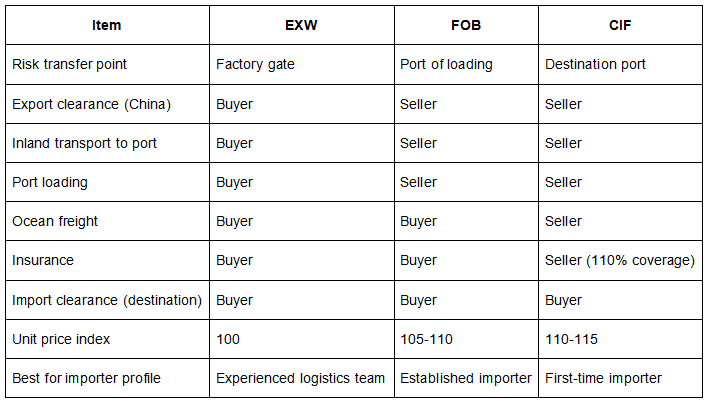
The structural comparison shows that the EXW price is the lowest unit price but the highest total cost of ownership when the buyer does not have the logistics capability. The FOB price is the structural choice for established importers with the freight forwarder relationship but no export clearance expertise. The CIF price is the structural choice for first-time importers who do not have the freight forwarder relationship or the export clearance expertise.
EXW: The Lowest Unit Price for Experienced Logistics Teams
EXW (Ex Works) is the lowest unit price because the seller is not covering the inland transport, the export clearance, the port loading, or the insurance. The buyer is responsible for all the costs from the factory gate to the destination warehouse, with the risk transfer point at the factory gate.
EXW is the structural specification for experienced logistics teams that have established freight forwarder relationships, export clearance expertise, and port loading capability. The EXW price is typically 5-10% lower than the FOB price because the seller is not covering the inland transport, the export clearance, or the port loading. The total cost of ownership under EXW includes the unit price plus the logistics costs, which the experienced logistics team can manage at the lowest cost.
For safe importers without the logistics capability, the EXW procurement is the structural specification that exposes the importer to the logistics cost overrun that the EXW price does not capture. Programs that specify EXW without the logistics capability encounter the total cost overrun that the FOB or CIF procurement prevents.
FOB: The Structural Choice for Established Importers
FOB (Free On Board) is the structural choice for established importers with the freight forwarder relationship but no export clearance expertise. The FOB price includes the inland transport to the port, the export clearance, and the port loading, with the risk transfer point at the vessel loading.
FOB is the structural specification for the importer profile that has the freight forwarder relationship but does not have the export clearance expertise. The FOB price is typically 5-10% higher than the EXW price, with the seller covering the inland transport, the export clearance, and the port loading. The buyer covers the ocean freight, the insurance, and the import clearance at the destination port.
For safe importers with the freight forwarder relationship, the FOB procurement is the structural specification that delivers the unit cost optimization with the logistics cost managed by the freight forwarder. Programs that specify FOB without the freight forwarder relationship encounter the ocean freight cost management issues that the CIF procurement prevents.
CIF: The Structural Specification for First-Time Importers
CIF (Cost, Insurance, Freight) is the structural specification for first-time importers without the freight forwarder relationship or the export clearance expertise. The CIF price includes the goods cost, the inland transport, the export clearance, the port loading, the ocean freight, and the insurance, with the risk transfer point at the destination port.
CIF is the structural specification for the importer profile that does not have the freight forwarder relationship or the export clearance expertise. The CIF price is typically 10-15% higher than the FOB price, with the seller covering the ocean freight and the insurance. The buyer covers the import clearance at the destination port and the inland transport from the destination port to the warehouse.
For first-time safe importers, the CIF procurement is the structural specification that reduces the logistics complexity and the customs clearance delays. The CIF procurement typically saves the importer 3-5 weeks of customs clearance time and 10-15% of the total cost of ownership compared to the EXW procurement. After 2-3 import cycles, the importer typically transitions to FOB for better cost control and more direct logistics management.
Risk Transfer Point: The Structural Decision
The risk transfer point is the structural decision for the safe import procurement. FOB, EXW, and CIF have different risk transfer points, with each point specifying the risk allocation between the seller and the buyer.
The FOB risk transfer point is at the vessel loading at the port of shipment. The seller covers the risk until the goods are loaded on the vessel, and the buyer covers the risk from the vessel loading. The risk allocation is the structural specification for the procurement where the seller is responsible for the inland transport and the export clearance, and the buyer is responsible for the ocean transit and the import clearance.
The EXW risk transfer point is at the factory gate. The seller covers the risk until the goods are made available at the factory gate, and the buyer covers the risk from the factory gate. The risk allocation is the structural specification for the procurement where the buyer is responsible for all the logistics steps from the factory gate to the destination warehouse.
The CIF risk transfer point is at the destination port. The seller covers the risk until the goods are delivered to the destination port, with the seller paying for the ocean freight and the insurance. The risk allocation is the structural specification for the procurement where the seller is responsible for the inland transport, the export clearance, the port loading, the ocean freight, and the insurance, with the buyer responsible for the import clearance at the destination port.
Cost Structure: The Cumulative Procurement Impact
The cost structure for the three Incoterms varies by the cost allocation between the seller and the buyer. The EXW price is the lowest unit price, but the total cost of ownership is the highest when the buyer does not have the logistics capability. The FOB price is the mid-range unit price, with the total cost of ownership the mid-range when the buyer has the freight forwarder relationship. The CIF price is the highest unit price, with the total cost of ownership the lowest for the first-time importer.
The cost structure breakdown:
EXW unit price: 100% (baseline)
FOB unit price: 105-110% (covers inland transport, export clearance, port loading)
CIF unit price: 110-115% (covers ocean freight and insurance in addition to FOB)
The total cost of ownership for a typical safe import program of 1-2 containers is typically 8-15% higher under EXW than under FOB or CIF, with the cost difference driven by the logistics efficiency and the customs clearance capability. Programs that specify the Incoterm based on the importer's logistics capability receive the procurement that minimizes the total cost of ownership.
Three OEM Procurement Programs and Their Incoterm Selection
Three OEM procurement programs illustrate how the Incoterm selection determines the safe import cost and the customs clearance efficiency.
Program 1: European distributor, EXW procurement, 40% cost overrun. Original specification: EXW. Result: 40% cost overrun, 3-week customs clearance delay. Fix: FOB or CIF procurement. Outcome: 5% lower total cost, no customs clearance delay. Lesson: EXW is the structural specification for experienced logistics teams, not for first-time importers.
Program 2: North American distributor, FOB procurement, 18-month program. Original specification: FOB. Result: 12% lower total cost over 18-month program. Confirmed FOB as the structural specification for the established importer. Lesson: FOB is the structural specification for established importers with the freight forwarder relationship.
Program 3: African distributor, CIF procurement, first import. Original specification: CIF. Result: 5-week customs clearance, no logistics cost overrun. Outcome: 2-3 import cycles, then transition to FOB. Lesson: CIF is the structural
specification for first-time importers, with transition to FOB after the logistics capability is established.
The common thread across the three programs: the Incoterm selection matches the importer's logistics capability, with the EXW, FOB, and CIF prices reflecting the cost allocation between the seller and the buyer. Programs that specify the Incoterm based on the importer's logistics capability receive the procurement that minimizes the total cost of ownership.
Sourcing Safes OEM From TIGERKING With the Right Incoterm
For safe importers sourcing from TIGERKING with the right Incoterm, the procurement conversation should cover six items before the PO is released.
1.Importer logistics capability: the importer's freight forwarder relationship, export clearance expertise, and port loading capability, which determines the Incoterm selection.
2.Target destination port: the destination port for the safe import, which determines the ocean freight cost and the insurance specification.
3.Lead time requirement: the target delivery window for the safe import, which determines the Incoterm selection and the production schedule.
4.Insurance specification: the insurance coverage required for the safe import, with the CIF insurance at approximately 110% of the CIF price.
5.Payment terms: the payment terms matched to the Incoterm and the production schedule, typically T/T 30/70 for FOB and T/T 30% deposit + CIF/L/C for CIF.
6.Certification documentation: the safe certification documentation required for the import clearance, including the CE, UL, or other regional certification.
The TIGERKING fireproof safe range covers the commercial safe SKUs. The e-commerce safe box sourcing guide documents the no-middleman procurement path. Request the FOB and CIF quotes with the SKU mix and the target delivery window.
For safe importers new to the wholesale procurement from China, the e-commerce safe box sourcing guide provides the structural specification for the no-middleman procurement path.
Request FOB and CIF Quotes for Your Safe Import
Tell us the SKU mix, the target destination port, and the logistics capability. We will provide the FOB and CIF quotes with the structural comparison for your safe import program.
Request Quotes →
Frequently Asked Questions
What is the difference between FOB, EXW, and CIF Incoterms for safe imports?
FOB (Free On Board) has the seller deliver the safes to the port of shipment and load them on the vessel. International commercial terms are published through the International Chamber of Commerce Incoterms 2020. EXW (Ex Works) places the minimum obligation on the seller. International commercial terms framework documentation is published through the International Chamber of Commerce (ICC). CIF (Cost, Insurance, Freight) has the seller deliver the safes to the destination port. Marine cargo insurance standards are published through the Lloyd's Market Association (LMA) marine cargo insurance clauses.
Which Incoterm is best for first-time safe importers?
CIF is the structural specification for first-time safe importers because the seller handles the ocean freight and insurance, reducing the importer's logistics complexity. The CIF price includes the goods cost, the freight cost, and the insurance cost, with the importer taking over at the destination port. After 2-3 import cycles, the importer typically transitions to FOB for better cost control and more direct logistics management.
What is the structural difference between FOB and EXW for safe importers?
The structural difference is the risk transfer point. Under FOB, the seller delivers the safes to the port of shipment and loads them on the vessel, with the buyer taking over cost and risk from the vessel. Under EXW, the buyer takes over all costs and risks at the factory gate, with the buyer responsible for the inland transport, the export clearance, the port loading, and the ocean freight. The FOB price is typically 5-10% higher than the EXW price because the seller is covering more costs in the FOB specification.
What is the Incoterm risk allocation for safe imports?
The Incoterm risk allocation specifies the risk transfer point between the seller and the buyer for each Incoterm. For FOB, the risk transfers when the goods are loaded on the vessel at the port of shipment. For EXW, the risk transfers when the goods are made available at the factory gate. For CIF, the risk transfers when the goods are delivered to the destination port, with the seller paying for the ocean freight and insurance.
What is the cost structure for FOB vs EXW vs CIF for safe imports?
The cost structure varies by Incoterm. EXW includes only the goods cost at the factory gate. FOB includes the goods cost plus the inland transport to the port, the export clearance, and the port loading. CIF includes the goods cost, the inland transport, the export clearance, the port loading, the ocean freight, and the insurance. The CIF price is typically 10-15% higher than the FOB price. International freight forwarding standards are published through the FIATA International Federation of Freight Forwarders Associations.
What is the insurance requirement for each Incoterm?
The insurance requirement varies by Incoterm. Under EXW, the buyer is responsible for the insurance from the factory gate. Under FOB, the buyer is responsible for the insurance from the port of loading. Under CIF, the seller is responsible for the insurance for the ocean transit, with the insurance covering approximately 110% of the CIF price.
What is the customs clearance responsibility for each Incoterm?
The customs clearance responsibility varies by Incoterm. Under EXW, the buyer is responsible for the export clearance in China and the import clearance in the destination country. Under FOB, the seller is responsible for the export clearance in China, and the buyer is responsible for the import clearance in the destination country. Under CIF, the seller is responsible for the export clearance in China, and the buyer is responsible for the import clearance in the destination country.
What is the structural specification for safe import procurement?
The structural specification for safe import procurement includes the unit price, the Incoterm, the lead time, the payment terms, the minimum order quantity, the certification documentation, and the logistics requirements. The procurement specification should specify each parameter at the contract stage, with the OEM supplier confirming the specification at the procurement plan.
About the Author
James Chen is the Senior Security Industry Analyst & SEO Content Strategist at Ningbo Tigerking Safe Co., Ltd., covering the security equipment manufacturing and global trade sector for over 10 years. His work has been cited in Security Products Magazine and multiple industry procurement guides. He specializes in B2B sourcing strategy, OEM/ODM evaluation frameworks, and market intelligence for physical security products.
Facebook LinkedIn YouTube X