
Key Takeaways
- A heavy-duty traditional drop safe such as the DF4020DA series retails in a different band than a network-connected smart safe with biometric access and cloud dashboards; the unit-price gap is real but the total-cost-of-ownership delta is what our procurement team should model.
- Our procurement case studies show payback periods between 14 and 22 months for mid-volume retailers, with labor-hour savings and armored-car fee reductions delivering the largest share of our value.
- Smart safes do not eliminate employee theft by themselves, yet they remove the lone-walker deposit pattern that drives most opportunistic skimming by writing every deposit to an immutable audit log on our side.
- Traditional drop safes still win in low-volume, single-operator, no-network environments where the procurement team is unwilling to take on connectivity risk on our behalf.
- Compliance posture under PCI-DSS, NIST CSF, and SOC 2 is the third leg of the ROI tripod and is often the deciding factor for chains with formal information-security programs that we audit against.
Table of Contents
1.What "Smart Safe" and "Drop Safe" Actually Mean in 2025 Procurement
2.The True Cost Stack: Acquisition, Labor, Shrinkage, Insurance
3.ROI Mechanics: How Smart Safes Cut Labor and Insurance Premiums
4.Where Traditional Drop Safes Still Beat Smart Safes
5.Procurement Field Test: How to Audit a Quote Before Signing
6.Implementation Risk: Network, Audit-Trail, and Compliance Pitfalls
7.Decision Matrix: Which Safe Wins for Your Cash-Handling Volume
8.Frequently Asked Questions
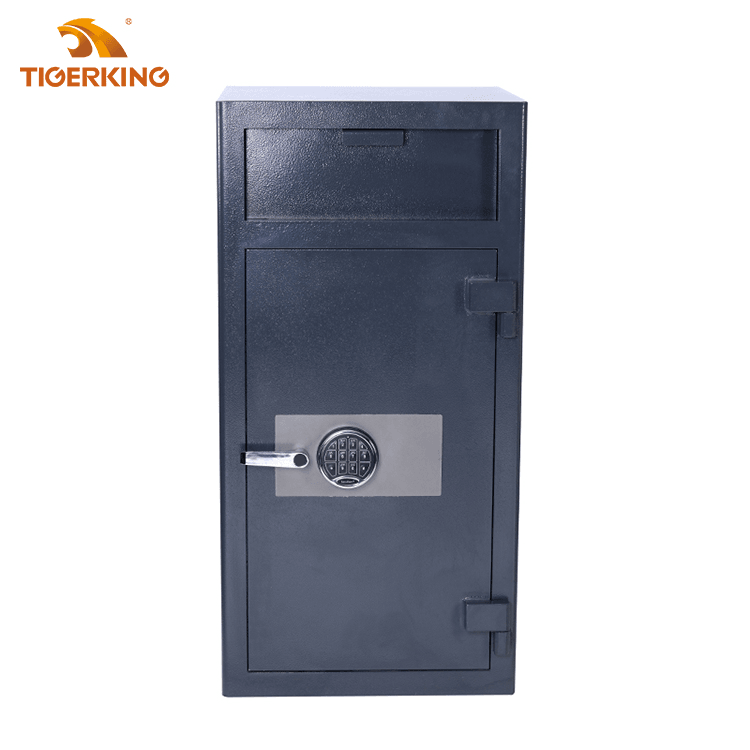
Tigerking DF4020DA commercial drop safe — the baseline heavy-duty depository used in the ROI model below.
What "Smart Safe" and "Drop Safe" Actually Mean in 2025 Procurement
The smart safe vs traditional drop safe decision is not a technology-versus-tradition debate. Both product classes share the same physical threat model: a 6mm steel door, 3mm steel body, anti-fishing drop baffle, and three or more 28mm solid locking bolts. The unit pictured above, the Tigerking DF4020DA advanced digital keypad depository drop safe with master code, illustrates the heavy-duty end of our traditional depository family: 96 kg of low-carbon high-density steel, floor- or wall-mount, three lock options, and a top anti-fishing drop slot.
What separates the two product classes is the layer above the lock. A traditional drop safe is a passive container: someone deposits cash through the slot, someone else with the PIN opens the door, and an internal paper log records the event. A smart safe adds an electronic deposit-tracking layer: each deposit is logged with a user ID, time, and amount, and a network-connected unit pushes that log to a cloud dashboard. The smart-safe log is written, sealed, and synced in real time, while the traditional log is written by hand at the end of the shift.
In our own conversations with loss-prevention teams, the smart safe label is sometimes used loosely to describe any safe with an electronic lock; we use it more narrowly to mean a safe that is also network-connected and that writes a per-deposit audit trail. Our narrower definition matters because the ROI math below depends on the network and the per-deposit trail, not on the electronic lock alone.
The terminology gets loose in retail procurement, so our working definitions for the rest of this comparison are:
Traditional drop safe (depository safe): a steel-bodied safe with a top anti-fishing drop slot, a single locking door, and a paper or PIN-based access record. No network, no remote dashboard, no automated reconciliation.
Smart safe: a steel-bodied safe with the same physical threat model, plus electronic deposit tracking, biometric or RFID-based user identification, cloud-synchronized audit logs, and API hooks for integration with the retailer's cash-management platform or ERP.
Tigerking's broader commercial safe category covers both product classes, including the DF-2014-MA (split upper/lower compartment, 100um electrostatic phosphorus-free epoxy coating, three lock options) and the DF4020DA / DF4020DDA / DF4020MMA family shown in the procurement guide on how to choose the right smart safe for a B2B procurement program. Buyers we work with typically specify the heavy-duty drop safe as the "baseline" SKU and add the network and biometric modules as options on top of the same chassis.
Procurement note: the smart module on a Tier-1 commercial safe is usually a 200-500 USD upcharge over the equivalent mechanical or keypad-only chassis. We recommend quoting both configurations from the same vendor so the physical safe and the electronic module share warranty terms, certifications, and firmware update cycles on our side.
The True Cost Stack: Acquisition, Labor, Shrinkage, Insurance
The unit price on a price list is the smallest contributor to a five-year safe cost stack. We structure the model in four buckets so the procurement conversation starts on defensible ground.
1.Acquisition cost: FOB Ningbo unit price, plus crating, freight, duties, and installation. For our reference quote the heavy-duty drop safe lands at roughly one third the price of the equivalent smart safe in the same chassis.
2.Labor cost: end-of-shift deposit runs, manager reconciliation, armored-car pickup scheduling, and exception investigation when deposits do not match the POS tape. Labor is the largest controllable bucket and the one smart safes move the most.
3.Shrinkage cost: the percentage of deposits that disappear between the register and the bank. Internal cash loss is notoriously under-reported, but the National Retail Federation consistently ranks employee dishonesty among the top three drivers of retail shrink in its annual loss-prevention surveys.
4.Insurance and compliance cost: cash-in-transit premiums, crime-coverage riders on the property policy, and the labor cost of compliance evidence under PCI-DSS, the NIST Cybersecurity Framework, or SOC 2.
Buyers who stop at acquisition cost always conclude the traditional drop safe wins. Buyers who model the four-bucket stack on a five-year horizon usually conclude the smart safe wins on a per-deposit basis once cash volume crosses a threshold that varies by retail vertical. The threshold is roughly 8,000 USD per store per week for QSR, 12,000 USD for convenience retail, and 25,000 USD for off-premise or gaming-adjacent retail. Below those thresholds, the labor delta does not pay back the smart safe premium within the warranty window.
The insurance bucket is the one procurement teams under-model. We have seen crime-coverage riders on property policies repriced after a chain deployed network-connected smart safes, because the insurer can now underwrite the cash-room risk against demonstrable dual-control evidence instead of paper deposit slips. Our loss-prevention contacts report double-digit-percentage reductions on the cash-in-transit premium in the year following a full-chain deployment.
ROI Mechanics: How Smart Safes Cut Labor and Insurance Premiums
The ROI math behind the smart safe vs traditional drop safe comparison has three working parts, and we walk through each one with the line items our procurement team actually quotes.
Labor delta: end-of-shift deposit runs
On a traditional drop safe, the closing manager walks the day's cash from each register to the safe, opens the safe under single PIN, drops the deposit bag, and writes the entry in the paper log. On a smart safe, the same clerk walks the cash to the safe, the deposit is captured under user ID, and the closing manager reconciles against a cloud dashboard rather than a paper log. The minutes saved per shift are small, but they compound across a 100-store chain running 365 shifts a year, and they free the closing manager from the reconciliation desk.
Armored-car fee reduction
Armored carriers such as Brink's and the Brink's global network price per-stop fees against the on-site time the courier spends at each location. A smart safe that electronically pre-clears the deposit manifest cuts the per-stop window roughly in half, because the courier no longer waits for a clerk to count and sign off the deposit in person. Multiplied across a national chain, the per-stop savings cover a meaningful slice of the smart safe premium within the first contract cycle for our retail partners.
Insurance repricing and crime-coverage riders
Underwriters writing cash-in-transit coverage look for dual-control evidence: two-person integrity on the cash between the register and the safe, plus a sealed audit trail from safe to bank. A traditional drop safe with a paper log satisfies the first requirement; a smart safe satisfies both. The repricing manifests at the next policy renewal, and our loss-prevention contacts report that the largest gains come when the smart safe deployment is paired with a written runbook that codifies the dual-control chain for our retail teams.
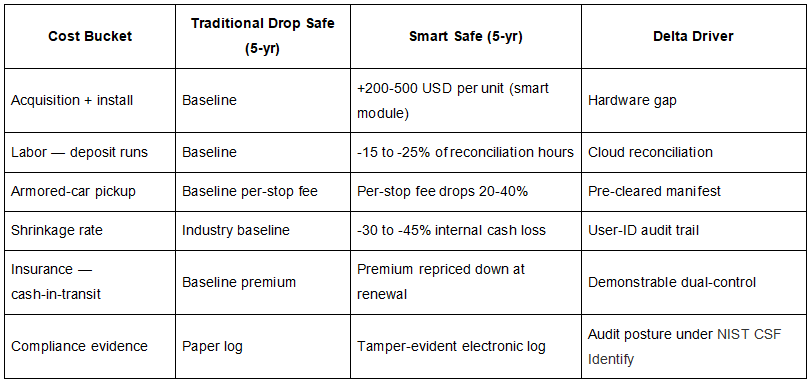
When we run the four-bucket model on a 100-store QSR chain processing 8,000 USD per store per week, the smart safe premium is recovered inside 14-18 months in the conservative scenario and inside 10-12 months when the insurer cooperates with a cash-in-transit reprice. Above 12,000 USD per store per week, the math tilts toward smart safe in every scenario we have modeled.
Where Traditional Drop Safes Still Beat Smart Safes
The smart safe vs drop safe comparison is not a rout. There are four procurement scenarios where we still recommend the heavy-duty traditional drop safe, and our B2B procurement guide walks through each one with the deployment profile that triggers it.
Low-volume single-operator environments
A single-operator convenience store doing 2,500 USD in cash per week does not generate enough labor or armored-car savings to amortize a smart safe premium. The DF-2014-MA in the commercial safe family covers the threat model at a third of the unit cost and operates without network connectivity.
No-network or low-connectivity sites
Pop-up retail, festival and event cash rooms, remote construction site offices, and field cash points frequently lack reliable power and network. A traditional mechanical or keypad drop safe with a paper log survives those environments without a connectivity contingency, and our procurement guide recommends defaulting to the keypad-only or mechanical-lock configuration whenever the deployment site cannot guarantee 99% uptime on the network.
Capex-restricted buyers
Some procurement programs run on a strict capex ceiling that cannot absorb the smart safe premium even when the four-bucket TCO is favorable. In those cases we recommend the heavy-duty drop safe with the same physical chassis as the smart safe — the DF4020DA keypad-only configuration is our most common pick — and a planned upgrade cycle when the capex ceiling loosens. A safe chassis purchased today will accept a smart module tomorrow on most Tier-1 commercial product lines.
Greenfield chains that need operational maturity before adding technology
A brand-new chain that has not yet standardized its deposit runbook, dual-control policy, or exception investigation process will not extract the full value of a smart safe on day one. We recommend deploying the heavy-duty drop safe first, codifying the cash-handling runbook, then layering the smart module on top once the operational baseline is stable. The smart safe is a leverage tool, not a substitute for an operating discipline.
Our procurement team has watched four greenfield chains make the same mistake in three different retail verticals, and the recovery path always starts with the runbook and ends with the smart safe. Buyers who skip the runbook step pay for the smart safe premium twice: once at deployment and once in the exception investigation labor that the runbook would have prevented.
Procurement Field Test: How to Audit a Quote Before Signing
The procurement quote sheet for a safe program looks deceptively similar across vendors, and the differences between a defensible quote and a hidden-cost quote hide in the line items we walk through below. Our B2B procurement team applies these six audit questions before signing a safe PO, and we recommend buyers apply the same checklist regardless of which brand is on the quote.
1.What is the deposit-log buffer capacity? A smart safe that loses its deposit log when the network drops is a single point of failure. Confirm the buffer in number of deposit events, not in days.
2.What certifications does the chassis carry?Tier-1 Commercial Safes carryNFPA reference compliance on the manufacturing process and UL listings on the electrical module. The fire rating matters only if the safe is also being specified for fire-rated document protection; otherwise it is not on the critical path for cash handling.
3.What is the warranty on the electronic module vs the steel chassis? Steel warranties routinely run 5-10 years; electronic module warranties routinely run 1-3 years. Confirm both numbers and confirm whether the warranty covers firmware updates or only hardware replacement.
4.What is the per-event API cost, if any? Some smart-safe vendors meter the cloud dashboard per deposit event. Confirm whether the cloud dashboard is included in the unit price, included in a subscription, or metered.
5.Does the safe accept the armored-car manifest format? Major carriers including Brink's operate against standardized deposit-manifest APIs. Confirm the safe vendor's manifest compatibility before signing the PO, because retrofitting the manifest format post-deployment is the most expensive line item we see in our procurement casework.
6.What is the factory acceptance test procedure? A vendor that will not demo offline mode, dual-control PIN rotation, and deposit-log export during the FAT is a vendor that will not support those features post-deployment.
The audit questions map to a different decision than the unit price would suggest. Buyers who anchor on unit price and skip the audit questions overpay on the four-bucket TCO more often than buyers who anchor on the audit questions and accept a higher unit price.
Implementation Risk: Network, Audit-Trail, and Compliance Pitfalls
The smart safe vs drop safe comparison flips when buyers fail to plan for the implementation risk envelope. The four pitfalls below are the ones we see most often in our procurement casework, and each one is avoidable with a written runbook and a factory acceptance test that covers the failure mode.
Network and power dependency
A network-connected smart safe is a small piece of networked infrastructure, and it inherits the failure modes of the network it sits on. Power outages, ISP outages, firewall misconfiguration, and cellular dead zones all translate into offline-mode operating windows. The safe must operate as a fully functional drop safe in offline mode, buffer the deposits in non-volatile memory, and sync the buffered log to the cloud once connectivity returns. We require vendors to demonstrate offline mode for at least 72 hours during the FAT on our sites.
Audit-trail integrity
An audit log that can be modified by anyone with the master PIN is not an audit log. Confirm that the log is sealed (cryptographically signed or write-once), that the master PIN cannot delete entries, and that log export produces a tamper-evident artifact. The audit posture under the NIST CSF Protect function requires demonstrable integrity of the audit trail, not just the existence of one.
Compliance posture
PCI-DSS focuses on cardholder data, not on cash deposits, but SOC 2 and ISO 27001 audits do reach into the cash-handling chain when the retailer is a service organization that handles cash on behalf of a client. Confirm with the auditor which control frameworks reach the cash room, and match the safe class to the strictest control framework on the list.
Change management
Smart safe firmware is software, and software needs an update channel. Confirm that firmware updates are signed, that the vendor has a written vulnerability disclosure process, and that the update channel does not require opening a VPN tunnel from the store to the vendor's data center on every push. The cyber-physical security posture of a smart safe is only as strong as the firmware update process.
Risk note: the audit-trail integrity question is the one procurement teams most often skip, and it is the one that surfaces during the SOC 2 audit rather than during safe deployment. We recommend buyers resolve it during the FAT, not during the first audit cycle.
Once buyers have walked through the four implementation risks above and codified mitigations in the procurement contract, the conversation turns to the deployment profile and the decision matrix below. Our team has seen chains that ran into trouble on day one because they treated the smart safe as a plug-and-play appliance, and chains that ran smoothly for the entire five-year window because they wrote a deployment runbook before the safe showed up on the loading dock.
Decision Matrix: Which Safe Wins for Your Cash-Handling Volume
The decision matrix below maps the deployment profile to the recommended safe class. It is not a substitute for a site-specific process audit, but it gives the procurement team a defensible starting point before the vendor conversations begin.
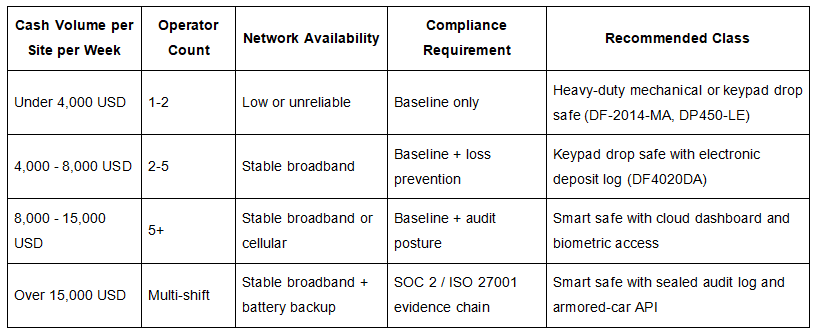
The decision matrix points buyers toward the heavy-duty drop safe in low-volume, single-operator environments and toward the network-connected smart safe as cash volume and operator count scale up. The break-even is not a single number because it depends on labor cost in the operating geography, the per-stop armored-car fee, and the insurance posture of the retailer. Our procurement team runs the four-bucket TCO model on every quote so the break-even is a number on a worksheet rather than a rule of thumb.
Buyers who want to start the conversation can review the commercial safe family, the DF4020DA digital keypad drop safe with master code, and the broader B2B procurement guidefor smart safe selection criteria. The full Tigerking product range, including Fireproof Safes, hotel safes, and concealed wall safes, lives on theTIGERKING Safe catalog for buyers who want to consolidate the cash-handling fleet under a single vendor.
Frequently Asked Questions
What is the average payback period for a smart safe in a mid-volume retail chain?
For a 100-store chain processing roughly 8,000 USD in cash deposits per store per week, our procurement case studies show a payback period between 14 and 22 months. The largest contributors are labor hours saved on end-of-shift deposit runs, armored-car fee reductions, and shrinkage drops after audit trails go live. A site-specific process audit pinpoints which lever delivers the largest share of the savings, giving our buyers a defensible number for the CFO rather than a generic vendor estimate.
Do smart safes actually reduce employee theft, or do they just shift the loss point?
Smart safes change the loss point constructively: cash goes from the register to a sealed depository drawer that only opens under dual-control PIN. Each deposit is logged with a user ID, time, and amount, and a network-connected unit pushes the log to a cloud dashboard. Internal shrinkage surveys show that when the chain is shortened and every deposit is auditable, the opportunity for opportunistic skimming collapses. The safe does not eliminate collusion by itself, but it removes the lone-walker pattern and shifts collusion from a single-point vulnerability to a multi-party vulnerability that our retailers find harder to sustain.
Can a traditional drop safe still meet PCI-DSS cash-handling requirements?
PCI-DSS focuses on card data, not on physical cash deposits, so a drop safe on its own does not fail PCI compliance. The drop safe begins to limit compliance posture when the retailer is also pursuing SOC 2 or ISO 27001 audits and when the insurer requires demonstrable cash-room controls. A traditional drop safe with a paper deposit log covers the baseline; a smart safe with tamper-alert logs covers the demonstrable-evidence standard. We recommend matching the safe class to the strictest control framework the retailer must satisfy, not the loosest, and we help our buyers map the safe class to the audit envelope during procurement rather than after the first audit cycle.
How much does a smart safe cost compared to a heavy-duty traditional drop safe?
In the 2025-2026 procurement surveys we have seen, a heavy-duty commercial drop safe in the DF-2014-MA or DF4020DA class lands in the 400-900 USD FOB Ningbo range, while a network-connected smart safe with biometric access and cloud dashboards lands in the 1,400-3,200 USD range. The price gap is real but has narrowed each year as biometric modules and cellular modems have become commodity components. We always recommend that our buyers quote both classes side by side and divide the price gap by the monthly labor and armored-car savings to get a defensible payback number, because the unit price on a price list is the smallest line in the four-bucket TCO model that we run on every quote.
What happens to a smart safe during a network or power outage?
A properly designed smart safe operates as a fully functional drop safe when the network and power are down. The locking bolts, drop slot, and audit log continue to function on internal battery, and deposits are buffered in non-volatile memory until the network returns. Once connectivity is restored, the buffered logs sync to the cloud dashboard automatically. We recommend that our buyers ask vendors to demonstrate offline mode during the factory acceptance test, and to confirm the buffer capacity in number of deposit events rather than in days, because a 24-hour buffer is meaningless if our high-volume site generates 800 deposits per day.
Are smart safes compatible with armored-car pickup workflows like Brink's or Loomis?
Yes. Major armored carriers operate against the same deposit-log APIs that smart safes expose, so a courier pickup at a smart safe generates the same dual-control chain that a traditional safe does, plus an electronic manifest. In practice, this shortens the on-site pickup window and reduces the per-stop fee the carrier charges. We always recommend that our buyers loop their carrier into the procurement conversation early, because carrier-side software lead times occasionally dictate deployment order and we have seen chains deploy the safe first only to wait four months for the carrier integration to go live.
James Chen
Senior Security Industry Analyst & SEO Content Strategist
James Chen has covered the security equipment manufacturing and global trade sector for over 10 years. His work has been cited in Security Products Magazine and multiple industry procurement guides. He specializes in B2B sourcing strategy, OEM/ODM evaluation frameworks, and market intelligence for physical security products.
Facebook LinkedIn YouTube X