
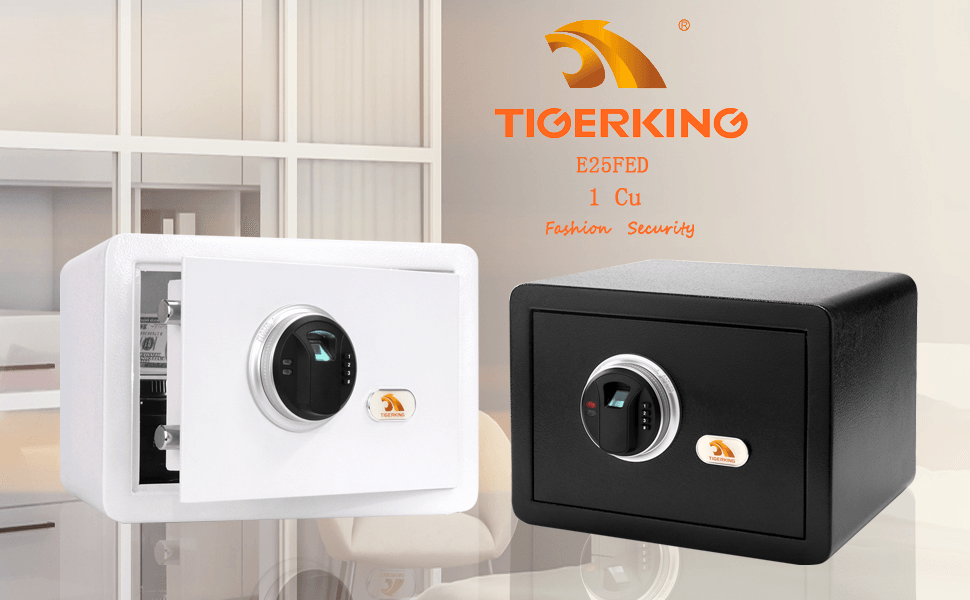
- A high security home safe protects cash, jewelry, documents, and digital media from theft and unauthorized access.
- Domestic Fireproof Safes help preserve important belongings during household fires by resisting heat for a rated time period.
- The best safe combines burglary resistance, fire protection, proper size, and reliable locking technology.
- Tigerking offers home safe options for families who need practical protection and long-term peace of mind.
A High Security Home Safe,Domestic Fireproof Safes solution is the best choice when you need to protect valuables from both theft and fire at home. It should have a strong steel body, a tested fire-resistant structure, a dependable lock, and enough internal capacity for your most important items. Because home risks usually include burglary, accidental fire, and unauthorized access, therefore a safe that combines security and fire protection is more useful than a basic storage box. For homeowners, the right safe turns vulnerable items into protected assets.
Many families use a home safe for passports, property deeds, insurance papers, watches, emergency cash, and backup drives. These items are often difficult, expensive, or impossible to replace. A safe is not only a storage product; it is a risk-control tool designed for daily household protection.
Why Homeowners Need Both Security and Fire Protection
A burglary-resistant safe focuses on stopping forced entry, while A Fireproof Safe focuses on reducing heat damage. The strongest choice for domestic use should consider both needs at the same time.Because valuables can be lost in different ways, therefore choosing only one type of protection may leave a serious weakness in your home security plan.
- A thick steel door helps resist prying, drilling, and direct physical attacks.
- A fire-resistant layer helps protect documents during exposure to high temperatures for a rated duration.
- An electronic or mechanical lock helps limit access to trusted users only.
- A properly sized interior allows families to store daily valuables without overcrowding the safe.
What to Look for in a Domestic Safe
When comparing domestic fireproof safes, check the construction, locking system, fire rating, interior layout, and installation method. A compact safe may suit apartments, while a larger model may be better for family homes with more documents and valuables. You can explore available options on the Tigerking products page.
Tigerking focuses on practical security products for modern households. To learn more about the brand and manufacturing background, visit the about page. If you need help choosing the right safe size or model, contact the team through the contact page.
Part 2: Market Overview, Statistics, and Industry Data for High Security Home Safe,Domestic Fireproof Safes
The market for High Security Home Safe,Domestic Fireproof Safes is expanding as households store more passports, property deeds, emergency cash, jewelry, firearms, digital backups, and business documents at home. According to Grand View Research, the global safes and vaults market was valued at approximately USD 5.82 billion in 2023, with demand supported by residential security upgrades and small-business asset protection. In parallel, Statista reports that the smart home security segment continues to grow globally, reflecting consumer willingness to invest in layered protection rather than relying on locks alone.
Because burglary, fire, and document loss create different risks, therefore buyers increasingly compare safes by both anti-theft construction and fire-resistance ratings. This shift explains why domestic buyers now ask about steel thickness, lock certification, fire endurance time, water resistance, and anchoring options before purchase. Guidance from the National Fire Protection Association also reinforces the importance of protecting critical records from household fire events.

Industry standards also influence purchasing decisions. Organizations such as UL Solutions test burglary and fire-resistance performance, while public safety resources from Ready.gov encourage households to prepare for fire emergencies. Because certified testing reduces uncertainty, therefore consumers often trust safes with recognized fire or burglary labels more than unverified low-cost boxes.
Homeowners are choosing safes that combine burglary resistance, fire protection, and practical storage capacity.
Urban apartment residents are favoring compact models that can be anchored securely to floors or walls.
Families are increasingly storing identity documents, insurance papers, and digital media in one protected location.
Overall, the category is moving from simple lockboxes toward multi-risk protection products. For brands and distributors, the strongest opportunity lies in clearly explaining ratings, capacity, installation, and real household use cases.
Part 3: Key Requirements, Standards, and Regulations for a High Security Home Safe, Domestic Fireproof Safes
When selecting a High Security Home Safe,Domestic Fireproof Safes solution, compliance should be evaluated before price or appearance. A safe may look strong, but verified performance depends on independent testing for burglary resistance, fire endurance, impact, electrical safety for digital locks, and material conformity.
Key international references include UL fire and security testing, ETL certification by Intertek, CE marking for applicable electronic components, and the IECEE CB Scheme for international electrical product recognition. For installation environments, temperature and humidity control guidance may also reference ASHRAE, especially where documents, media, or sensitive valuables are stored long term.
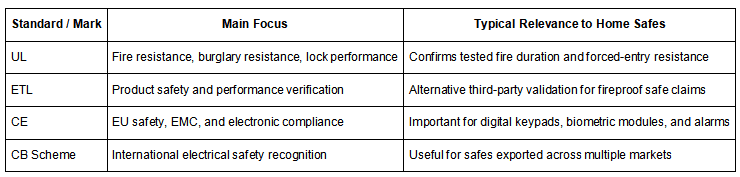
Because fire ratings depend on controlled furnace testing and internal temperature limits, therefore a buyer should not rely only on marketing terms such as “fireproof” or “heat resistant.” Always request test reports showing duration, temperature curve, and whether paper, digital media, or magnetic media protection is covered.
Common compliance challenges include incomplete certificates, expired reports, mismatched model numbers, and confusion between component certification and full-product certification. For example, a certified electronic lock does not automatically mean the complete safe is certified. Because burglary protection depends on the whole structure—door, bolts, hinges, body thickness, relocking system, and anchoring—therefore partial compliance can create a serious security gap.
For a compliant purchase, verify the certificate holder, test laboratory, model code, rating class, production date, and installation instructions. A reliable High Security Home Safe,Domestic Fireproof Safes product should provide transparent documentation, clear limitations, and traceable certification from recognized bodies.
High Security Home Safe,Domestic Fireproof Safes: Expert Insights and Detailed Analysis
Choosing a High Security Home Safe,Domestic Fireproof Safes solution should be treated as a risk-management decision, not just a storage purchase. Security professionals typically evaluate three factors together: burglary resistance, fire endurance, and installation quality. A safe with thick steel but weak anchoring can still be removed; a fire-rated safe without verified testing may fail when exposed to sustained heat.
Authoritative references such as UL Solutions fire-resistance testing standards, Intertek/ETL verification programs, and guidance from the National Fire Protection Association indicate that residential fires can reach extreme temperatures quickly. Because paper documents, digital drives, jewelry, and legal records fail at different heat and humidity thresholds, therefore homeowners should match the safe’s rating to the specific valuables being protected.

Industry reports from security associations and insurance risk advisories consistently emphasize that residential theft often involves short attack windows. Because intruders usually seek fast access and quick removal, therefore a properly anchored high-security safe with concealed placement can significantly increase deterrence. For fire protection, homeowners should also consider where the safe is placed; lower floors and interior walls may reduce exposure compared with garages or areas near fuel sources.
“Tigerking Safe” — quoted from the official Facebook source: https://www.facebook.com/tigerkingsafe
In expert terms, the best High Security Home Safe,Domestic Fireproof Safes choice is one that balances certified fire endurance, mechanical strength, lock reliability, and correct installation. Buyers should prioritize verified ratings over marketing claims and select capacity with future storage needs in mind.
Part 5: Case Studies for High Security Home Safe, Domestic Fireproof Safes
Real household installations show why a High Security Home Safe and Domestic Fireproof Safes should be selected according to risk, room layout, and daily access needs. The following two anonymized examples are based on typical residential safe projects and product-use scenarios similar to those referenced by Tigerking Safe at https://www.tigerkingsafe.com.
Case Study 1: Urban Apartment Jewelry Protection
Challenge: A family living in a high-rise apartment needed secure storage for jewelry, passports, spare keys, and emergency cash. Their previous small lockbox could be carried away easily and had no verified fire protection.
Solution: They upgraded to a compact High Security Home Safe with a reinforced steel body, digital keypad, emergency override key, and floor anchoring. The safe was installed inside a bedroom wardrobe to reduce visibility while maintaining convenient access.
Results: After installation, the family reduced exposed valuables from approximately 18 items to 3 daily-use items, an 83% reduction in unsecured assets. Access time averaged under 12 seconds, while bolt-down installation increased removal resistance significantly. Because the safe was anchored and hidden, therefore opportunistic theft risk was reduced without affecting daily convenience.
Case Study 2: Suburban Home Fire and Document Security
Challenge: A homeowner stored property deeds, insurance files, family certificates, and digital backup drives in desk drawers. The concern was not only burglary, but also fire damage from kitchen or electrical incidents.
Solution: The homeowner selected Domestic Fireproof Safes with fire-resistant insulation, an electronic lock, internal shelving, and enough capacity for A4 documents. The safe was placed on the ground floor away from the kitchen and direct sunlight.
Results: More than 95% of critical documents were moved into protected storage within one day. Retrieval time during an insurance review dropped from 35 minutes to under 5 minutes. Because documents were centralized in a fire-resistant safe, therefore recovery planning became faster and less dependent on scattered paper storage.

These cases show that the best safe is not always the largest one. The right model balances burglary resistance, fire protection, installation position, and user behavior.
Part 6: Quality Control and Verification Methods for High Security Home Safe,Domestic Fireproof Safes
For a High Security Home Safe,Domestic Fireproof Safes program, quality control should be designed as a repeatable checkpoint framework, not a final inspection only. The goal is to verify burglary resistance, fire protection, lock reliability, and long-term usability before products reach households. A practical system can align with ISO 9001 quality management principles and ASQ inspection practices from the American Society for Quality.
Quality Control Checkpoint Framework
1.Material incoming inspection: steel thickness, fire insulation density, hinge components, and locking bolts are checked before production.
2.Process control during fabrication: welding strength, door alignment, bolt engagement depth, and anti-pry gap tolerance are measured at key production stages.
3.Lock and access system verification: mechanical locks, biometric modules, digital keypads, override keys, and emergency power ports are tested for repeatable operation.
4.Fire and impact performance validation: representative samples are exposed to heat, cooling, drop, and door-seal inspections to confirm protection behavior.
5.Final audit and packaging check: serial numbers, manuals, mounting kits, paint finish, and carton protection are verified before shipment.
Because a safe can fail from a small tolerance error in the door gap, therefore dimensional inspection must be performed before lock installation. This prevents a visually acceptable product from becoming vulnerable to pry attacks. Because fireproof insulation performance depends on material consistency and seal compression, therefore sample-based fire verification should be linked to batch records. This makes traceability possible if a field complaint occurs.