Every year, thousands of retailers, hotel chains, and security equipment distributors face the same critical question: how do you find a safe manufacturer that delivers consistent quality, competitive pricing, and reliable supply chain support?
With the global security safe market projected to exceed USD 18 billion by 2030, choosing the right safe manufacturer has never been more important — or more complex. This guide breaks down exactly what B2B buyers need to evaluate when sourcing safes from overseas partners, covering everything from certification requirements to production capacity and logistics.
Why Does the Right Safe Manufacturer Matter for Your Brand?
Your brand reputation rests on the products you sell. For distributors of home security safes, gun cabinets, hotel locking systems, and commercial deposit safes, product failure doesn't just mean a returned item — it means a customer who lost trust in your brand entirely.
A 2024 survey by Security Industry Association (SIA) found that 72% of B2B safe buyers ranked product reliability and manufacturer credentials above price when selecting a long-term supplier. The cheapest option rarely wins in the second or third year of a partnership.
Behind every successful private-label safe brand is a manufacturing partner with deep expertise, rigorous quality control, and a proven track record in global exports. Let's examine the framework for evaluating potential partners.
What Certifications Should a Qualified Safe Manufacturer Hold?
International certifications are the single most reliable shortcut to evaluating a manufacturer's quality systems. Here are the certifications that matter in the safe industry:
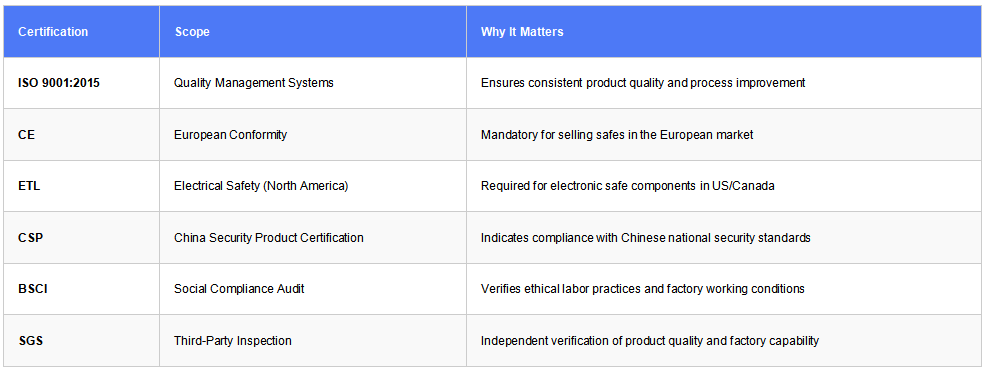
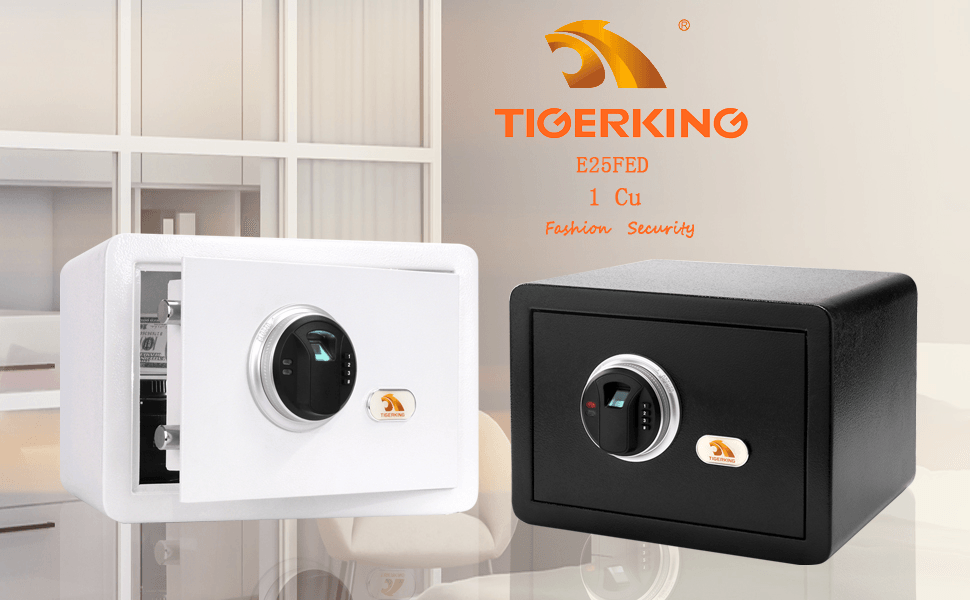
For example, Tigerking Safe — a leading safe manufacturer in Ningbo, China — holds all six of these certifications, along with 6S and lean production system accreditation. This gives their global partners a baseline of trust before a single unit is shipped.
How Do You Evaluate a Safe Manufacturer's Production Capability?
Beyond certifications, a factory visit (physical or virtual) should answer these five operational questions:
1.Annual production capacity — Can they scale from pilot runs to full container loads without quality degradation?
2.R&D & in-house tooling — Do they design their own molds, or outsource tooling to third parties?
3.Raw material sourcing — What gauge steel do they use? Is the material traceable back to mills?
4.Quality checkpoints — How many QC inspections happen between raw material and finished crate?
5.Lead time track record — What is their on-time delivery percentage over the past 12 months?
Production Case: How a Tier-1 Safe Manufacturer Operates
Established manufacturers like Tigerking Safe operate across a 10,000 m² facility with over 100 employees and 10+ international patents. Their process integrates press forming, laser welding, electrostatic painting, electronic assembly, and final quality testing under one roof — eliminating the variability of multi-vendor supply chains.
What Types of Safes Can a Full-Range Manufacturer Offer?
B2B buyers often start with one product category and expand over time. Working with a manufacturer that produces a complete portfolio saves the cost and complexity of managing multiple suppliers. Here are the main categories offered by top-tier safe manufacturers:
1. Home Security Safes
The backbone of any safe lineup. These include fireproof safes with fire resistance ratings (typically 20–60 minutes at 1200°F), digital keypad models, and biometric fingerprint variants. The growing trend toward smart home integration means Bluetooth/WiFi-enabled models are increasingly in demand.
2. Gun Safes & Pistol Safes
North America represents the largest market for gun safes, driven by both regulatory requirements and consumer safety awareness. Quick-access biometric models for handguns and large-capacity rifle safes with dual-locking mechanisms represent opposite ends of this spectrum.
3. Hotel Safes
The hospitality sector is a massive consumer of hotel safes. These require electronic locking systems, key card compatibility, master override features, and silent operation — as well as aesthetic consistency with hotel room design. Over 4 million Hotel Safes are replaced or newly installed globally each year according to the International Hotel & Restaurant Association.
4. Biometric Safes
Fingerprint recognition technology has moved from premium to mainstream in the safe industry. A biometric safe typically offers sub-one-second recognition speed and can store 30–100 unique fingerprints per unit.
5. Commercial Drop Safes
Restaurants, retail stores, and financial institutions use depository drop safes for cash management. These feature anti-fish baffles, time-delay locks, and heavy-gauge steel construction.
What Is the Safe OEM/ODM Process — Step by Step?
For B2B buyers entering a private-label arrangement, understanding the end-to-end process is crucial. Here is how a professional safe manufacturer and exporter typically manages an OEM/ODM project:
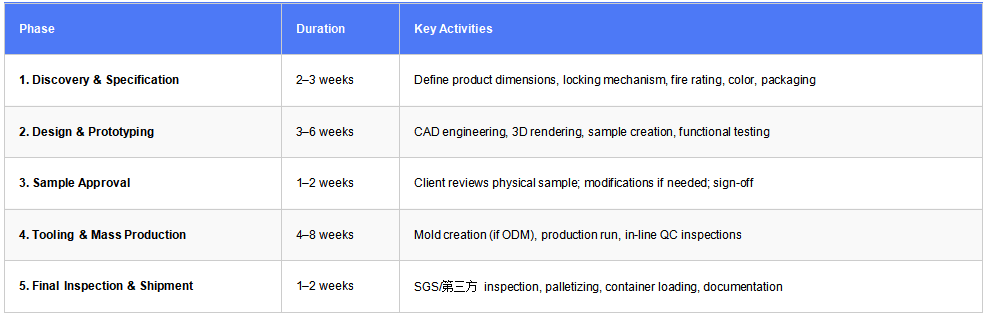
Total timeline: 10 to 18 weeks from initial inquiry to FOB shipment, depending on product complexity and order volume.
Why Are Quality Control Systems Critical in Safe Manufacturing?
In 2023, the Consumer Product Safety Commission (CPSC) issued recall notices for over 230,000 safes sold in the United States due to electronic lock failures and fire seal defects. For B2B distributors, even a single recall can damage years of brand equity built in a market.
That is why established safe manufacturers implement multi-layer quality control:
- Pre-production inspection: Raw steel thickness verification, electronic component testing
- In-line inspection: Welding seam integrity, lock mechanism cycling (5,000+ test cycles)
- Final QC: Fire resistance test, drop test, surge voltage test, packaging durability check
- Pre-shipment inspection: Random sampling (AQL 2.5 standard) by internal or third-party teams
"We switched our safe supplier after three years with a lower-cost factory. The difference in lock failure rate — from 4.2% to 0.3% — paid for our entire R&D budget. If your manufacturer doesn't voluntarily show you their QC reports, that's a red flag."
— Senior Procurement Director, leading North American hardware retail chain (name withheld for confidentiality)
How Do Global Logistics and Compliance Affect Safe Sourcing?
Sourcing safes from overseas involves navigating customs classifications (HS codes 8303.00 for security safes), country-specific fire rating standards (UL 72 in the US, EN 1047 in Europe, GB 10409 in China), and import tariffs that vary by trade agreement.
A knowledgeable manufacturing partner handles these complexities internally. Key logistics questions to ask prospective suppliers:
- Which ports do you ship from? Ningbo and Shanghai ports handle the majority of safe exports from China.
- Can you provide FOB, CIF, or DDP pricing? Flexible incoterms indicate logistics experience.
- What is your average container loading quantity? For a standard 20-foot container, expect 150–300 units depending on safe size.
- Do you handle customs documentation and compliance paperwork? This includes certificate of origin, fumigation certificates, and test reports.
What to Look for in Long-Term Safe Manufacturing Partnerships
The most successful B2B relationships in the safe industry share common traits. Based on interviews with procurement executives at six major security equipment distributors (anonymized), here are the top factors that predict a successful partnership:
✅ Willingness to Customize
Cookie-cutter products rarely win in competitive markets. A manufacturer that offers custom color, interior configuration, lock type selection, and private-label packaging signals a genuine OEM/ODM capability rather than a simple wholesaler.
✅ Transparent Communication
Weekly production updates, real-time order tracking access, and English-speaking account managers are non-negotiable for overseas B2B buyers.
✅ Continuous Innovation
Patents filed in multiple jurisdictions (USPTO, EUIPO, CNIPA) demonstrate a manufacturer's commitment to R&D. For example, Tigerking Safe holds over 10 global patents spanning electronic locking mechanisms, biometric sensor integration, and fire-resistant material compositions.
✅ Market Intelligence Sharing
The best manufacturers proactively share market trend data, competitor product analysis, and regulatory changes with their distribution partners.
Frequently Asked Questions About Safe Manufacturing (FAQ)
What is the minimum order quantity (MOQ) for private label safes?
MOQ varies by safe size and complexity. For compact home safes and pistol boxes, MOQ typically ranges from 500 to 1,000 units. For larger Gun Safes or fireproof models, MOQ may be 200 to 500 units. Some manufacturers offer lower MOQ for first-time partnerships to help new brands validate their market.
How long does it take to develop a custom safe from scratch?
A full ODM project — from concept to first shipment — typically takes 12 to 18 weeks. This includes design, mold creation (4–6 weeks), prototype testing (2–3 weeks), and mass production (4–8 weeks). Pre-existing mold designs can shorten this to 6–8 weeks for OEM (branding-only) projects.
Which safe type has the highest demand in the international market?
Home security safes (including fireproof and digital keypad models) represent the largest category by volume globally. The gun safe segment, however, has the highest growth rate — driven by North American demand where an estimated 5+ million gun safes are sold annually. Hotel safes constitute a steady, high-volume niche with consistent replacement cycles.
Are Chinese safe manufacturers compliant with international quality standards?
Yes — reputable safe manufacturers in China hold ISO 9001, CE, ETL, SGS, and BSCI certifications. Leading factories in Zhejiang and Guangdong provinces have been exporting to North America and Europe for over two decades. The key is conducting due diligence: request certification copies, arrange video factory tours, and order pre-production samples before committing to large volumes.
Can a safe manufacturer integrate smart home features like WiFi or Bluetooth?
Absolutely. Many modern safe manufacturers now offer smart safes with Bluetooth app connectivity, WiFi remote monitoring, voice assistant compatibility (Alexa/Google Home), and real-time tamper alerts. These features are no longer premium add-ons — they are becoming baseline expectations in markets like the EU and North America.
JC James Chen
Senior Security Industry Analyst & SEO Content Strategist
James Chen has covered the security equipment manufacturing and global trade sector for over 10 years. His work has been cited in Security Products Magazine and multiple industry procurement guides. He specializes in B2B sourcing strategy, OEM/ODM evaluation frameworks, and market intelligence for physical security products.