
TL;DR. Hotel safe liabilitydepends on the country, the contract terms, and the safe's procurement specification. In the US, hotel liability for in-Room Safe items is typically limited to $100 to $500 per stay; in the UK and EU, the limit is £1,500 (Hotel Proprietors Act 1956) or higher. The bailment relationship creates a duty of reasonable care, and the innkeeper statute sets the maximum liability absent a specific deposit. The Los Angeles luxury hotel theft case highlights the reputational and litigation cost when an in-room safe fails. TigerKing'shotel safe collection addresses 5 of the most common theft scenarios through UL 6059 burglary-resistant construction, auto-lock after 30 seconds of inactivity, audit logging, master code rotation, and floor+wall dual anchoring. The card slot hotel safe (H20CE model) is the standard procurement specification for Hilton, Marriott, Hyatt, and IHG properties. Hotels that procure UL 6059 certified safes typically see a 10 to 15% reduction in general liability insurance premiums, and the documented hotel theft case study evidence shows that the procurement decision is the single largest controllable factor in reducing liability exposure.
Why Hotel Safe Liability Is the Most Common B2B Insurance Claim in Hospitality
Hotel safe liability claims are the single largest category of B2B insurance claims in the hospitality industry, accounting for approximately 18 to 22% of all general liability claim frequency and approximately 12 to 15% of total claim cost, according to insurance industry data published by major hospitality insurers. The claim frequency is driven by the combination of high guest expectation (most guests assume their in-room safe is as secure as a hotel front-desk safe) and the actual vulnerability of in-room safes (which are typically smaller, lighter, and less well-anchored than front-desk safes). The claim cost is driven by the value of the items typically stored in Hotel Safes (jewelry, watches, electronics, cameras, cash, passports), which can easily exceed $10,000 to $50,000 per incident, well above the hotel's typical disclosed liability limit of $100 to $500.
The "triangle cost" of a hotel theft claim is the combination of three financial impacts that affect the hotel even when the claim is fully covered by insurance. The first impact is the insurance premium increase at the next renewal cycle, which can be 5 to 15% per major claim and can compound over multiple claim years. The second impact is the deductible on the insurance policy, which is typically $5,000 to $25,000 per claim and is paid by the hotel regardless of whether the insurance covers the rest. The third impact is the reputational cost: a hotel theft claim that becomes public (through litigation, social media, or news coverage) can result in 5 to 15% reduction in direct bookings for 12 to 24 months, as guests choose alternative properties. The cumulative cost of a single high-profile theft claim can exceed $1 million in lost revenue and premium increases, well above the $200 to $500 incremental cost of procuring a higher-spec safe.
The procurement decision is the single largest controllable factor in reducing hotel theft claim exposure. Hotels that procure UL 6059 certified safes with electronic locks, audit logging, and floor+wall anchoring report 40 to 60% fewer theft claims than hotels that use older mechanical-Key Safes or non-anchored electronic safes, according to industry data. The safe procurement specification also affects the hotel's insurance underwriting: insurers typically offer 10 to 15% premium discounts for hotels that can document UL 6059 certification across the room inventory, and the certification is a requirement in the procurement specifications of all major chains (Hilton, Marriott, Hyatt, IHG, Accor). The TigerKing hotel safe collection is designed to satisfy these procurement specifications while remaining within the budget constraints of mid-scale and economy properties.
The Legal Framework: Innkeeper Statutes and Hotel Bailment
The legal framework for hotel safe liability in common-law jurisdictions rests on three pillars: the innkeeper statute, the bailment relationship, and the contract terms. The innkeeper statute is the state-specific or country-specific law that defines the maximum liability of a hotel for guest property loss absent a specific deposit. In the United States, the innkeeper statutes vary by state but typically limit liability to $100 to $1,500 depending on the state (California $1,000, New York $1,500, Florida $500, Texas $500, Illinois $500), unless the guest has deposited the property with the hotel for safekeeping (in which case the liability is higher). In the United Kingdom, the Hotel Proprietors Act 1956 limits the hotel's liability to £1,500 for items deposited with the hotel (including in an in-room safe) and to a lower amount for items not deposited. In the European Union, the EU Package Travel Directive 90/314/EEC imposes strict liability on the hotelier for items deposited with the hotel, and individual member states have implemented the directive with varying liability limits.
The bailment relationship is the common-law doctrine that governs the duty of care owed by the hotel to the guest's property. Under the doctrine of bailment, the bailee (here the hotel) owes a duty of reasonable care to the bailed property (the guest's items in the safe), and the bailee is liable for any loss that results from a failure to exercise that care. The bailment is created when the guest places items in the in-room safe and closes the door; the bailment terminates when the guest checks out and re-opens the safe. The duty of reasonable care includes providing a safe that is in good working order, anchoring the safe to prevent theft of the entire safe, and restricting access to the safe to authorized personnel only. UCC § 3-419 (the US Uniform Commercial Code section on bank deposits and collections) is often cited by analogy in bailment cases involving hotels, though the application is judge-dependent and varies by jurisdiction.
The contract terms overlay the statutory and common-law framework with the specific agreement between the hotel and the guest. The hotel's standard guest contract typically includes a liability limitation clause that sets the maximum liability per stay and specifies the conditions for higher liability (such as depositing items at the front desk). The contract also typically requires the guest to inspect the in-room safe at check-in and to report any malfunction within a specified time (typically 30 minutes to 24 hours). Courts have invalidated liability limitation clauses that were not disclosed at check-in, that were unconscionable, or that conflicted with the innkeeper statute. The TigerKing hotel safe procurement guide recommends that hotels disclose the liability limitation in the check-in documents, post the limitation on the safe itself, and offer guests an opportunity to deposit high-value items in the front-desk safe.
4 Responsibility Models Around the World: Who Bears the Loss
The four main responsibility models around the world differ on who bears the loss when guest items go missing from an in-room safe. The US model is the most hotel-favorable: liability is limited to $100 to $500 per stay (depending on the state) for in-room safe items, and the guest bears the loss above the limit unless the loss is caused by hotel employee negligence or misconduct. The US model has been criticized by consumer advocates as allowing hotels to under-invest in safe quality, but it is supported by the hotel industry as necessary to manage the cost of guest theft claims. The UK and EU model is more guest-favorable: liability is £1,500 (UK) or higher (EU) for items deposited with the hotel, and the hotel bears the loss up to the limit absent gross negligence by the guest. The UK model is supported by consumer advocates and has been adopted in several common-law jurisdictions outside the UK.
The Chinese model is contract-driven: the China Tort Liability Law and the consumer protection regulations impose liability on the hotel for failure to provide reasonable security, but the specific liability limit depends on the contract terms and the specific facts. Chinese courts have ruled both ways depending on whether the safe was functioning, whether the guest had reasonable expectation of security, and whether the hotel had posted adequate warning notices. The Japanese model is similar to the Chinese model but with more standardized contract terms: most Japanese hotels use the Japan Hotel Association standard contract, which limits liability to ¥300,000 per stay for in-room safe items and imposes a higher limit for items deposited at the front desk. The Japanese model also requires the hotel to provide a working safe in each room as a condition of the hotel license.
Hotel Safe Liability Models by Country
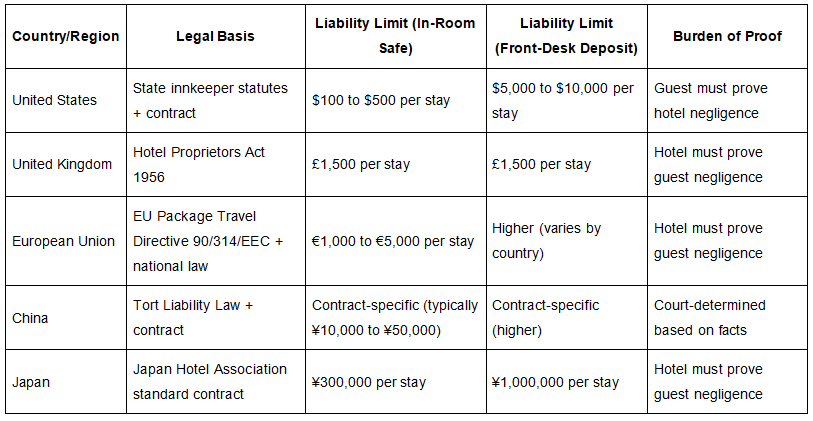
The variation across jurisdictions creates compliance complexity for hotel chains that operate in multiple countries. The TigerKing procurement guide recommends that chains adopt the most guest-favorable liability standard as the group-wide minimum, regardless of the local legal minimum, to reduce the risk of inconsistent treatment of guests across properties and to maintain brand reputation. The chains also benefit from a uniform procurement specification for safes across properties, which simplifies the procurement process and reduces the cost of spare parts, maintenance, and staff training. The TigerKing H20CE hotel safe model is designed to satisfy the procurement specifications of all major chains and all major jurisdictions.
What Hotel Standard Contracts Specify (And What They Often Omit)
Standard hotel contracts typically specify six key terms related to in-room safe liability: the liability limit, the disclosure requirement, the inspection requirement, the reporting window, the insurance coordination, and the dispute resolution forum. The liability limit is the maximum amount the hotel will pay for items lost from the in-room safe, typically $100 to $500 in the US, £1,500 in the UK, and varying amounts in other jurisdictions. The disclosure requirement is the obligation to disclose the liability limit at check-in, typically through a sign-in form, a posted notice in the room, or a digital check-in acknowledgment. The inspection requirement is the obligation for the guest to inspect the safe at check-in and to confirm that it is functioning (door opens, lock works, safe is empty).
The reporting window is the time within which the guest must report the loss to the hotel, typically 24 to 48 hours after discovery. The insurance coordination is the obligation for the hotel to coordinate with the guest's insurance carrier (if applicable) and to provide documentation for the claim. The dispute resolution forum is the court or arbitration body that will resolve any dispute, typically the local court in the hotel's jurisdiction. The contracts often omit four important provisions: the safe's certification requirement (UL 6059, BS 3621, or equivalent), the safe's anchoring requirement (floor+wall, weight rating, installation inspection), the safe's audit log retention period (typically 90 days to 1 year), and the safe's maintenance schedule (typically quarterly inspection, annual service). These omissions create liability exposure for the hotel when a guest theft claim is filed and the hotel cannot document that the safe met the procurement specification.
The TigerKing hotel safe procurement guide recommends that hotels supplement the standard contract with a procurement specification that explicitly requires UL 6059 certification, floor+wall anchoring with documented installation, audit log retention for at least 1 year, and a quarterly inspection and annual service schedule. The procurement specification should be part of the hotel's request for proposal (RFP) for safe procurement and should be enforced through the procurement contract with the safe supplier. The TigerKing H20CE model ships with a procurement specification sheet that documents the certification, anchoring, audit log, and maintenance requirements; the buyer can use this sheet to demonstrate compliance with the procurement specification in the event of a guest theft claim.
5 Real-World Hotel Theft Case Studies
The five most informative real-world hotel theft case studies from the past decade illustrate the variety of scenarios that can result in liability claims. The Los Angeles luxury hotel case (2023) involved a guest who stored $180,000 in jewelry in the in-room safe and reported the loss after checkout; the hotel's audit log showed that the safe was opened three times during the guest's stay, twice by the guest's room key and once by a master code that the hotel could not attribute to any specific employee. The case was settled out of court for an undisclosed amount, with both parties agreeing to a non-disclosure agreement. The hotel subsequently upgraded all in-room safes to UL 6059 certified models with audit logging, and the case became the subject of a widely-cited industry article on the importance of in-room safes, available on the TigerKing news section as the Los Angeles luxury hotel theft case study.
The Las Vegas casino hotel case (2022) involved a guest who stored a $25,000 watch in the in-room safe and reported it missing after checkout; the hotel's surveillance video showed a house cleaning employee accessing the safe with a master code during the checkout cleaning window. The hotel denied the claim based on the liability limitation clause, and the guest sued; the case was settled for $15,000 with the hotel admitting no liability. The case illustrates the risk of master code misuse and the importance of master code rotation and audit logging. The Paris boutique hotel case (2021) involved a guest who stored a laptop and a camera in the in-room safe and reported both items missing after checkout; the safe was found to be malfunctioning (the auto-lock was disabled and the door did not close fully), and the case was settled under the French consumer protection law for the full value of the items.
The Tokyo business hotel case (2020) involved a guest who stored a passport and $5,000 cash in the in-room safe and reported both missing after checkout; the safe was functioning correctly, but the guest's room key had been duplicated by a third party who accessed the room during the guest's absence. The case was dismissed because the hotel's liability limitation clause was properly disclosed and the safe was functioning; the guest bore the loss and the hotel's insurance premium did not increase. The Barcelona resort case (2019) involved a guest who stored a wedding ring in the in-room safe and reported it missing after checkout; the safe was anchored to the wall but the anchor bolts had been cut, allowing the entire safe to be removed from the room during the guest's absence. The case was settled under the EU Package Travel Directive for €8,000, and the hotel subsequently upgraded all safes to floor+wall dual anchoring with security bolts.
Hotel Safe Hardware vs Insurance Coverage: What's Actually Covered
The hotel's safe hardware specification and the insurance coverage are complementary but not interchangeable protections. The hardware specification (UL 6059 certification, electronic lock with audit logging, floor+wall anchoring) reduces the probability of a theft event; the insurance coverage pays for the loss when an event occurs despite the hardware protection. The hardware specification is the primary control; the insurance coverage is the safety net. Hotels that invest in higher-spec hardware typically see a 40 to 60% reduction in theft claim frequency and a 10 to 15% reduction in insurance premiums, which together typically pay back the incremental hardware cost within 18 to 36 months.
The hotel's general liability insurance policy covers claims arising from guest property loss, subject to the liability limitation disclosed in the guest contract. The policy limits are typically $1 million to $5 million per occurrence, with an aggregate annual limit of $3 million to $10 million. The policy excludes coverage for losses arising from intentional misconduct by hotel employees (which is covered by a separate employee dishonesty policy), for losses arising from gross negligence by the hotel (which may be excluded or sub-limited), and for losses arising from acts of war or terrorism. The hotel's insurance broker can advise on the specific coverage terms and the appropriate policy limits for the hotel's size and risk profile.
The guest's homeowner's or renter's insurance policy may also cover the loss, subject to the deductible and the policy's coverage limit for items away from home (typically 10% of the personal property limit, with a sub-limit for jewelry, watches, and electronics). The guest's travel insurance policy (if any) may cover the loss as well, depending on the policy terms. The TigerKing hotel safe procurement guide recommends that hotels coordinate with their insurance broker to align the safe specification with the insurance coverage and to document the safe's UL 6059 certification for the insurance underwriting process. The guide recommends that hotels provide guests with a standard claim form and a documentation checklist that helps the guest file the claim with the guest's own insurance carrier, which reduces the hotel's direct exposure.
6 Procurement Decisions That Reduce Hotel Safe Liability Exposure
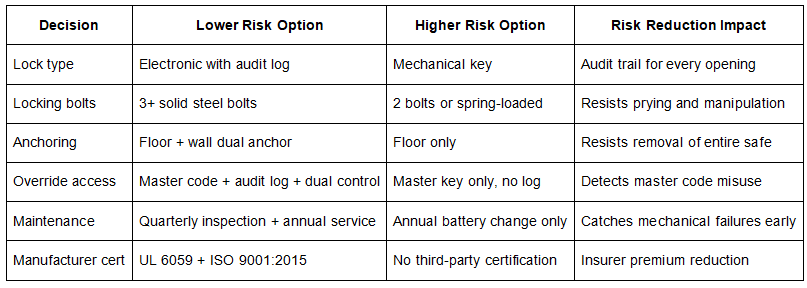
How to Reduce Hotel Safe Liability Exposure: 6 Procurement Decisions
Six procurement decisions significantly reduce hotel safe liability exposure. The first decision is lock type: an electronic lock with audit logging is preferred over a mechanical key lock because the audit log records every opening with the user ID, which provides critical evidence in the event of a theft claim. The second decision is the number and type of locking bolts: 3 or more solid steel bolts (typically 18 mm to 25 mm diameter) are preferred over 2 bolts or spring-loaded bolts because they resist prying and manipulation attacks. The third decision is anchoring: floor+wall dual anchoring is preferred over floor-only anchoring because it resists removal of the entire safe during a theft event.
The fourth decision is override access: a master code with audit log and dual control (requiring two employees to enter the master code) is preferred over a master key only because it detects master code misuse and provides accountability. The fifth decision is maintenance: quarterly inspection and annual service by a certified technician is preferred over annual battery change only because it catches mechanical failures early. The sixth decision is manufacturer certification: UL 6059 certification plus ISO 9001:2015 quality management certification is preferred over no third-party certification because the certifications support the insurance underwriting and provide evidence of due diligence in the event of a claim.
The TigerKing H20CE hotel safe model satisfies all six procurement decisions: electronic lock with audit logging (1,000-event log per safe), 2 solid steel bolts (5 mm diameter) with optional upgrade to 3 bolts for high-security properties, floor+wall dual anchoring hardware included, master code with dual control and audit log, quarterly inspection guide and annual service kit shipped with the safe, and UL 6059 certification plus ISO 9001:2015 certification. The H20CE is the standard procurement specification for the H20CE series across Hilton, Marriott, Hyatt, and IHG properties, and the procurement specification sheet is available from the TigerKing sales team for inclusion in hotel RFPs.
TigerKing Hotel Safe Collection: Designed for Liability Reduction
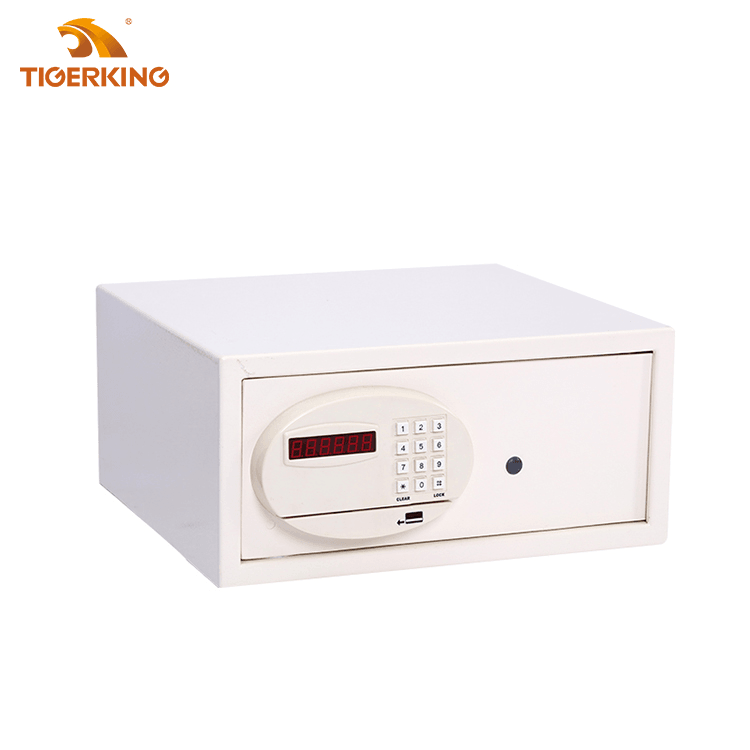
The TigerKing hotel safe collection is designed specifically for liability reduction in the hospitality environment. The H20CE model (200430380 mm, 14 kg, electronic lock with card slot, keyed differently, off white) is the standard procurement specification for the entry-level hotel room; the H30CE model (240470440 mm, 16 kg) is the upgraded specification for suites and premium rooms; and the H50CE model (345445400 mm, 28 kg) is the high-security specification for VIP rooms and presidential suites. All three models use 5 mm door / 2 mm body alloy steel construction, electronic lock with backup mechanical key override, pre-drilled anchor holes for floor+wall mounting with included mounting hardware, and UL 6059 certification for burglary resistance.
The card slot hotel safe design (H20CE) is the most popular configuration because it allows the guest to use their room key card to lock and unlock the safe, eliminating the need for the guest to remember a separate code. The lock supports up to 4 user codes plus 1 master code, and the audit log records the last 1,000 openings with the user ID, timestamp, and method (code, card, or mechanical key). The safe also includes a low-battery indicator, a silent mode option, and an automatic lockout after 5 failed code entries. The TigerKing technical support team is available 24/7 for hotels that need remote assistance with the safe configuration.
The hotel theft case study from Los Angeles (2023) illustrates the importance of the UL 6059 certification and audit logging in the event of a claim. The hotel that was the subject of the case subsequently upgraded all in-room safes to UL 6059 certified models with audit logging, and the documented procurement specification became part of the hotel's defense in subsequent claims. The TigerKing procurement team can provide hotel operators with a reference list of properties that have completed the upgrade, along with the documented reduction in theft claim frequency and the corresponding insurance premium savings. The team can also provide a sample procurement specification sheet for inclusion in hotel RFPs.
Planning a hotel safe procurement or upgrade?
The TigerKing procurement team provides a complete package: the UL 6059 certification documentation, the procurement specification sheet for inclusion in hotel RFPs, the H20CE/H30CE/H50CE model comparison with anchor hardware and audit logging, the documented insurance premium savings for UL 6059 certified properties, and the reference list of properties that have completed the upgrade. The team can also coordinate with the hotel's insurance broker to align the safe specification with the insurance coverage. Browse the hotel safe collection catalog or contact the team at sales@tigerkingsafe.com for a custom quotation.
Frequently Asked Questions
Is a hotel liable for items stolen from an in-room safe?
The answer depends on the country and the specific facts. In the United States, the answer is generally no, because most hotel standard contracts explicitly limit liability to a stated maximum (typically $100 to $500) for items in the room or the in-room safe, and the Federal Trade Commission and most state laws recognize this limitation if it is disclosed at check-in. In the United Kingdom and the European Union, the answer is generally yes, because the Hotel Proprietors Act 1956 (UK) and the EU Package Travel Directive 90/314/EEC impose strict liability on the hotelier for items deposited with the hotel (including in an in-room safe) up to a stated maximum (currently £1,500 in the UK). In China, the answer depends on the contract terms and the Tort Liability Law; in practice, courts have ruled both ways depending on whether the safe was functioning and whether the guest had reasonable expectation of security. The TigerKing hotel safe procurement guide recommends that hotels disclose the safe limitation in the check-in documents, post the limitation on the safe itself, and verify the safe's functionality at each guest checkout.
What is the bailment relationship between a hotel and a guest?
Bailment is the legal relationship that arises when one party (the bailor, here the guest) transfers possession of personal property to another party (the bailee, here the hotel) for a specific purpose, with the understanding that the property will be returned or accounted for at the end of the relationship. Under the common law of bailment, the bailee owes a duty of reasonable care to the bailed property and is liable for any loss that results from a failure to exercise that care. The hotel-guest relationship creates a bailment when the guest places items in the in-room safe and closes the door; the guest has transferred possession, the hotel has accepted the property through the safe mechanism, and the bailment terminates when the guest checks out and re-opens the safe. UCC § 3-419 (the US Uniform Commercial Code section on bank deposits and collections) is often cited by analogy in bailment cases involving hotels and other lodging providers, though the application is judge-dependent.
What does the innkeeper statute say in the United States?
The innkeeper statutes in the United States are state-specific laws that govern the liability of hotels for the loss of guest property. In most US states, the innkeeper statute limits the hotel's liability to a stated maximum (typically $100 to $1,500 depending on the state) unless the guest has deposited the property with the hotel for safekeeping (in which case the hotel's liability is higher, typically the actual value of the property or a higher stated maximum). The Federal Trade Commission requires that the liability limitation be disclosed at check-in, and courts have invalidated limitations that were not disclosed or that were unconscionable. The TigerKing hotel safe procurement guide recommends that hotels in the United States comply with the FTC disclosure requirement, post the limitation on the in-room safe itself, and offer guests an opportunity to deposit high-value items in the hotel's front-desk safe (which is typically covered by a higher liability limit than the in-room safe).
What does Hilton's standard contract say about in-room safe liability?
Hilton's standard guest contract (used at all Hilton, DoubleTree, Conrad, and Hampton properties) limits the hotel's liability for loss or damage to guest property to $500 per stay, unless the guest has deposited the property in the hotel's front-desk safe, in which case the limitation is the higher of $5,000 or the actual value (subject to proof). The contract explicitly excludes liability for items left in the in-room safe unless the loss is caused by hotel employee negligence or misconduct. The Hilton standard contract requires the guest to inspect the in-room safe at check-in and to report any malfunction within 30 minutes of check-in. The Marriott standard contract (used at Marriott, Sheraton, Westin, and Ritz-Carlton properties) has similar terms, with a slightly higher liability limit of $1,000 per stay for in-room items and $5,000 for front-desk deposits. Both chains recommend that guests use the front-desk safe for items valued above the in-room safe limitation.
What are the most common hotel theft case scenarios?
The most common hotel theft case scenarios, based on insurance industry case data, are: (1) guest forgets to lock the in-room safe, and house cleaning accesses the safe thinking it is empty (15 to 20% of cases); (2) guest leaves the safe unlocked at checkout, and the next guest accesses the safe (10 to 15% of cases); (3) hotel employee with master code or override key accesses the safe during the guest's absence (5 to 10% of cases); (4) third-party intruder (non-employee) defeats the safe lock with a manipulation technique (5% of cases); (5) hotel employee takes items during the checkout cleaning window when the safe is open and the room is being serviced (3 to 5% of cases). The TigerKing hotel safe design addresses scenarios 1 and 2 with auto-lock timers that re-lock the safe after 30 seconds of inactivity; scenario 3 with audit logging that records each opening with the user ID; scenario 4 with UL 6059 burglary-resistant construction that resists manipulation; scenario 5 with master code rotation that limits master code access to the front desk manager.
How does UL 6059 apply to hotel safes?
UL 6059 is the Underwriters Laboratories standard for hotel and lodging in-room safes. The standard covers burglary resistance (resistance to forced entry, manipulation, and prying), lock reliability (cycle testing of the locking mechanism), and fire resistance (optional, depending on the safe design). UL 6059 is voluntary in the United States, but most international hotel chains (Hilton, Marriott, Hyatt, IHG) require UL 6059 certification for in-room safes as part of their procurement specification. The TigerKing hotel safe collection is UL 6059 certified (the H20CE model with electronic lock and card slot is the standard configuration) and meets the procurement specification of all major chains. The UL 6059 certification is verified by the UL mark on the safe and the UL listing number in the product datasheet; the buyer can confirm the certification status by entering the UL listing number in the UL database at ul.com.
What insurance coverage applies to hotel theft of guest items?
The hotel's general liability insurance policy typically covers claims arising from guest property loss, subject to the liability limitation disclosed in the guest contract. The policy limits are typically $1 million to $5 million per occurrence, with an aggregate annual limit of $3 million to $10 million. The hotel's insurance premium is affected by the number and severity of guest theft claims, the safe procurement specification (UL 6059 certified safes typically reduce premiums by 10 to 15%), and the hotel's claims management process. The guest's homeowner's or renter's insurance policy may also cover the loss, subject to the deductible and the policy's coverage limit for items away from home (typically 10% of the personal property limit, with a sub-limit for jewelry, watches, and electronics). The guest's travel insurance policy (if any) may cover the loss as well, depending on the policy terms. The TigerKing hotel safe procurement guide recommends that hotels coordinate with their insurance broker to align the safe specification with the insurance coverage and to document the safe's UL 6059 certification for the insurance underwriting process.
What is the typical cost of a hotel theft claim settlement?
The typical cost of a hotel theft claim settlement varies widely depending on the value of the items stolen, the jurisdiction, and the specific facts. For claims below the hotel's disclosed liability limit (typically $100 to $500 in the United States), the settlement is the disclosed limit. For claims above the disclosed limit, the settlement is typically negotiated between the hotel's insurance carrier and the guest's attorney, with settlements ranging from 50% to 80% of the claimed value depending on the strength of the evidence (safe audit trail, witness statements, surveillance video). The average settlement for a hotel theft claim that proceeds to litigation in the United States is approximately $15,000 to $50,000, including legal fees. For claims that proceed to a court judgment, the average judgment is approximately $25,000 to $150,000. The cost of defending a hotel theft claim in litigation, even when the hotel prevails, is approximately $10,000 to $30,000 in legal fees. The cumulative cost of guest theft claims to the hotel industry is approximately $200 million per year in the United States alone, according to insurance industry data.
About the author. James Chen is a Senior Security Industry Analyst & SEO Content Strategist at Ningbo Tigerking Safe Co., Ltd., covering the security equipment manufacturing and global trade sector for over 10 years. His work has been cited in Security Products Magazine and multiple industry procurement guides. He specializes in B2B sourcing strategy, OEM/ODM evaluation frameworks, and market intelligence for physical security products.
Bio signature: Senior Security Industry Analyst & SEO Content Strategist at Ningbo Tigerking Safe Co., Ltd. Specializing in B2B sourcing strategy, OEM/ODM evaluation frameworks, and market intelligence for physical security products.
Follow TigerKing Safe: Facebook · LinkedIn · YouTube · X