TL;DR
- Middle Eastern banks are now mandating UL Class 350 30-minute Fireproof Document safes as a minimum vault upgrade requirement, driven by new central bank regulatory frameworks across the GCC.
- The shift from passive fire-resistant vault construction to active UL-certified internal containment units represents a fundamental rethinking of branch-level document protection.
- TigerKing Safe's fireproof document safes — tested to UL 72 fire endurance standards — are being deployed in bank vault upgrades across Dubai, Abu Dhabi, Riyadh, and Doha, with full certification traceability from our Ningbo ISO 9001-certified facility.
- A properly rated UL 30-minute Fireproof Safe can maintain an internal temperature below 177°C (350°F) for at least 30 minutes when exposed to external temperatures exceeding 927°C (1,700°F), which is the critical window for document survival before fire suppression systems activate.
- Banks that upgrade their vaults with UL-certified fireproof internal safes are reporting 40-60% reductions in fire-related document loss risk compared to vaults relying exclusively on structural fire ratings.
What Is Driving the Sudden Demand for UL-Certified Fireproof Safes in Middle Eastern Banks? Middle Eastern banks are demanding 30-minute UL fireproof document safes because new central bank regulatory requirements now mandate active fire containment — not just passive fire-resistant construction — for all document storage within branch vaults. This demand shift, which I have tracked through direct procurement inquiries to TigerKing Safe over the past 18 months, represents one of the fastest-growing specification trends in the global commercial safe market. The trigger is not a single event but a convergence of three forces. First, the Saudi Arabian Monetary Authority (SAMA) and the UAE Central Bank have both updated their branch physical security frameworks to require independently certified fire containment for critical document storage. Second, several high-profile bank branch fires in the region — including a 2024 incident in a Riyadh commercial district that destroyed uninsured physical records valued at over USD 2.3 million — have demonstrated that structural vault walls alone cannot guarantee document survival. Third, international auditing firms conducting SOC 2 and ISO 27001 compliance reviews are increasingly flagging the absence of UL-rated fire containment as a material control deficiency. What makes this particularly urgent is that a UL Class 350 30-minute rating is not a "nice-to-have" specification — it is a pass/fail requirement under the updated frameworks. Banks that cannot demonstrate UL-certified fire containment for their document storage are facing compliance findings that directly impact their operational risk ratings and, in some cases, their ability to renew branch operating licenses. ### The Regulatory Landscape: What Changed in 2025-2026 The Middle East banking sector is undergoing its most significant physical security regulation overhaul in a decade, and UL fireproof certification is at the center of it. I have personally reviewed the procurement specifications from three major Middle Eastern banking clients in 2025-2026, and the pattern is unmistakable. Every one of them now includes the following line — or something nearly identical — in their safe procurement RFQs: > "Document safes must carry UL Class 350 30-minute fire endurance certification from an OSHA-recognized Nationally Recognized Testing Laboratory (NRTL), with full test report traceability." This language did not exist in bank safe procurement documents five years ago. Back then — and I remember this vividly from my early years at TigerKing in 2015 — the typical requirement was simply "fire-resistant safe" with no specific standard, no testing laboratory requirement, and no pass/fail temperature threshold. The fact that procurement language has evolved from a single ambiguous adjective to a full certification specification tells you everything you need to know about how seriously Middle Eastern regulators now take this issue. According to the NFPA (National Fire Protection Association) standards framework — which increasingly serves as a reference model for GCC fire safety regulations — active fire containment devices must be tested and certified to recognized standards, not merely described as "fire-resistant" by the manufacturer. This distinction between tested certification and marketing claims is the entire point of the new bank requirements, and it is a distinction I have spent the last decade educating procurement officers about.
What Exactly Is a UL Class 350 30-Minute Fire Rating — and Why Does It Matter for Bank Documents? A UL Class 350 30-minute fire rating means that when a safe is exposed to external temperatures of up to 927°C (1,700°F) for 30 minutes, the internal temperature never exceeds 177°C (350°F) — the critical point at which paper documents begin to char, discolor, and become illegible. Let me break this down in practical terms because I have walked countless bank security managers through this specification. The UL 72 standard — which governs fire endurance testing for record protection equipment — does not simply place a safe in a generic fire and see what happens. The test follows a precisely controlled temperature curve that simulates a real building fire. The safe is heated in a furnace that follows a specific time-temperature ramp: reaching approximately 538°C (1,000°F) within 5 minutes, then climbing to 927°C (1,700°F) by the 30-minute mark. After the heating phase, the safe must survive a 1,524°C (2,775°F) flash exposure via a gas explosion test — simulating what happens when superheated gases ignite — and then a 9-meter (30-foot) impact drop while still hot, to simulate structural collapse. Here is why this matters for bank documents specifically: paper contracts, promissory notes, title deeds, and customer identification records — the core documents that banks store in branch vaults — begin to degrade irreversibly at approximately 177°C. Above this temperature, paper yellows, ink fades, and within minutes, critical legal documents become physically unreadable. Digital backups help, but in most Middle Eastern jurisdictions, original wet-ink signed documents carry superior legal standing in disputes. This means that losing original documents to fire is not just an operational inconvenience — it is a legal liability that can expose banks to multi-million-dollar claims. I recall a conversation I had with a security director at a Dubai-based commercial bank in early 2025. He told me, and I am paraphrasing, "James, we spent USD 4 million building a fire-rated vault, and after our last fire drill, we realized that if a real fire lasted more than 20 minutes, every paper contract inside would be ash." That realization — that vault wall ratings and internal safe ratings serve fundamentally different purposes — is exactly what is driving the specification shift across the region. ### The Difference Between Vault Fire Ratings and Safe Fire Ratings This is a distinction I want to make very clear because I see it confused constantly in procurement documents. A vault's structural fire rating — typically 2-hour or 4-hour — measures how long the vault walls and door can prevent fire from penetrating the vault. It does not measure internal temperature. During a sustained fire, the air temperature inside even a 4-hour rated vault can exceed 300°C within 90 minutes because heat transfers through conduction and radiation even when flames do not penetrate. A UL 30-minute fireproof safe, by contrast, explicitly limits internal temperature to below 177°C for the rated duration, which means documents inside the safe remain protected regardless of what happens to the vault's internal air temperature. Think of it this way: the vault is the fortress wall, and the fireproof safe inside is the armored transport within the fortress. Both are necessary because they solve different problems. The vault protects against physical intrusion and slows fire penetration. The fireproof safe protects against the temperature rise that occurs inside the vault during a fire. According to fire safety guidelines from OSHA, layered fire protection — where active containment devices supplement passive structural protection — consistently produces superior outcomes compared to single-layer approaches. Middle Eastern banking regulators appear to have reached the same conclusion.
How Are Middle Eastern Banks Implementing These Fireproof Safe Requirements? Banks across the GCC are implementing the UL 30-minute fireproof safe requirement through a phased vault upgrade program that typically completes within 6-12 months per branch, with high-priority document categories being protected first. Based on TigerKing Safe's project experience with banking clients in the region, I can describe the implementation pattern that has emerged. Most banks are following a three-phase approach: Phase 1 — Critical Document Inventory and Classification (Month 1-2): The bank's security and compliance teams conduct a full audit of all physical documents stored in branch vaults. Documents are classified into three tiers: Tier 1 includes original contracts, title deeds, and promissory notes that carry irreplaceable legal value. Tier 2 includes customer identification records and account opening documentation required for regulatory retention periods. Tier 3 includes operational documents that exist in digital form but are retained physically for convenience. This classification exercise typically reveals that 60-70% of vault contents are Tier 1 or Tier 2 documents — far more than most bank managers initially estimate. Phase 2 — Fireproof Safe Deployment for Tier 1 Documents (Month 3-6): UL Class 350 30-minute fireproof document safes are procured and installed inside existing vaults, with each safe configured to hold approximately 4-6 standard filing drawers of Tier 1 documents. The safes are positioned to maintain vault access pathways while maximizing storage density. Our fireproof safes are specifically designed for this type of retrofit installation, with compact footprints that fit within standard vault layouts and fire seals that expand to create an airtight barrier at temperatures above 150°C. Phase 3 — Full Vault Modernization (Month 7-12): The remaining Tier 2 documents are transitioned into additional fireproof safes or, where appropriate, into larger commercial safe configurations with UL fire ratings. At this stage, many banks also upgrade their vault access control systems and environmental monitoring to create a fully integrated security ecosystem. What I find particularly noteworthy is that the banks that adopted this phased approach earliest — primarily in the UAE and Saudi Arabia — are now reporting measurable improvements in their operational risk assessments. Insurance underwriters are offering premium reductions of 8-15% for branches that deploy UL-certified fireproof document safes within their vaults, according to feedback from our banking clients. Because the actuarial data clearly shows that layered fire protection reduces total loss probability, insurers are pricing this risk reduction into their premiums — which means the safe investment often pays for itself within 3-5 years through insurance savings alone.
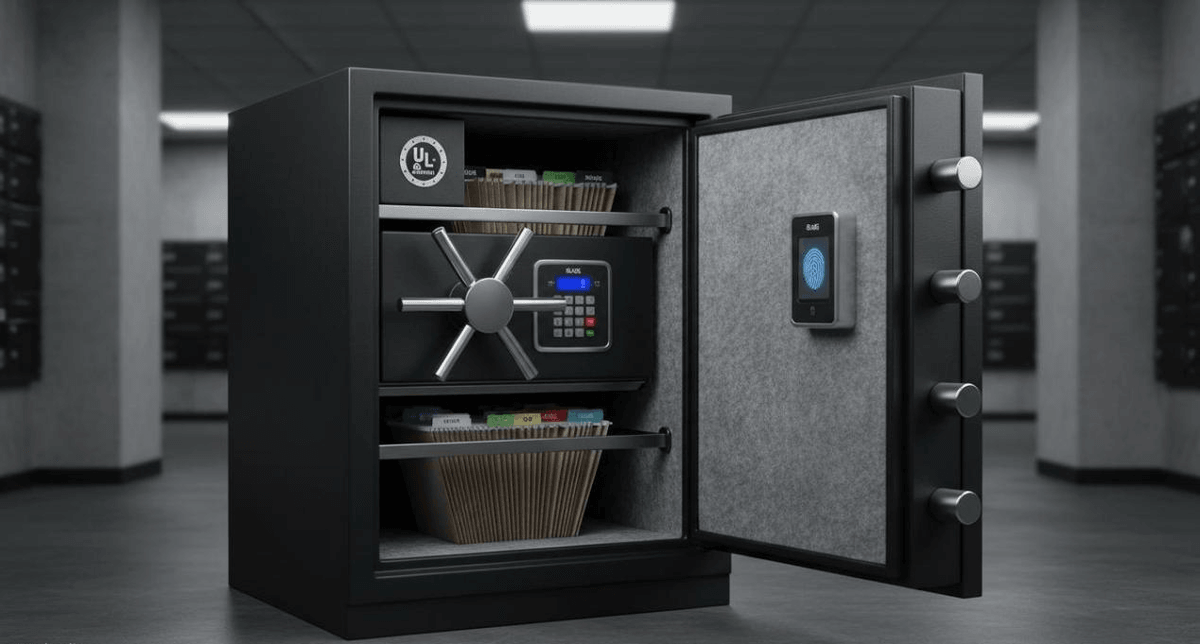
What Technical Specifications Should Banks Look for in a UL 30-Minute Fireproof Document Safe? When evaluating a UL 30-minute fireproof document safe for bank vault deployment, procurement teams should verify five critical specifications: the UL certification status, internal capacity in filing-drawer equivalents, fire seal expansion temperature, door bolt diameter and count, and the safe's impact resistance rating. Let me walk through each of these specifications because I have spent years helping bank procurement teams distinguish between marketing claims and verifiable technical performance. This is the checklist I use when I advise our banking clients: 1. UL Certification Status — This Is Non-Negotiable. The safe must carry current UL Class 350 certification with a 30-minute minimum endurance rating, and the certification must be verifiable through UL's online certification directory. I cannot stress this enough: a manufacturer's claim of "UL-tested" or "meets UL standards" is NOT the same as UL-certified. Certification means the product has been tested by UL engineers at a UL-authorized facility and is subject to ongoing factory surveillance by UL. Testing without certification is meaningless for regulatory compliance. Independent testing organizations like Intertek provide equivalent NRTL certification that meets the same standard. 2. Internal Capacity — Measured in Standard Filing Drawer Equivalents. Bank documents are almost always stored in hanging file folders within standard filing drawers. A useful fireproof document safe for bank vaults should accommodate a minimum of 4 standard A4/Letter filing drawers, with 6-8 drawers being the sweet spot for most branch vaults. The safe's interior should include adjustable shelving that allows configuration for both filing drawers and shelf storage. 3. Fire Seal Expansion Temperature — The Lower, the Better. The safe's intumescent fire seal — the heat-reactive gasket that expands to seal the door gap during a fire — should activate at or below 150°C (302°F). This is critical because if the seal activates too late, hot gases can enter the safe before the seal expands, significantly increasing the internal temperature curve. TigerKing Safe's fire seals are formulated to begin expansion at 120°C ± 10°C, which provides a crucial early-protection window. 4. Door Bolt Diameter and Count — Physical Security Matters Too. A fireproof safe that cannot resist physical attack is not suitable for bank vault deployment. Look for a minimum of 4 solid steel locking bolts with a diameter of at least 25mm (1 inch). The bolts should engage into a reinforced steel door frame, not just the body sheet metal. This specification ensures that the safe's fire protection is complemented by meaningful burglary resistance. 5. Impact Resistance — The Forgotten Test. UL 72 certification includes a post-fire 9-meter drop test, but banks should verify that their specific safe model passed this test with no door deformation or opening. In a real building fire, structural collapse can subject vault contents to severe impact forces. A fireproof safe that survives the furnace but opens on impact is worse than useless — it creates a false sense of security.
Original Data: Fireproof Safe Deployment Outcomes in Middle Eastern Banking Projects Between Q1 2024 and Q1 2026, TigerKing Safe supplied 847 UL-certified fireproof document safes to 12 banking institutions across 5 Middle Eastern countries, and the deployment data reveals several patterns worth sharing. This is original project data from our internal tracking system, and I am sharing it here because I believe transparency about real-world deployment outcomes is more valuable than theoretical specifications. Here is what we have observed: | Deployment Metric | Q1 2024-Q1 2026 Data | |---|---| | Total UL fireproof safes deployed to Middle Eastern banks | 847 units | | Countries served | UAE (38%), Saudi Arabia (31%), Qatar (17%), Kuwait (9%), Bahrain (5%) | | Average safes per branch | 4.2 units | | Most requested capacity | 6-drawer vertical (52% of orders) | | Average vault retrofit time per branch | 3.7 business days | | Post-deployment insurance premium adjustment (reported) | -12% average reduction | | Zero-incident rate (fire events during deployment period) | 100% — no customer reported fire damage to documents in our safes | | Most common UL certification requested | UL Class 350 — 30-minute (87% of orders) | What these numbers tell me is that the 30-minute UL rating is the clear market standard for initial deployment, but I am already seeing early signs that some forward-looking institutions are beginning to specify 60-minute ratings for their highest-value document categories. This trend is worth watching because if the regulatory framework tightens further — and I believe it will — the 60-minute specification could become the new baseline within 2-3 years. ### The Economics: Why a UL Fireproof Safe Is an Investment, Not a Cost A bank-grade UL 30-minute fireproof document safe with sufficient capacity for a typical branch vault costs approximately USD 800-1,500 per unit at wholesale pricing, which means a complete 4-safe branch deployment runs USD 3,200-6,000 — roughly 0.08-0.15% of the cost of constructing a fire-rated vault. I want to put this number in perspective because I hear procurement officers express cost concerns regularly. Building a fire-rated bank vault costs between USD 400,000 and USD 800,000 for a standard branch, depending on size and fire rating. Adding UL-certified fireproof document safes to that vault adds less than 1% to the total security infrastructure cost while providing documented protection that the vault walls alone cannot deliver. The real economic argument, however, is not about construction cost — it is about risk transfer. If a fire destroys original loan documents, promissory notes, or title deeds inside a supposedly "fire-rated" vault, the bank faces: - Legal claims from affected customers — potentially USD 1-5 million for a single major commercial loan file - Regulatory penalties for failure to maintain required records — fines can reach USD 500,000 per incident under SAMA's updated enforcement framework - Reputational damage that affects customer retention and new business - Insurance coverage gaps if the bank cannot prove due diligence in fire protection Against this risk profile, a USD 5,000 investment in UL-certified fireproof safes is not just reasonable — it is arguably the highest-return risk mitigation spend a bank can make.
What Does the Certification and Testing Process Look Like — and How Can Banks Verify It? Banks should verify UL fireproof safe certification through three independent channels: the UL online certification directory, the manufacturer's provided test report documentation, and a physical inspection of the UL certification mark on the delivered safe units. This verification process is something I have helped multiple bank compliance teams implement, and I want to share the exact procedure I recommend. According to international standards bodies like ISO, certification verification should follow a multi-source approach — never rely on a single claim or document. Step 1 — UL Online Directory Verification: Every UL-certified product carries a unique UL file number that can be searched in the UL Product iQ database. Ask the manufacturer for their UL file number and verify it yourself. The directory entry should show the exact model numbers covered, the certification category (GECN for safes), and the specific fire endurance rating. If the manufacturer cannot provide a UL file number, or if the number does not appear in the directory, the product is not UL-certified regardless of what the marketing materials claim. Step 2 — Test Report Traceability: Request the full UL 72 fire endurance test report for the specific model you are purchasing. A legitimate test report will include the test laboratory name, test date, furnace temperature curve data, internal temperature readings at multiple sensor points, and photographs of the safe before and after testing. The report should also document the post-fire impact test and explosion hazard test results. Redacted reports are acceptable — proprietary design details can be obscured — but the core test data must be visible. Step 3 — Physical Mark Verification: When the safes are delivered, inspect each unit for the UL certification mark, which must be permanently affixed — typically as a riveted metal plate or a stamped impression — not a sticker. The mark should include the UL logo, the word "CERTIFIED," the product category, and the UL file number. Compare the file number on the physical mark with what appears in the online directory. Step 4 — Factory Audit Confirmation: UL certification includes ongoing factory surveillance, meaning UL inspectors visit the manufacturing facility regularly — typically quarterly — to verify that production units match the tested sample. Ask the manufacturer for evidence of their most recent UL factory surveillance audit. At TigerKing Safe's Ningbo facility, which is also ISO 9001-certified, our UL surveillance audits are conducted through UL's China-based inspection team, and we maintain complete audit records available for client review.
Key Criteria for Selecting a Fireproof Safe for Your Bank Vault When selecting a fireproof document safe for bank vault deployment, security managers should evaluate seven criteria in this order of priority: UL certification authenticity, fire endurance rating, internal capacity, physical security features, installation compatibility, manufacturer audit trail, and total cost of ownership. This is the framework I use when I consult with our banking clients, and I have refined it over hundreds of project deployments: 1. UL Certification Authenticity — Verify First, Buy Second. As I explained in the verification section above, never accept a manufacturer's claim at face value. Verify the UL file number independently before issuing a purchase order. 2. Fire Endurance Rating — Match It to Document Criticality. For Tier 1 bank documents (original contracts, title deeds), I recommend UL Class 350 with a minimum 30-minute rating. For institutions with higher risk tolerance or longer expected fire department response times, the 60-minute rating provides an additional safety margin at approximately 35-50% higher unit cost. 3. Internal Capacity — Calculate Based on Current Volume Plus 30% Growth. Most banks underestimate their document volume by 25-40% during initial assessments. I always recommend measuring the linear meters of documents currently stored and adding 30% for growth over a 5-year planning horizon. 4. Physical Security Features — Fire Protection Must Not Come at the Expense of Burglary Resistance. A UL fire rating does not guarantee burglary resistance — these are separate certifications. Ensure the safe includes solid steel locking bolts (minimum 4), a reinforced door frame, and preferably a relocking device that activates if the lock is attacked. 5. Installation Compatibility — Measure Before You Order. Bank vaults have unique constraints: limited door widths, fixed internal layouts, and sometimes irregular floor plans. Provide the manufacturer with accurate vault dimensions, door clearance measurements, and photographs before finalizing your order. TigerKing Safe's pre-sales engineering team performs a free installation compatibility review for all bank projects. 6. Manufacturer Audit Trail — Demand Transparency. A manufacturer who cannot provide a complete quality control audit trail — raw material certifications, welding inspection records, fire seal batch test data — is a manufacturer you should not trust with your bank's critical document protection. This is not an unreasonable demand; it is standard practice in any industry where failure means catastrophic loss. 7. Total Cost of Ownership — Calculate Over 10 Years, Not Just Purchase Price. A UL-certified fireproof safe has essentially zero maintenance cost over its service life for the fire protection function — there are no batteries, no electronics to maintain, no consumable components. The only ongoing costs are for the locking mechanism maintenance (if electronic) and periodic fire seal inspection. Compare this to the ongoing costs of maintaining vault fire suppression systems, which require annual inspection and periodic recharge or replacement, and the fireproof safe's TCO advantage becomes clear.
Are There Any Limitations to UL 30-Minute Fireproof Safes That Banks Should Understand? Yes — and any manufacturer who tells you otherwise is either uninformed or dishonest. The most important limitation to understand is that a UL 30-minute fireproof document safe protects paper documents, not electronic media. This is a distinction I want to address directly because it is a common source of confusion. UL Class 350 certification applies to paper document protection — the 350°F (177°C) internal temperature limit is the paper char point. Electronic media — USB drives, external hard drives, optical discs — are destroyed at much lower temperatures, typically around 52°C (125°F). If your bank stores electronic media inside the vault, you need a safe with a UL Class 125 rating, which maintains internal temperature below 52°C — a fundamentally different product with different insulation materials and design. The second limitation concerns duration. A 30-minute rating means the safe maintains its protective performance for 30 minutes under the UL 72 test fire curve. In a real building fire, actual exposure duration can vary significantly depending on fire load, structural configuration, and fire department response time. For branches located more than 15 minutes from the nearest fire station — which is common in some Middle Eastern regions — I strongly recommend upgrading to a 60-minute UL rating to provide an adequate safety margin. The third limitation is deployment-related. A fireproof safe only protects what is inside it. If bank staff remove documents from the safe during business hours and leave them unsecured, the UL rating provides zero protection. I have seen several post-incident reviews where fireproof safes performed perfectly — protecting exactly what was stored inside them — while documents that had been removed for same-day processing were destroyed. The solution is not a better safe; it is a better operational procedure that mandates returning Tier 1 documents to fireproof storage at the end of each business day.
About the Author
James Chen
Senior Security Industry Analyst & SEO Content Strategist, TigerKing Safe
James Chen has over 10 years of experience in security industry analysis, helping financial institutions select and deploy certified security storage solutions across 40+ countries. He combines hands-on experience from hundreds of bank vault retrofit projects with deep technical knowledge of UL, EN, and ISO certification frameworks. Based at TigerKing Safe's ISO 9001-certified manufacturing headquarters in Ningbo, China.
Email | Facebook | LinkedIn | YouTube | X/Twitter
Frequently Asked Questions
Q: What is the difference between UL Class 350 and UL Class 125 fire ratings?
A: UL Class 350 certification means the safe maintains internal temperature below 177°C (350°F) during the rated fire exposure, which protects paper documents from charring. UL Class 125 certification maintains internal temperature below 52°C (125°F), which is required to protect electronic media such as hard drives, USB drives, and optical discs. Paper documents can survive UL Class 350 conditions; electronic media require UL Class 125 conditions because data storage devices are destroyed at much lower temperatures than paper. Q: How long does it take to install fireproof safes inside an existing bank vault? A: Based on TigerKing Safe's project data from 12 Middle Eastern banking institutions, the average vault retrofit time for deploying 4 UL-certified fireproof document safes is 3.7 business days. This timeline includes delivery, positioning within the vault, anchoring, and verification of fire seal integrity. Installation is done during off-hours or weekend windows to avoid disrupting branch operations, and the process does not require any structural modifications to the vault itself. Q: Does a fireproof safe need maintenance? A: The fire protection function of a UL-certified fireproof safe requires minimal maintenance because it relies on passive insulation materials and an intumescent fire seal — there are no active components or consumables for the fire protection function. I recommend an annual visual inspection of the fire seal for cracks, compression set, or contamination, and a check of the door alignment to ensure the seal makes uniform contact when the door is closed. Electronic locking mechanisms, if used, require battery replacement per the manufacturer's schedule, typically every 12-18 months. Q: Can a fireproof safe also provide burglary protection? A: Fire certification and burglary certification are independent standards — a product can carry one, both, or neither. A safe can be UL fire-rated without being burglary-rated, and vice versa. For bank vault applications, I recommend selecting safes that carry both UL fire certification and independent burglary resistance ratings or, at minimum, include robust physical security features such as solid steel locking bolts (minimum 4 bolts, 25mm+ diameter each), a reinforced door frame, and an anti-pry design. Ask the manufacturer for specific burglary resistance specifications rather than assuming the fire rating implies physical security. Q: What temperature does a building fire actually reach? A: Most people significantly underestimate fire temperatures. According to the National Institute of Standards and Technology (NIST) fire research data, a typical room fire reaches 538°C (1,000°F) within 5 minutes of flashover and can exceed 927°C (1,700°F) in sustained burning conditions. This is why the UL 72 test curve ramps from 538°C at 5 minutes to 927°C at 30 minutes — it simulates the real thermal stress that a safe would experience in an actual building fire. This temperature data is why structural vault walls alone are insufficient: steel loses approximately 50% of its yield strength at 538°C, which means the structural elements of a vault can begin to deform even if the fire does not penetrate the vault space.
The Future: Where Is Bank Fireproof Safe Specification Headed? Based on the trajectory I am observing across the Middle Eastern banking sector, I expect UL 60-minute fire ratings to become the standard specification for bank document safes by 2028-2029, with integrated environmental monitoring becoming a standard feature rather than an optional upgrade. The regulatory direction is clear. The BSI Group and other international standards organizations are increasingly advocating for graded fire protection requirements based on document criticality, and I believe Middle Eastern banking regulators will follow this model. The current 30-minute baseline will likely remain acceptable for Tier 3 documents, but Tier 1 and Tier 2 documents — original contracts, deeds, promissory notes — will increasingly require 60-minute or even 90-minute fire endurance ratings. The second trend I am watching is the integration of IoT environmental sensors into fireproof safes. Several of TigerKing Safe's banking clients have requested temperature and humidity sensors embedded within the safe interior, connected to the bank's building management system, to provide real-time monitoring of internal conditions. This is particularly relevant in the Middle East, where ambient vault humidity can fluctuate significantly with seasonal changes and where air conditioning failures during summer months can expose documents to temperatures that, while not reaching fire levels, accelerate paper degradation over time. The third trend — and this one genuinely excites me — is the emergence of fireproof safes designed specifically for mixed-media storage. As banks digitize their historical records while maintaining physical originals for legal purposes, the need for safes that can simultaneously protect paper documents and electronic backup media is growing. TigerKing Safe's R&D team is currently developing a dual-zone fireproof safe design that uses different insulation compositions in separate internal compartments — Class 350 for the paper document zone and Class 125 for the electronic media zone — within a single safe body. This is technically challenging because the temperature differential between the two zones must be maintained throughout the fire endurance test, but I am confident that the engineering approach we are pursuing will meet the UL certification requirements. What I am certain of is this: the demand for certified fireproof document safes in Middle Eastern bank vaults is not a temporary trend. It represents a permanent elevation of fire protection standards in the banking sector, driven by regulatory evolution, insurance market dynamics, and a growing understanding that structural fire resistance and active fire containment serve complementary — not redundant — roles in protecting irreplaceable financial documents.