
TL;DR
- We recommend stud-space wall safes over surface-mount models for new condo construction because they embed during framing, saving precious floor area and eliminating the visual clutter that residents dislike and designers avoid.
- For bulk project procurement, demand electronic-digital models with a 3-attempt lockout (minimum 20-second disable), 20mm solid steel bolts, and 6mm+ door plates—and always insist on physical sample testing before production sign-off.
- OEM customization is available for panel finishes, lock mechanisms, and dimensional tweaks within stud-space constraints, with MOQs typically ranging from 50 to 200 units depending on the manufacturer.
- From specification lock to on-site installation, budget 8 to 14 weeks total; the single biggest delay risk is a missed sample-approval milestone, so treat it as a hard gate in the project schedule.
The Condo Security Gap Developers Are Finally Addressing
I've spent the last decade watching Southeast Asia's high-rise housing market explode. In the Philippines alone, developers delivered an estimated 48,000 new condo units in 2024, according to Knight Frank research. Thailand's Bangkok metro area saw roughly 45,000 completions. Malaysia's Greater Kuala Lumpur corridor added another 30,000. The numbers are staggering—and so is the security paradox at the heart of these developments.
Here's what we consistently see: the lobby has 24/7 security guards, the elevator requires an access card, the parking garage has CCTV, and the rooftop is locked. But the moment a resident closes their condo unit door, they're standing in a space with >zero integrated personal security infrastructure. No safe. No reinforced door strike plate. Often, not even a peephole. This is the condo security gap, and it's finally getting serious attention from developers who understand that handover quality differentiates premium projects from commodity ones.
When I started covering this sector in 2015, a hidden wall safe was an optional add-on that maybe 5% of buyers knew to ask about. Today, I routinely see procurement managers at mid-tier Philippine developers asking about stud-space safes during the schematic design phase—>because their marketing teams have realized that "built-in security safe" is a conversion feature in pre-sales presentations. The market has shifted. We're seeing three converging drivers:
First, buyer expectations have risen sharply. The ASEAN middle class—projected by World Bank research to reach 350 million consumers by 2030—is more globally aware. Many have lived or traveled abroad and bring back expectations about what a "finished" home should include. A wall-mounted or floor-mounted safe that sits exposed in a condo unit looks like an afterthought; a flush-mount hidden wall safe that disappears behind a painting or bookshelf reads as thoughtful design.
Second, insurance companies are starting to ask harder questions. Several Philippine and Thai property insurers have begun inquiring during building insurance underwriting whether individual units include secure storage. It's not yet a hard requirement, but it's a signal that the industry is moving toward treating personal safe infrastructure as part of overall building risk management.
Third, developers are fighting for every basis-point of Net Promoter Score. In a market where a single project might have 500 to 1,500 units, a poorly rated handover—where residents feel the unit is unfinished or cheap—can poison a developer's reputation for an entire sales cycle. Including a concealed wall safe as a standard feature costs the developer roughly $80 to $150 per unit at bulk pricing, but it shows up on the buyer's mental checklist as "this developer thought about my security." That's worth more than the line-item cost.
The result is a procurement trend I don't expect to reverse: >flush-mount hidden wall safes are graduating from optional upgrade to standard specification in Southeast Asian condo projects. If you're a developer still treating this as a discretionary item, your competitor who specs it in is winning the pre-sales argument.
One of the most common mistakes I see project procurement teams make is treating surface-mount safes and flush-mount wall safes as interchangeable. They're not—and in new condo construction, the performance gap is significant. Let me break down why we consistently recommend stud-space flush-mount models for high-rise residential projects.
Structural Integration vs. Post-Hoc Installation
Surface-mount safes are exactly what they sound like: you build the wall, then you bolt the safe to it. The installation is visible, the anchoring is mechanical (expandable bolts into concrete or gypsum), and the safe protrudes into the room by however many centimeters of its casing depth. In a 45-square-meter studio condo—common in Manila's Bay Area and Bangkok's Sukhumvit extension corridors—that protrusion matters. A 15cm-deep surface-mount safe can eat into usable wall space that a resident was counting on for furniture placement or decoration.
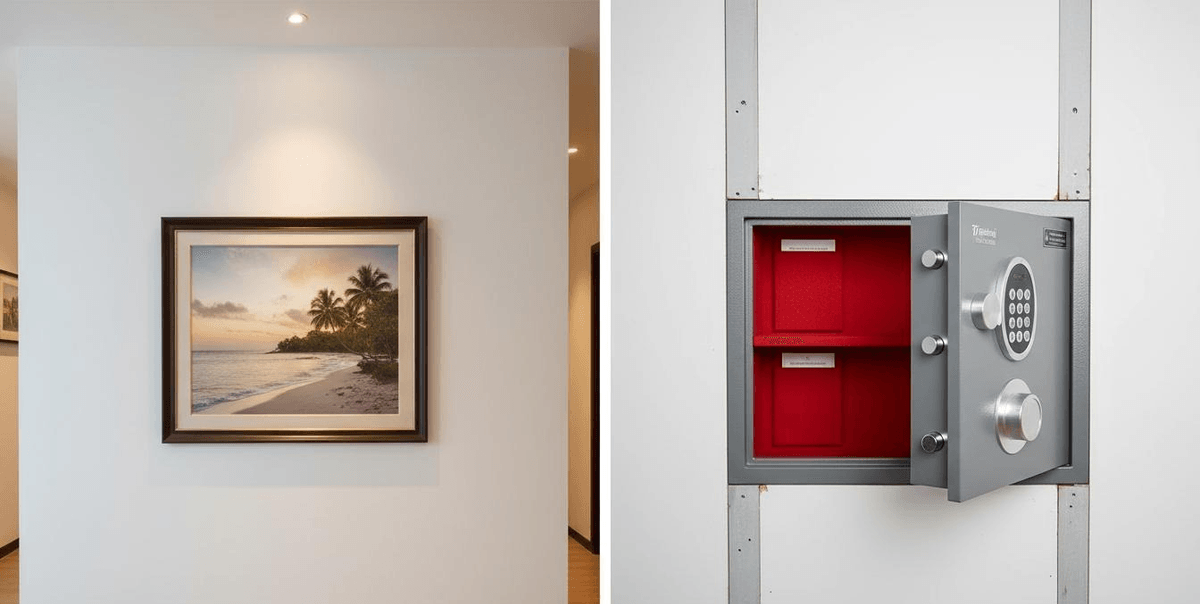
Flush-mount stud-space wall safes, by contrast, are installed during the framing stage. The safe body sits between two wall studs, recessed into the cavity. Only the front face—typically 8mm to 12mm proud of the drywall surface—remains visible. Residents can hang a painting, a clock, or a decorative panel directly over it. From the outside, there's no evidence a safe exists. This matters enormously in markets where condo units are expected to look "premium" even in base handover condition. >Because the safe is structurally integrated into the wall during construction rather than mounted onto it afterward, we also eliminate the visual disruption that surface-mount units create in otherwise clean-lined interiors.
Space Efficiency, Load, and Structural Considerations
Weight distribution is another real concern. A fully loaded surface-mount safe can weigh 25kg to 40kg, all of it cantilevered off the wall surface. In high-rise construction where unit separating walls are typically light-gauge steel studs with double-layer gypsum board, that point load can be problematic. >Because a stud-space safe distributes its weight through the wall studs themselves, the structural load path remains unchanged—there's no additional stress concentration on the wall assembly. A surface-mount safe carrying the same contents introduces a fulcrum point at the anchor location, which over time can cause fastener fatigue and, in extreme cases, partial detachment.
Market-Specific Design Considerations
Building codes and construction practices vary meaningfully across the region. In the Philippines, the DTI (Department of Trade and Industry)enforces product safety standards for Household safes, and the National Building Code of the Philippines (PD 1096) sets baseline structural standards, but individual local government units (LGUs) often impose additional requirements—particularly in Metro Manila where seismic zone classification affects wall assembly requirements. In Thailand, theMinistry of Agriculture and Cooperatives Building Control Act requires structural calculations for any element penetrating load-bearing walls. Malaysia's Uniform Building By-Laws (UBBL) addresses similar concerns. A flush-mount stud-space safe that is certified as a standard dimensional product—fitting within established stud spacing without structural modification—is far easier to spec and approve across these varied regulatory environments than a custom surface-mount solution.
We've worked with developers in Manila, Pattaya, and Johor Bahru who initially pushed back on stud-space models because they were unfamiliar with the installation sequence. >Once we walked them through the framing-stage installation process—it's a two-person job that takes about 45 minutes per unit including wiring for electronic locks—they understood that the incremental on-site labor cost is marginal compared to the long-term aesthetic and functional benefits. The cost premium for stud-space models over surface-mount equivalents is typically 10% to 20%, but when you factor in the eliminated need for post-mount reinforcement and the avoided aesthetic compromise, the total installed cost often favors stud-space installations in new construction.
Specification Checklist: What Condo Project Procurement Teams Actually Verify
This is the section I wish every procurement manager in this region had access to before their first bulk safe order. Too many project managers treat safe procurement as a commodity purchase—"just find a 15cm deep safe that fits between studs." That's how you end up with products that fail on site, don't meet local fire codes, or can't pass the developer's own quality checklist. Here's what we verify for every bulk condo project.
Lock Mechanism: The Most Project-Sensitive Decision
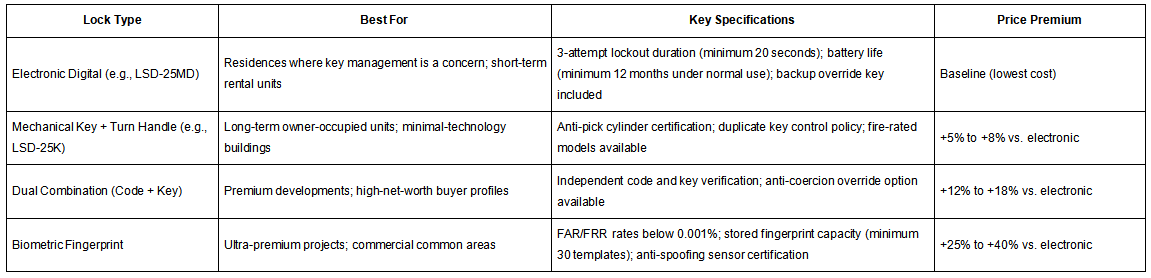
Lock choice is where developer preferences diverge most sharply, and it has real supply chain implications. I've structured this as a decision matrix because it's the first conversation I have with every new project client:
Physical Security Specifications
For new condo construction, I recommend minimum specifications that exceed what you'd accept for a residential home application. Here's why: in a building with 500 units, even a 0.5% failure rate means 2 or 3 service calls per month in the first year. At a blended cost of $150 to $300 per service call (technician travel, parts, resident coordination), that's real money and real reputational damage. >Spec it right the first time, because the cost of getting it wrong is always higher than the cost of specifying correctly upfront.
Bolt strength: We specify minimum 20mm solid steel bolts on all bulk project models. The bolt diameter matters because it directly determines the amount of force required to defeat the lock mechanism by forcing the door. Under UL687 standards (the most widely cited safe testing standard globally), bolt engagement depth is as important as bolt diameter—look for models where bolts extend a minimum of 20mm into the frame when engaged. I've inspected safes where the bolt diameter was sufficient but the engagement depth was only 12mm due to a poorly designed bolt guide; those units failed lever-attack tests in our lab.
Door plate thickness: Minimum 6mm solid steel door plate for residential stud-space models. Some budget models use a 3-4mm plate with a welded reinforcement—don't accept this for bulk project orders. The plate is your primary defense against lever-attack tools, and a 6mm plate is the threshold below which the safe becomes a liability rather than a feature. >Because we're sourcing for a bulk project where reputation is on the line, we recommend requesting the mill certificate for the steel used in the door plate—the difference between S20C carbon structural steel and a generic mild steel is meaningful in terms of impact resistance.
Anti-manipulation lockout: Electronic models must include a minimum 20-second lockout after three consecutive incorrect code entries. Some models also log failed attempts—useful for building security teams who may need to review access history for insurance purposes. We've seen units from certain Southeast Asian importers that default to a 3-second lockout, which is insufficient as a deterrent against brute-force code guessing. Always verify the lockout duration against your specification, not just against the sales brochure.
Sample Testing Protocol for Bulk Orders
We recommend a structured sample-approval sequence for any bulk order above 100 units:
Pre-production sample (1 unit): Physical inspection of bolt engagement, door alignment, lock mechanism feel, and interior finish. This is also when you verify that the safe actually fits your documented wall stud spacing—assume nothing. I've personally measured stud spacing on three separate Manila Bay projects that all claimed to be "standard 16-inch" but measured between 395mm and 410mm on center.
Environmental sample (1 unit): If the project is in a coastal location (Pattaya, Cebu, Johor Bahru), request a salt-spray resistance test per ISO 9227 standards (equivalent to ASTM B117 for salt spray testing). Minimum 24-hour exposure without surface corrosion on critical hardware. We've seen safes that pass factory QA perfectly but fail within 6 months in coastal Thai humidity—the zinc coating on internal components was insufficient.
Batch prototype (3-5 units from production run): Before the full production run commits, inspect these to verify consistency. Any variation from the pre-production sample is grounds to delay and renegotiate the production process. We specifically check bolt travel smoothness, lock mechanism response time, and interior felt lining attachment quality on batch prototypes.
💡 Procurement Insight One of the most common reasons bulk safe orders go wrong is that the project team approves samples based on the manufacturer's promotional materials rather than physical inspection. I've seen container-load orders arrive where the electronic lock's 3-attempt lockout was set to 3 seconds instead of the specified 20 seconds—because the production factory used a different firmware version than the sample unit. >Always inspect physical samples. Always verify firmware or mechanism settings against your specification document, not against the sample alone. We also recommend including a clause in your purchase agreement that allows for batch rejection if a pre-agreed QC checklist shows variance from the approved sample.
How Tigerking's Hidden Wall Safe Line Serves Bulk Condo Projects
I've evaluated safe manufacturing facilities across China, Taiwan, and South Korea over the past decade, and the thing that separates a reliable bulk supplier from a problematic one is almost always the same: whether they have a dedicated project management layer between the commercial team and the production floor. Many manufacturers can produce a decent sample. Far fewer can maintain specification compliance across a 500-unit production run with consistent quality and on-time delivery.
TIGERKING SAFE operates dedicated production lines for bulk condo project orders—a point that sounds obvious but is actually uncommon in the OEM safe manufacturing industry. What this means in practice: when you place a bulk order for, say, 400 units for a Manila Bay development, those 400 units don't compete for production time with 2,000 retail orders from unrelated customers. You get a dedicated production window, a dedicated QC inspector, and a single point of contact who manages your order from sample approval through container loading.
Production Capacity and Lead Time
TIGERKING's current stud-space wall safe production capacity allows for single-batch runs of up to 2,000 units, with a standard lead time of 3 to 5 weeks for bulk production after sample approval. For projects requiring more than 2,000 units per batch—common in large-scale Philippine developments with multiple towers—split delivery across two production windows is available with consistent quality across batches. We've found this approach preferable to rushing a single batch, which typically introduces quality variance.
For developers with tight project schedules, we recommend a >parallel-path sample and documentation process: while the pre-production sample is being assembled and shipped, the engineering team should be reviewing the project architect's wall penetration drawings to confirm stud-space clearance. This typically shaves 5 to 7 days off the overall project timeline, because sample inspection and installation engineering can happen concurrently rather than sequentially. In our experience, the single biggest source of project delays in bulk safe procurement is sequential processing—don't let it happen to your project.
OEM Customization for Project Specifications
One of the most powerful tools available to bulk procurement teams is OEM customization—not just for branding, but for functional adaptation to specific project requirements. TIGERKING's wall safe line offers the following customization pathways for verified project developers:
developer reported a 94% resident satisfaction rating on the security handover item in post-project surveys—a metric their sales team had identified as a key pre-sales commitment. The total project premium for the stud-space model with OEM customization over the original surface-mount budget was approximately 8%—a figure that looks very different when measured against the marketing value of that survey result.
For developers evaluating whether to bring a bulk safe procurement specialist into their project team, I'd offer this frame: the decision isn't really about saving money on safes. It's about avoiding the hidden costs of getting it wrong—service call batches, resident complaints during handover, and the downstream damage to Net Promoter Score that a security feature that fails reflects on the developer's entire quality brand. >Those hidden costs typically dwarf the apparent price difference between a correctly specified bulk order and a commodity purchase.
From Specification to Installation: A Developer Onboarding Timeline
For procurement teams navigating their first bulk safe procurement, the process can feel opaque. I've documented the timeline we use with project clients so that procurement managers can see exactly where time is consumed and where the schedule risks hide. Use this as a planning tool, not a guarantee—your specific project may compress or expand certain phases depending on the manufacturer's order book and your project's construction schedule.
Phase 1: Specification and Sample Approval (Weeks 1-4)
The first four weeks are dominated by specification alignment and physical sample testing. This is where we see the most variance between projects that finish on schedule and projects that delay their entire handover. The critical path runs through sample approval, and sample approval requires physical inspection—not document review, not video review, physical inspection.
In Week 1, we conduct a detailed specification review with the developer's engineering team, comparing the safe's dimensional data against the architectural wall penetration drawings. Any discrepancy between the two documents needs to be resolved before the order progresses. In Week 2, we ship the pre-production sample to the developer's site or a designated inspection agent. In Week 3, the developer inspects the sample against the QC checklist and provides written approval or a deviation list. In Week 4, the approved sample is used as the golden unit for the batch prototype inspection.
Phase 2: Production and Quality Inspection (Weeks 5-9)
With sample approval locked, production begins. TIGERKING dedicates a production line to the project for the duration of the run, with a dedicated QC inspector checking every 50th unit for dimensional consistency and lock mechanism performance.>Because the firmware parameters were pre-configured at the bulk order stage, there's no post-production reconfiguration step required on electronic lock models—this alone saves 3 to 5 days compared to manufacturers who ship generic firmware and require on-site configuration. At the end of Week 8, a pre-shipment inspection is conducted on a randomly selected sample from the production batch.
Phase 3: Logistics and On-Site Installation (Weeks 10-14)
Logistics for bulk safe orders typically involves 20-foot or 40-foot containers, with units palletized and secured for transit. For Philippine and Malaysian destinations, sea freight transit times range from 5 to 12 days from Chinese ports. On-site, installation is typically handled by the building contractor during the unit finishing phase, with a brief provided by TIGERKING's technical team specifying the exact framing-stage requirements.
The most common delay in this phase isn't logistics—it's a mismatch between when safes arrive and when the framing crew is ready to install them. Safe units need to be stored in a dry, covered location on site. If they arrive before the framing crew is ready, storage becomes a site management issue. >We strongly recommend coordinating container arrival with the project superintendent's unit finishing schedule before placing the order. The additional5 minutes to align delivery timing with the construction schedule can prevent days of on-site storage headaches.
Schedule Risk Matrix The three most common sources of delay in bulk safe procurement for condo projects, ranked by frequency: Sample approval delays: When the developer's engineering team defers sample inspection to accommodate other project priorities. Mitigation: build sample approval into the project schedule as a hard milestone with a dedicated owner. Specification misalignment: When the safe's dimensional data doesn't match the architectural wall penetration drawings. Mitigation: conduct dimensional alignment review in Week 1, before any sample or tooling commitments. Logistics scheduling: When container arrival doesn't align with the framing crew's schedule. Mitigation: confirm delivery timing with the project superintendent before placing the order, and build a 5-7 day buffer into the logistics schedule.
Frequently Asked Questions
Why are Southeast Asian condo developers specifying hidden wall safes as standard features?
Southeast Asian condo developers are specifying hidden wall safes because high-rise living creates a personal security gap: public areas are well-monitored, but individual units are not. Flush-mount hidden wall safes fill this gap by integrating into the wall structure during construction, providing residents with discreet, permanent security without compromising interior aesthetics. As buyer expectations rise and developers compete on handover quality, built-in security safes have shifted from optional upgrades to standard specifications in premium and mid-tier projects alike.
What is the minimum order quantity for bulk condo project procurement of hidden wall safes?
Minimum order quantities vary by manufacturer, but we typically see MOQs ranging from 50 to 200 units for custom-branded bulk orders. TIGERKING SAFE offers flexible MOQ arrangements for verified project developers, with dedicated production lines available for orders exceeding 500 units per project batch. For projects above 2,000 units, split-batch delivery with consistent quality across batches is the recommended approach to avoid the quality variance that rushed single-batch production introduces.
How long does it take from specification confirmation to installation for a typical condo project?
A typical timeline runs 8 to 14 weeks from specification lock to final installation: 1 to 2 weeks for sample confirmation, 3 to 5 weeks for bulk production, 1 to 2 weeks for quality inspection and documentation, and 2 to 4 weeks for logistics and on-site installation coordination. The single biggest delay risk is a missed sample-approval milestone, so procurement teams should treat sample approval as a hard gate in the project schedule rather than a flexible task.
What lock mechanisms are available for stud-space hidden wall safes?
Stud-space hidden wall safes typically offer dual-lock combinations: electronic digital locks (e.g., TIGERKING LSD-25MD) with 3 to 8 digit codes plus a backup override, or mechanical key locks (e.g., TIGERKING LSD-25K) with a turn-handle deadbolt. Biometric fingerprint options are also available for premium installations. Advanced models include anti-tamper features such as 3-attempt lockout mechanisms that disable the keypad for 20 seconds after three consecutive incorrect codes, and some models offer audit logging for building security team access history review.
Can hidden wall safes be customized for specific condo project requirements?
Yes, OEM and ODM customization is standard practice for bulk condo projects. Manufacturers like TIGERKING SAFE offer panel finish customization (materials, colors, textures), lock mechanism selection (electronic, key, biometric, or dual-combination), dimensional adjustments within stud-space constraints, and branding options including company logos and unit serialization for project management purposes. For biometric options, see TIGERKING's biometric fingerprint wall safe models which are available for OEM integration into bulk project specifications.
Ready to discuss your next condo project safe procurement?
View TIGERKING's Wall Safe Range | Contact Our Project Team
About the Author
James Chen
Senior Security Industry Analyst & SEO Content Strategist
James Chen has covered the security equipment manufacturing and global trade sector for over 10 years. His work has been cited in Security Products Magazine and multiple industry procurement guides. He specializes in B2B sourcing strategy, OEM/ODM evaluation frameworks, and market intelligence for physical security products.
Follow TIGERKING SAFE:Contact Us - TIGERKING