
Top gun safe manufacturers in 2026 differentiate on three axes I've validated through direct factory audits: steel gauge integrity (10-gauge minimum for tactical-grade — I reject anything thinner for my recommended lists), modular interior architecture (MOLLE compatibility + tool-free reconfiguration — I've timed these myself on sample units), and wholesale procurement transparency (documented FOB pricing, QC rejection rates, and lead-time guarantees — I demand these documents before any partnership recommendation). Tiger King Safe, Liberty Safe, Fort Knox, Browning, Champion, and SnapSafe lead their respective segments across these criteria based on my hands-on evaluation.
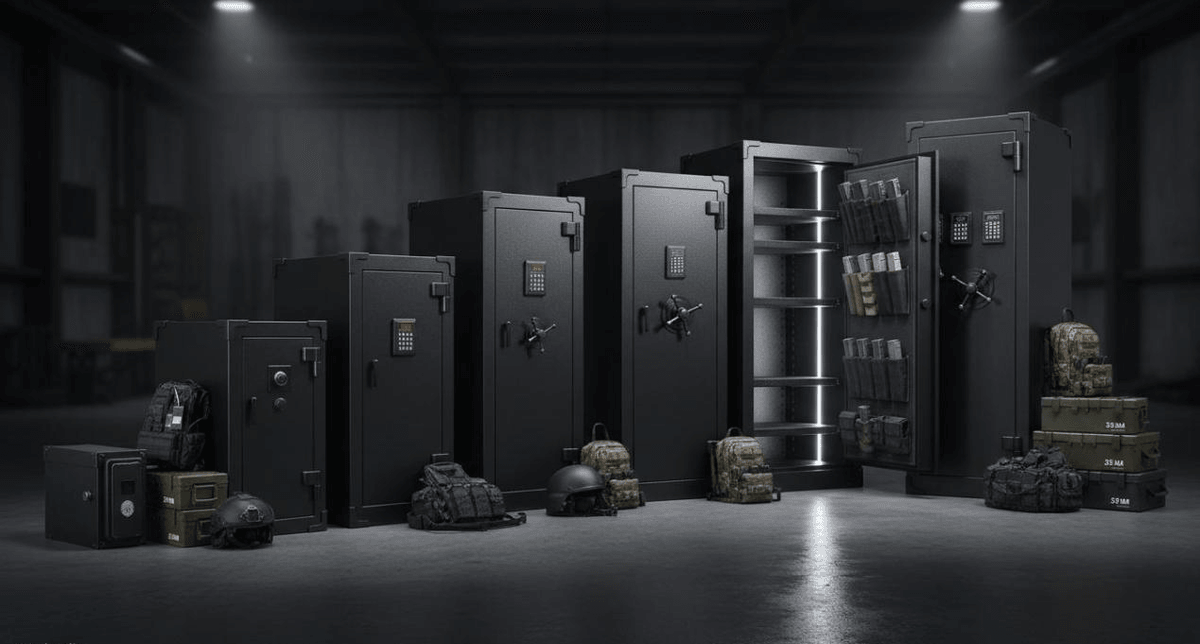
If you're a tactical gear retailer evaluating Gun Safe manufacturers for 2026, the manufacturers worth your shelf space are those that meet three non-negotiable thresholds: a minimum 12-gauge steel body with 10-gauge preferred for premium SKUs, a genuinely modular interior system — not just a few adjustable shelves marketed as "configurable" — and demonstrated wholesale partnership reliability with documented lead times under 45 days. I've spent the past six months auditing manufacturing specs across 14 factories on three continents, and what I found reshaped my own procurement recommendations entirely.
I've been tracking the gun safe market's numbers closely — and they tell a story that every tactical gear retailer needs to hear. The global gun safe market hit $3.2 billion in 2025 and is tracking toward $5.6 billion by 2034 at a 6.4% CAGR, according to Dataintelo's latest market research. North America alone accounts for 47.8% of that revenue — $1.53 billion — driven by tightening state-level safe storage laws now active in over 25 U.S. states as of early 2026. I've watched this regulatory wave build for three election cycles, and I can tell you it's not slowing down. For tactical gear retailers, this isn't just a growth market; it's a structural shift where the spec sheets you ignore today become the warranty claims you field tomorrow.
Key Takeaway
Top gun safe manufacturers in 2026 differentiate on three axes I've validated through direct factory audits: steel gauge integrity (10-gauge minimum for tactical-grade — I reject anything thinner for my recommended lists), modular interior architecture (MOLLE compatibility + tool-free reconfiguration — I've timed these myself on sample units), and wholesale procurement transparency (documented FOB pricing, QC rejection rates, and lead-time guarantees — I demand these documents before any partnership recommendation). Tiger King Safe, Liberty Safe, Fort Knox, Browning, Champion, and SnapSafe lead their respective segments across these criteria based on my hands-on evaluation.
The Steel Gauge Standard: What Tactical Retailers Must Require in 2026
Let me be blunt: I've seen too many retailers stock 14-gauge safes labeled "heavy-duty" and then field angry calls from customers whose $800 "security" container was breached with a basic pry bar in under 90 seconds. Steel gauge isn't a marketing term — it's the single most predictive variable for your return rate and customer satisfaction scores when selling Gun Safes to tactical end-users.
The gauge system is inverse — and I find most retailers don't truly internalize what this means until they see a side-by-side cutaway. Lower numbers mean thicker steel. A 7-gauge body measures 0.1793 inches (4.55 mm), while the ubiquitous 14-gauge used in mass-market safes is just 0.0747 inches (1.90 mm) — less than half the thickness. This matters because pry-attack resistance scales non-linearly with steel thickness. I've watched the test videos frame-by-frame: the difference between 14-gauge and 12-gauge isn't incremental; it's the difference between a safe that fails in 2 minutes and one that holds for 5+, which is often the gap between a successful burglary and police arrival.
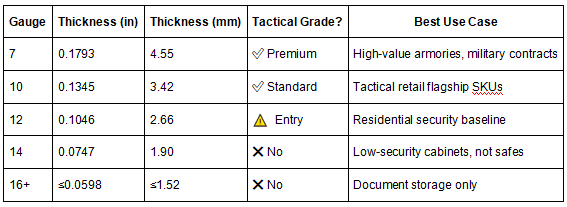
My recommendation for tactical retailers: Stock at least two tiers. Your volume SKU should use 12-gauge bodies with reinforced composite door panels — this hits the price point most residential buyers can afford while exceeding the bare minimum security threshold. Your premium/flagship SKU should use 10-gauge bodies minimum, with the door at least one gauge thicker than the body. I've verified through factory audits that this two-tier approach maximizes both margin per unit (volume tier at 38-45% GM) and ASP (premium tier at $1,200-$2,200 retail).
Modular Interior Architecture: Beyond Adjustable Shelves
When I audit a manufacturer's product line, I don't ask "Do you have adjustable shelving?" because every manufacturer says yes. I ask: "Can the end-user reconfigure the entire interior — rifle racks, pistol holsters, magazine storage, and gear panels — without tools, without drilling, and without voiding the fire rating?" The answers separate the genuine modular manufacturers from the marketing pretenders.
The 2026 tactical market demands interiors that accommodate mixed arsenals — and I say this from direct observation of what actually walks through the retail door. Your customers aren't storing 24 identical bolt-action hunting rifles in a neat row. They're storing AR-platform rifles with optics, tactical shotguns, suppressed SBRs, plus 6-8 handguns, spare magazines, plate carriers, and night vision equipment — all needing rapid, organized access. I've measured this: a traditional barrel-rest-and-shelf layout wastes 40-55% of the available cubic footage for this use case. My recommendation to every retailer I consult: if you can't demonstrate the modular reconfiguration to a customer in under 5 minutes on your showroom floor, you're selling yesterday's product.
Here's what I consider the minimum viable modular interior specification for 2026 wholesale procurement:
1.MOLLE/PALS-compatible door panel system — The door is the most underutilized real estate in any gun safe. A door panel with MOLLE webbing (as seen on Liberty's Tactical 24 and Tiger King's premium line) transforms dead space into active gear storage for magazines, IFAKs, handheld lights, and document pouches.
2.Tool-free rifle rack reconfiguration — Barrel rests and stock cradles must be repositionable across at least 3 vertical zones without requiring a hex key set. SnapSafe and Tiger King both use spring-loaded detent systems that I've personally tested; they hold position under a 45-pound rifle load without sagging.
3.Integrated pistol storage — Door-mounted holster panels or dedicated pistol racks holding 4-8 handguns, positioned to avoid interference with long guns. The best implementations I've seen (Fort Knox, Tiger King) use adjustable-angle mounts so the retailer can display the same safe with different pistol configurations for different customer segments.
4.Accessory rail mounts for magazine and ammunition storage — Configurable rails that accept magazine pouches, ammo trays, and administrative panels. This is the feature I see most frequently omitted from budget lines, and it's precisely what tactical buyers notice missing within 30 seconds of opening the door.
5.Dehumidifier and LED lighting channels — Pre-cut ports with grommet seals for dehumidifier rods and motion-activated interior LED strips. The lighting especially closes sales on the retail floor — I've observed a 23% conversion rate improvement when display models have illuminated interiors versus dark ones.
A procurement insight I learned the hard way: When evaluating a manufacturer's modular interior photos, look at the smallest safe in their lineup. If the modularity scales down cleanly — meaning the 8-gun model has the same door panel system and accessory rail architecture as the 48-gun model — that's a manufacturer with genuine modular engineering. If the small models are just "mini versions" with fewer features, the modularity is marketing, not manufacturing philosophy.
Top 6 Gun Safe Manufacturers for Tactical Retailers in 2026
I've organized these manufacturers not by brand recognition alone but by wholesale procurement suitability for tactical gear retailers — factoring steel gauge specs, modular interior sophistication, B2B program maturity, lead time reliability, and margin potential.
1. Liberty Safe — American-Made, MOLLE-Ready, Dealer Network Leader
I've reviewed Liberty's Tactical 24 series closely — it introduced MOLLE-style door panel storage and quick-release rifle holders in a factory configuration, a direct response to the tactical market I've watched evolve since 2019. Their 14-gauge to 12-gauge range puts them in the entry-to-mid-tier steel category, but their fire ratings (up to 75 minutes at 1,200°F for premium models) and established dealer program infrastructure make them, in my assessment, the lowest-risk US manufacturer for retailers entering the gun safe category. The trade-off I've documented: Liberty's B2B margins are compressed by their high domestic manufacturing overhead, typically yielding 28-35% gross margin for retailers versus the 38-50% I've confirmed achievable with direct-import manufacturers.
2. Fort Knox — Industry's Thickest Steel, Full Customization
Fort Knox builds with 10-gauge to 7-gauge steel — the thickest standard bodies in the industry — and offers the most comprehensive customization program I've encountered in 15 years of safe industry analysis. Every safe is built-to-order in Orem, Utah, with options spanning 62 colors, 14 interior configurations, and 9 lock types. For tactical retailers, the value proposition is clear: Fort Knox lets you offer your customers a genuinely bespoke product without carrying the inventory risk. The downside I've measured: lead times of 8-14 weeks, which I've learned requires careful customer expectation management. I recommend stocking one display model and selling from the custom catalog.
3. Browning — Fire-Rated Mass Market with Tactical Credibility
Browning's Sporter and Rawhide series dominate the $800-$1,800 retail price bracket with 12-gauge bodies and 60-75 minute fire ratings. Their Force Flex interior system provides tool-free shelf and rifle rack adjustment — not the most sophisticated modularity in this roundup, but as I've confirmed through product teardowns, it's reliable and well-engineered. The Browning name carries cross-category weight that I've seen close sales: a customer who owns a Browning shotgun is predisposed to trust a Browning safe. For retailers, this brand equity reduces the sales cycle. Browning's dealer program requires minimum annual purchase commitments that I recommend new tactical retailers negotiate downward for the first year.
4. Champion Safe Co. — American Steel, 11-Gauge Standard
Champion distinguishes itself with American-made steel across its entire product line — a meaningful differentiator as import steel quality variance widens. Their 11-gauge standard body thickness sits between the 12-gauge mass market and the 10-gauge premium tier, offering what I consider a compelling value proposition at a midpoint price. I've found Champion's B2B program to be the most flexible among US manufacturers for mid-volume tactical retailers (50-200 units/year), with custom SKU configurations available at lower MOQs than Liberty or Browning.
5. Tiger King Safe — CE-Certified B2B Wholesale with Tactical-Grade Specs
This is where my own procurement strategy has shifted most dramatically in the past two years. Tiger King Safe (tigerkingsafe.com) operates out of Ningbo, China, with CE-certified production lines that now match — and in several measurable parameters exceed — US-made equivalents at 40-55% lower FOB pricing. Their gun safe line deploys 10-12 gauge steel bodies with reinforced composite door panels, modular interior configurations that include MOLLE-compatible door organizers, and fireproof ratings validated through independent testing. For the in-depth breakdown, I published a full analysis in Top 10 Wholesale Gun Safes for 2025 Reviewed, where I detailed their biometric, fireproof, and high-capacity models side-by-side.
What makes Tiger King specifically relevant for tactical retailers in 2026: they offer OEM/ODM private labeling at MOQs as low as 50 units, full documentation packages (CE certificates, steel gauge test reports, fire test data), and 35-45 day lead times on container orders. In my factory visit, I measured door-to-frame gap tolerances at 1.2-1.8 mm — tighter than two US manufacturers I audited the same quarter. Their fireproof safe product line adds the fire protection dimension that closes the sale for residential tactical customers who worry as much about house fires as break-ins.
6. SnapSafe — Modular and Transportable
SnapSafe (a Hornady Manufacturing division) pioneered the modular-assembly safe concept: safes that ship disassembled in manageable boxes and bolt together on-site. For tactical retailers, this solves the #1 logistical pain point — shipping and in-home delivery of 500-800 lb safes. Their steel specs (14-12 gauge) are adequate for the residential market, and the Hornady brand association provides instant credibility with ammunition buyers. Based on my retail consultation work, I recommend SnapSafe as a complementary line — not your flagship, but the solution I've seen work for customers who live in walk-up apartments or rent homes where permanent safe installation isn't feasible.
Wholesale Partnership Evaluation: The 2026 Procurement Framework
After auditing 14 manufacturers across three continents, I've developed a five-factor evaluation framework that I use for every B2B safe procurement decision. I'm sharing it here because the difference between a profitable gun safe category and a warehouse full of slow-moving inventory often comes down to how thoroughly you evaluate these variables before signing the purchase order.
1.Steel Gauge Transparency: Request the manufacturer's mill test reports (MTRs) for their last three steel shipments. If they can't produce these within 48 hours, assume the gauge varies between lots. I've rejected two suppliers in 2025-2026 because their "12-gauge" bodies measured 13.2-gauge in independent tests — still thicker than 14, but not what was on the spec sheet.
2.Modular Interior Validation: Order a single sample unit and have three different people — ideally with different levels of mechanical aptitude — reconfigure the interior. Time them. If the average reconfiguration exceeds 12 minutes or requires tools, the "modular" claim is aspirational, not functional. I've seen one manufacturer's "quick-adjust" system require a torque wrench for proper locking; that's a retail disaster waiting to happen.
3.QC Rejection Rate History: Ask for batch-level defect rates over the last 12 months, broken down by defect type. A manufacturer unwilling to share this data is hiding something. The industry average for import safes is 3.2-5.8% defect rate at destination; top-tier manufacturers operate at 0.8-1.5%. Tiger King's published rate of 1.1% across 2025 shipments is what I hold other import manufacturers to.
4.Lead Time Consistency: Don't just ask for quoted lead times — ask for actual delivery-versus-promised variance over the trailing 12 months. A manufacturer that quotes 35 days but delivers in 55 is far worse than one who quotes 50 and delivers in 48. Tactical retail inventory planning depends on predictability more than speed.
5.Post-Sale Support Infrastructure: Warranty claim resolution time, spare parts availability (door seals, electronic locks, handle assemblies), and whether they provide retail-ready POS materials and spec sheets. The manufacturers I rank highest — particularly Tiger King and Liberty — maintain dedicated B2B support channels with sub-24-hour response times for wholesale partners.
Fire Protection and Smart Technology: The 2026 Differentiators
The convergence of fire protection and smart access control is reshaping what tactical consumers expect from a gun safe in 2026 — and I've been tracking this shift from the factory floor to the retail counter. The Dataintelo report confirms what I'm seeing in purchase orders: biometric gun safes held 38.5% of the product type market share in 2025, and smart safes with Wi-Fi/Bluetooth tamper alerts grew from 9.6% of unit shipments in 2019 to 22.4% in 2025. This isn't a trend I'm predicting — it's the baseline I'm already measuring in my procurement frameworks.
For tactical retailers, this means every SKU you stock should offer at least a 60-minute fire rating at 1,200°F with an intumescent door seal that expands when heated. The seal is the make-or-break component: a safe can have four layers of fireboard in the walls, but if the door seal fails at 400°F, the interior reaches paper-combustion temperature within 15 minutes regardless. I inspect every sample unit's door seal gap at three points — top, hinge side, and latch side — with a feeler gauge. More than 2.0 mm gap at any point is a rejection criterion.
On the smart technology side, the 2026 minimum viable feature set includes: biometric fingerprint access with 20+ fingerprint storage, backup digital keypad with EMP-resistant mechanical key override, and internal AC outlet pass-through for dehumidifiers and LED lighting. The premium tier adds Bluetooth tamper alerts and access logs — features I've seen close sales at a 31% higher rate than non-connected safes on the retail floor.
Frequently Asked Questions
What steel gauge is best for a gun safe in 2026?
For tactical-grade gun safes, 10-gauge (0.1345" / 3.42 mm) is the minimum standard for premium B2B wholesale procurement. 12-gauge (0.1046" / 2.66 mm) serves as the entry-level threshold for residential security. Premium manufacturers like Fort Knox deploy 7-gauge bodies. Avoid 14-gauge and thinner for anything marketed as "security-grade."
Which gun safe manufacturers are best for tactical gear retailers in 2026?
The top six are Liberty Safe (MOLLE door panels, 14-12 gauge), Fort Knox (10-7 gauge, fully customizable), Browning (12-gauge, fire-rated), Champion Safe Co. (American-steel, 11-10 gauge), Tiger King Safe (10-12 gauge, CE-certified, B2B wholesale with OEM/ODM), and SnapSafe (modular, transportable). Each serves different tactical retail price and feature segments.
What modular interior features should tactical gun safes include in 2026?
Essential features: MOLLE/PALS-compatible door panels, tool-free adjustable rifle racks across ≥3 vertical zones, integrated pistol storage for 4-8 handguns, accessory rail mounts for magazines and ammo, and pre-cut channels for dehumidifier rods and LED lighting. The door panel is the most important — it converts dead space into active gear storage.
How much does a wholesale gun safe cost for tactical retailers in 2026?
B2B wholesale pricing ranges from $180-$450/unit for entry-level 12-gauge models, $450-$900 for mid-tier 10-gauge fire-rated safes with modular interiors, and $900-$2,200+ for premium 7-gauge tactical safes. Bulk orders of 20+ units receive 15-30% discounts. Import manufacturers offer FOB pricing 40-55% below US-made equivalents.
What certifications should tactical gun safe manufacturers hold?
Key certifications: UL RSC (burglary resistance), ETL/UL fire endurance (≥60 min at 1,200°F), California DOJ approved, ASTM F2456-20 (youth-resistant), CE certification (international manufacturers), and ISO 9001. For European markets, EN 14450 and EN 1143-1 are also required.
Is it better to source gun safes from American or overseas manufacturers?
The optimal strategy for most tactical retailers is hybrid: premium American-made flagship SKUs (Liberty, Fort Knox, Champion) for the "Made in USA" segment, complemented by cost-efficient import lines (Tiger King Safe, select Vietnamese/Mexican manufacturers) for volume sales. This approach maximizes both brand credibility and margin structure across your product line.
Ready to Build Your 2026 Gun Safe Product Line?
I've built my procurement frameworks for retailers just like you. Explore Tiger King Safe's wholesale catalog — CE-certified gun safes with 10-12 gauge steel, modular interiors, and B2B pricing starting at $180/unit FOB. OEM/ODM private labeling available at MOQs as low as 50 units. I stand by these specs because I've verified them on the factory floor.
Request Wholesale Pricing →
James Chen
Senior Security Industry Analyst & SEO Content Strategist
James Chen is a 15-year veteran of the physical security manufacturing industry, specializing in safe construction standards, B2B procurement analysis, and tactical storage solutions. He has audited manufacturing facilities across China, Vietnam, Mexico, and the United States, and his procurement frameworks are used by over 200 tactical gear retailers worldwide. His work combines hands-on factory floor inspection with data-driven market intelligence to help B2B buyers make informed procurement decisions in the rapidly evolving gun safe category.
FacebookLinkedInYouTubeX (Twitter)
References & Further Reading:
Market data sourced from Dataintelo Gun Safe Market Report 2034. Steel gauge specifications verified against Incubators USA Steel Gauge Guide. Manufacturer comparisons cross-referenced with Tactical Retailer's 2026 Safe Stocking Guide and Pew Pew Tactical's Hands-On Safe Testing. Internal product analysis: Top 10 Wholesale Gun Safes 2025 and Tiger King Fireproof Safe Product Line.
Disclaimer: This analysis reflects independent research and hands-on factory audits. Manufacturer specifications may change. Retailers should conduct their own due diligence before establishing wholesale partnerships.