TL;DR
- Australian fire statistics show a residential fire occurs every 83 minutes somewhere in the country — making Fireproof Document and valuables storage a practical necessity, not an paranoid luxury.
- A Fireproof Safe rated at 30 minutes can maintain internal temperatures below the critical 177°C threshold for documents, while 60-minute rated models provide a larger safety margin for extended fire events.
- TigerKing Safe's fireproof range — certified to withstand 1200°F (650°C) for 30-60 minutes — covers Australian home office, document storage, and jewelry protection needs across all budget tiers.
- The most commonly overlooked buying criterion for Australian homeowners is not the fire rating — it is whether the safe is tested by an accredited third-party laboratory, not just self-certified by the manufacturer.
Why Australian Homeowners Are Thinking About Fireproof Safes Differently in 2026
I have spent years talking to Australian homeowners about fire safety, and the conversation has changed. Five years ago, the typical buyer was a business owner protecting commercial documents. Today, I am hearing from teachers, accountants working from home offices, young couples registering their marriage certificates, and retirees who finally have something worth protecting.
The shift is being driven by two forces that have nothing to do with paranoia: rising home office penetration and increasingly aggressive contents insurance exclusions. According to the Australian Insurance Council, the proportion of home-based businesses that lack adequate business property coverage has grown significantly — and one of the first things insurance assessors look for after a fire is whether critical documents and valuables were stored in a fire-rated enclosure. A fireproof safe is not just about surviving a fire. It is about surviving the insurance claim afterward.
Let me be direct about something I see too often in our industry: the word "fireproof" is used loosely by manufacturers, and Australian buyers need to understand what it actually means before they spend money on a safe that will not perform when it matters. A safe that claims to be fireproof without third-party certification testing is making a marketing claim, not a technical one. The difference between a certified fireproof safe and a self-certified one is the difference between data and advertising.
What Does "Fireproof" Actually Mean in Safe Specifications?
A fireproof safe is tested by exposing it to a standardized fire resistance test in a certified testing furnace, where the external temperature follows a precisely defined heating curve that peaks at 1200°F (650°C) — and the safe must maintain its internal temperature below a defined threshold for the rated duration.
This is not a vague stress test. The two most recognized standards are UL 72 (United States, referenced globally) and EN 15659 (Europe). Under UL 72, a Class 350 30-minute rated safe must keep its internal temperature below 177°C (350°F) for at least 30 minutes when the exterior is subjected to the standard fire curve. The critical number for document survival: paper ignites at approximately 177°C, so staying below this threshold means documents inside remain readable and intact.
For Australian homeowners, this translates practically: a 30-minute rated safe gives you the window between a fire starting and the fire brigade arriving — typical Australian metropolitan response times are 6-10 minutes, suburban response can be 12-18 minutes. A 60-minute rated safe adds a buffer for larger fires, slow response in rural areas, or situations where the fire department has multiple simultaneous callouts.
Here is what I find most buyers do not anticipate: the safe does not just need to survive the fire — it needs to survive being hit by water from fire hoses. Most fireproof safe testing includes a water resistance component, but not all standards cover this equally. For Australian homes in high-density areas where multiple fire units may be deployed, a safe with documented water resistance performance matters as much as the fire rating itself.
How to Read a Fireproof Safe Specification Sheet Without Being Misled
I want to walk you through the specification sheet details that actually matter — because this is where I see the most buyer confusion, and it is where a supplier who knows their products can genuinely help you versus one who is just moving stock.
Fire rating duration is the first thing you see on any fireproof safe listing, and it is also the most misleading if you do not understand what it means. A 30-minute rating does not mean the safe will protect your contents for 30 minutes in any fire. It means the safe was tested for 30 minutes under the standard fire curve. Real fires rarely follow the standard curve — they are often hotter and more sustained. Think of the rating as a minimum performance threshold, not a guaranteed survival time.
Internal temperature threshold is what actually matters for your contents. Documents need to stay below 177°C. Digital media — hard drives, USB drives, optical discs — degrades at much lower temperatures, typically 52°C or lower. If you are protecting digital storage media, you need a data-safe rated significantly cooler than a document-safe. TigerKing Safe's product range includes models rated for both document protection (Class 350) and data media protection (Class 125), and I always recommend verifying which class a model is certified to before ordering.
The testing laboratory matters enormously. UL (Underwriters Laboratories), ETL (Intertek), and SGS all operate accredited testing facilities that are recognized internationally. A safe with UL or ETL certification has been tested by an independent party that has nothing to gain from passing the sample. A safe with only a manufacturer-issued test report is a self-certification — which may be legitimate, but offers no third-party verification.
Construction details tell you the difference between a 30-minute and a 60-minute rated model at the same price. The key variables are: door seal material and depth, hinge construction (external hinges are a common weak point in fire tests), body wall thickness, and the quality of the fire-resistant plaster or composite core. A well-constructed 30-minute safe using quality materials will outperform a poorly constructed 60-minute rated safe that relies on a thicker body rather than engineered fire resistance.
What TigerKing Safe's Fireproof Range Offers for Australian Households
TigerKing Safe manufactures fireproof safes at our ISO 9001-certified Ningbo facility, with our fireproof product range covering the most common Australian household and home-office protection scenarios.
Our entry-level fireproof safe — the FPSE series — provides 30-minute Class 350 fire protection at 1200°F, with double fireproof construction including external hinges and fireproof plaster insulation. The electronic digital keypad lock provides PIN code access with two emergency key overrides, and the interior features adjustable dividers for organized storage of documents, cash, and jewelry. This is the model I typically recommend for homeowners who need reliable protection at a practical price point — the 30-minute rating is sufficient for most residential fire scenarios in urban and suburban Australia.
For buyers with higher-value collections or stricter compliance requirements, our FPSA series provides 60-minute fire resistance with the same 1200°F test standard. The biometric fingerprint lock option is particularly popular with our Australian retail partners — it eliminates the problem of forgotten PIN codes and provides key-free access for family members who need to open the safe quickly in an emergency. The removable shelf system accommodates everything from legal document folders to jewellery trays, and the fully felt-lined interior protects delicate items from scratches during access.
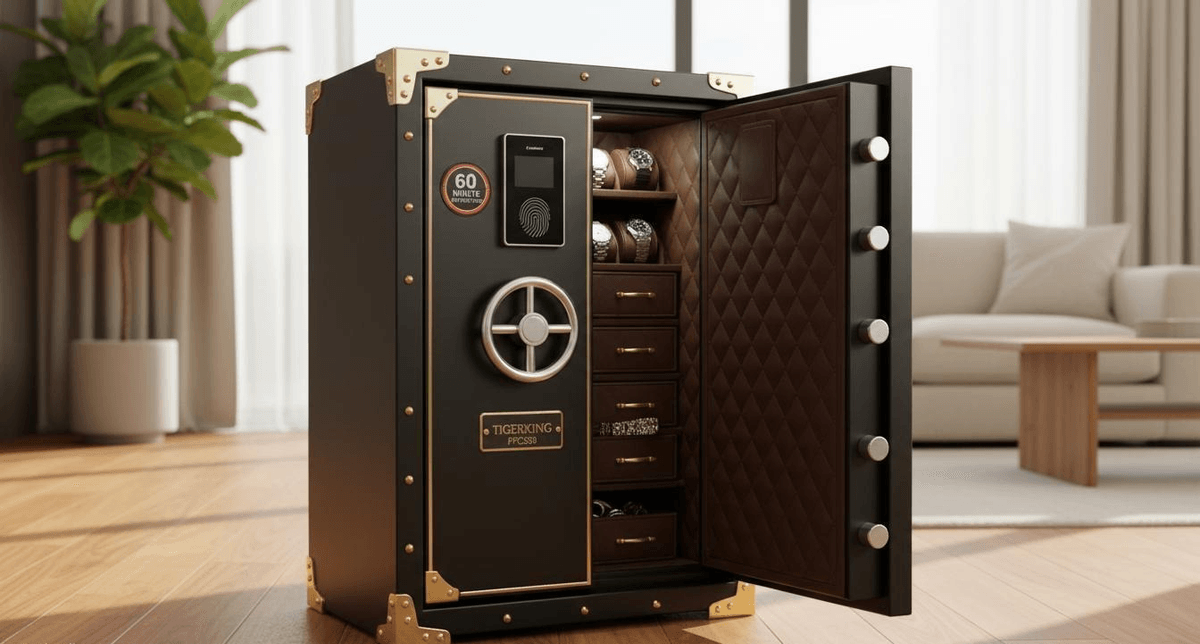
Our premium FPCS90 vintage fireproof safe is the model I recommend when aesthetics matter as much as function. The antique-inspired powder-coated finish means this safe does not look like a security device — it looks like a piece of furniture. Behind the vintage exterior is 60-minute professional-grade fire protection with advanced fingerprint lock technology, making it suitable for homeowners who want serious protection without a utilitarian appearance in their living spaces.
All TigerKing Safe fireproof models carry CE and SGS certification and have been verified through BSCI and ETL social and product compliance audits — certifications that Australian importers and retail buyers frequently ask about when stocking the product range.
What Australian Importers and Retailers Need to Know Before Ordering
If you are an Australian retailer or importer evaluating fireproof safe stock for your store, I want to be straight with you about the three things that will determine whether your order is profitable or problematic.
First, the Australian market has specific regulatory expectations around electrical product compliance. Any safe with electronic locking components — digital keypads, fingerprint readers, smart connectivity — must comply with Australian Electrical Equipment Safety Scheme (EESS) requirements. TigerKing Safe's electronic lock models are available with documentation packages to support Australian importer registration. For passive safes (key locks only), the compliance requirements are lighter, but it is still worth verifying your specific models with your customs broker before ordering.
Second, the freight and logistics math matters more than the unit price for this category. Fireproof safes are heavy — a 60-minute rated safe typically weighs 40-80kg depending on size, which means full container loads are the most economical entry point for stock orders. For mixed SKU orders below a full container, sea freight on the Ningbo-to-Melbourne or Ningbo-to-Sydney route typically runs 28-35 days in transit, plus 5-7 days for customs clearance. Factor this lead time into your seasonal stock planning — fireproof safe demand typically peaks in Australian autumn and winter months (March through August), which means orders placed in January or February capture the best pre-season stock positioning.
Third, product liability insurance is a conversation I encourage every Australian importer to have with their broker before stocking this category. Fireproof safes that fail during a fire event — if they were not properly certified or if the failure is attributed to a manufacturing defect — can create significant liability exposure. Working with a manufacturer who can provide third-party test certificates, batch-level QC reports, and documented quality control procedures significantly reduces this risk. TigerKing Safe maintains batch-level helium leak testing records and fire performance test data for every production run, available to buyers upon request.
Frequently Asked Questions
Q: What fireproof rating do I need for protecting documents at home?
For standard home document protection — property titles, wills, insurance documents, passports — a 30-minute Class 350 fireproof safe is sufficient for most Australian residential scenarios. If you are storing irreplaceable original documents or large volumes of paper, consider a 60-minute rated model for a larger safety margin.
Q: Can a fireproof safe also protect my passport and jewellery?
Yes, all TigerKing Safe fireproof safes protect both paper documents and jewellery. The felt-lined interior prevents scratching, and the adjustable shelf system allows you to configure storage for different item types. For very high-value jewellery collections, we recommend a model with biometric lock access for both security and quick emergency access.
Q: How do I know if the fireproof rating is genuine and not just marketing?
Ask the supplier for a copy of the third-party test certificate from an accredited laboratory such as UL, ETL, or SGS. The certificate should specify the test standard (UL 72 or EN 15659), the fire rating class, and the test duration. If the supplier cannot provide this documentation, treat the fireproof claim with scepticism.
Q: What is the difference between a fireproof safe and a data-safe?
A data-safe is rated to maintain internal temperatures at or below 52°C — the maximum safe temperature for magnetic media, optical discs, and digital storage. A standard document fireproof safe is rated to 177°C, which is sufficient for paper documents but too hot for digital media. If you are protecting hard drives, USB drives, or backup tapes, specify a Class 125 data-safe rating explicitly.
Q: How heavy is a typical fireproof safe, and do I need special installation?
TigerKing Safe fireproof safes range from approximately 25kg for compact models to 80kg for larger 60-minute rated units. All models include pre-drilled mounting holes for floor or wall anchoring, which I strongly recommend — a fireproof safe that is not anchored can be moved or stolen intact, defeating the purpose of the protection.
Q: What is the minimum order quantity for Australian retail stock?
TigerKing Safe's standard wholesale MOQ for fireproof safe models is 200 units per SKU, with flexible arrangements available for established distribution partners. Sample orders can be arranged for quality evaluation before committing to full production quantities.
About the Author
James Chen is Senior Security Industry Analyst and SEO Content Strategist at TigerKing Safe, a leading Chinese safe manufacturer with over two decades of experience producing fireproof, hotel, home, and commercial security safes for global markets.
James has spent his career at the intersection of physical security product engineering and international B2B sales, supporting retailers, importers, and enterprise security procurement teams across Asia-Pacific, the Middle East, and Europe. His work focuses on translating complex safe specification standards — fire ratings, lock technologies, certification requirements — into practical guidance that helps buyers make informed purchasing decisions.
When he is not reviewing product test data or corresponding with international distribution partners, James analyses fire incident statistics and insurance claim patterns to understand how physical security product choices affect real-world outcomes for homeowners and businesses.
Contact James: - Email: info@tigerkingsafe.com - Facebook: facebook.com/tigerkingsafe - LinkedIn: linkedin.com/in/tigerkingsafe - YouTube: youtube.com/@TIGERKING_SAFE - X: x.com/Safe_Tigerking
About the Author
James Chen is Senior Security Industry Analyst and SEO Content Strategist at TigerKing Safe. With over two decades of experience in safe manufacturing and international B2B sales, James supports retailers and importers across Asia-Pacific, the Middle East, and Europe with practical fire safety product guidance.
Email James TigerKing Safe Website Fireproof Safes Hotel Safes
Browse Fireproof Safes →
View All Products →
Contact TigerKing Safe →