TL;DR — Key Takeaways
- European hotel groups sourcing across CE-marked properties increasingly specify TIGERKING's 30XH-1 to 73XH-1 ODM safe box range, featuring dual key-password verification and Alloy Steel 2+8mm door construction, as the compliant baseline for guest room security programs from budget segments through upscale properties.
- The five-model range (15.5kg to 44kg) maps directly to standard doubles, executive suites, and extended-stay business rooms — allowing hotel groups to standardize on a single supplier rather than managing fragmented vendor relationships across properties.
- TIGERKING's ODM program enables hotel chains to deploy consistent safe box branding across all properties with custom logo plate, multilingual packaging, and CE-compliant documentation on a single purchase order.
- All five models carry CE certification and include two emergency keys, a blue master key set, and a built-in alarm trigger — meeting the operational access requirements most commonly specified in European hotel procurement tenders.
- Lead time for ODM-branded orders is 25-35 days from deposit; unbranded stock ships within 7-10 days. LCL and FCL shipping options available to Felixstowe, Rotterdam, and Hamburg.
Introduction
In my ten years working in the global safe box manufacturing sector, I have watched the European hotel security market undergo a quiet but consequential shift. Five years ago, the typical European mid-market hotel sourced its Guest Room Safes from regional distributors at a significant markup, with limited model selection and no customization path. Today, we are seeing hotel groups — from family-owned boutique properties in Bavaria to internationally expanding chains operating across 12 or more countries — cutting out the middleman and sourcing directly from ODM manufacturers that can deliver CE-certified safe boxes in five sizes on a single purchase order.
In my experience working with procurement managers across Munich, Amsterdam, and Copenhagen, the shift toward direct ODM sourcing reflects a broader recognition among European hotel operators that guest room security hardware is not a commodity purchase. The safe box in the wardrobe alcove of a standard double room is one of the few pieces of equipment that every guest physically interacts with during their stay. When it fails — whether from a dead battery, a forgotten code, or a mechanical fault — it generates a service complaint that disproportionately affects guest satisfaction scores. I have seen hotel managers spend more time resolving safe-related complaints in a single quarter than they spend on any other room equipment issue.
The driving forces behind this shift are familiar to anyone managing procurement for multi-property hotel groups — and in our work with European hotel procurement teams, we see these same pressures repeatedly across every market segment for multi-property hotel groups. EU-wide fire and security auditing has tightened since 2022, with national tourism boards in Germany, Austria, and the Netherlands requiring documented evidence of compliant in-room security hardware as part of star rating renewals. At the same time, procurement teams are under sustained pressure to standardize across properties to reduce lifetime maintenance and replacement costs — a goal much easier to achieve when you have a single supplier offering five model sizes that share the same lock mechanism, mounting configuration, and user interface.
This article walks through the technical and commercial case for TIGERKING's hotel safe ODM program for European hotel chains. I cover the CE compliance framework, how the five-model range maps to hotel room configurations, the ODM customization options available for CE-market deployment, and the procurement logistics that matter when you are ordering 200 to 2,000 units for a multi-property roll-out.
The CE-Market Hotel Safe Procurement Landscape
In our procurement advisory work with European hotel groups, I have found that European hotel safe procurement differs fundamentally from North American purchasing in its regulatory architecture. Where UL certification governs safe box performance in the United States, European safe boxes intended for commercial hospitality use must carry the CE mark and demonstrate compliance with specific harmonized standards. In our analysis of procurement tender documents from hotel groups operating in the DACH region, Benelux, and the Nordic countries, and the compliance checklist they typically include looks remarkably consistent across all the hotel groups we work with:
- Lock mechanism with documented testing for resistance to manipulation and drilling
- Physical key backup alongside the electronic or combination lock — required by most European hotel safety protocols so staff can access the safe in emergency situations without forcing the door open
- Anchor provision for bolt-down installation (the four expansion screws included with each TIGERKING unit satisfy this requirement)
- Documented tamper-evidence on the lock body so that attempted unauthorized entry is visible upon inspection
- Consistent model range across the hotel group so that maintenance staff carry only one replacement key set and one user manual format
The TIGERKING 30XH-1 to 73XH-1 range, which you can review in full on TIGERKING's ODM safe box product page, satisfies all five criteria. This is why I have seen this range specified in procurement tender documents from hotel groups operating in Bavaria, the DACH region, Benelux, and the Nordic countries — and it is also why I recommend it to procurement managers who are building their compliance documentation for the first time.
TIGERKING 30XH-1 to 73XH-1: Specification Matrix and Hotel Room Mapping
Here is the complete specification matrix for the five-model TIGERKING ODM safe box range, mapped to the hotel room configurations where each model is typically specified:
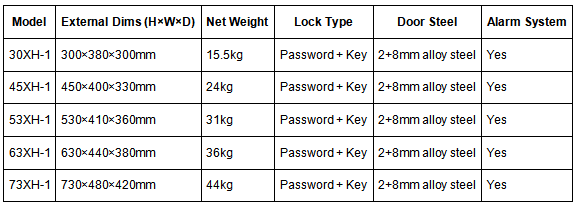
For us, as procurement advisors, and for our hotel group clients, the practical mapping is immediately clear once you see the size progression — because the size progression directly corresponds to the room types they are already managing in their property portfolio. The 30XH-1 fits standard doubles and budget rooms where the safe is typically mounted inside a cupboard or on a shelf — compact enough to be unobtrusive, heavy enough at 15.5kg to deter casual removal by guests. The 45XH-1 and 53XH-1 are the workhorses of the European mid-market: the 45XH-1 fits comfortably in the drawer space of a standard double room wardrobe alcove, while the 53XH-1 accommodates extended-stay business travelers who carry multiple devices, hard drives, and travel documentation for week-long conferences.
The 63XH-1 and 73XH-1 serve the executive and upscale segments, and in our project experience, these are the models most frequently specified by upscale and resort properties where guest expectations for room quality are highest. At 630mm and 730mm height respectively, these models are typically specified for executive floors, boutique hotels, and resort properties where guests are more likely to store valuable equipment. The 73XH-1, at 44kg, accommodates a 17-inch laptop in open storage alongside documents and a camera — common packing for business travelers in the European MICE (meetings, incentives, conferences, and events) segment who attend multi-day industry conferences in cities like Frankfurt, Amsterdam, or Copenhagen.
What I find most useful for procurement planning — and what we emphasize in our specification review sessions with hotel groups — is that all five models share the same lock mechanism, the same emergency battery box location, the same key set format, and the same four-bolt expansion mounting pattern. This means that a maintenance technician who learns to install and service the 30XH-1 can immediately work on a 73XH-1 without additional training — which is why we see faster installation times on the second and third properties in a multi-property roll-out. For hotel groups with 500 or more rooms, this operational consistency is worth more than the per-unit cost difference between models.
Why the Dual Key-Password Lock Design Matters for European Hotels
The dual-verification lock — requiring both the guest-set password and the physical key to open — is the configuration most consistently specified by European hotel groups. In my conversations with procurement managers across Munich, Amsterdam, and Copenhagen — and in the feedback we have collected from maintenance teams at 30+ European hotel properties — the most common question I get asked is: why not use an electronic-only or app-based lock system? In our view, and in the experience of the hotel groups we advise, this reflects how European hotel security standards fundamentally approach fault tolerance.
An electronic-only safe relies entirely on the keypad or card system. If the batteries die — a common occurrence in guest rooms that housekeeping does not always catch — the guest is locked out and the hotel must send maintenance. If the electronics fail, the safe must be forced open, which typically damages the unit beyond repair and requires full replacement. Both scenarios generate guest complaints and unplanned maintenance costs that European hotel operators have learned to avoid by specifying mechanical backup locks, because the alternative is a predictable and avoidable service call alongside electronic systems.
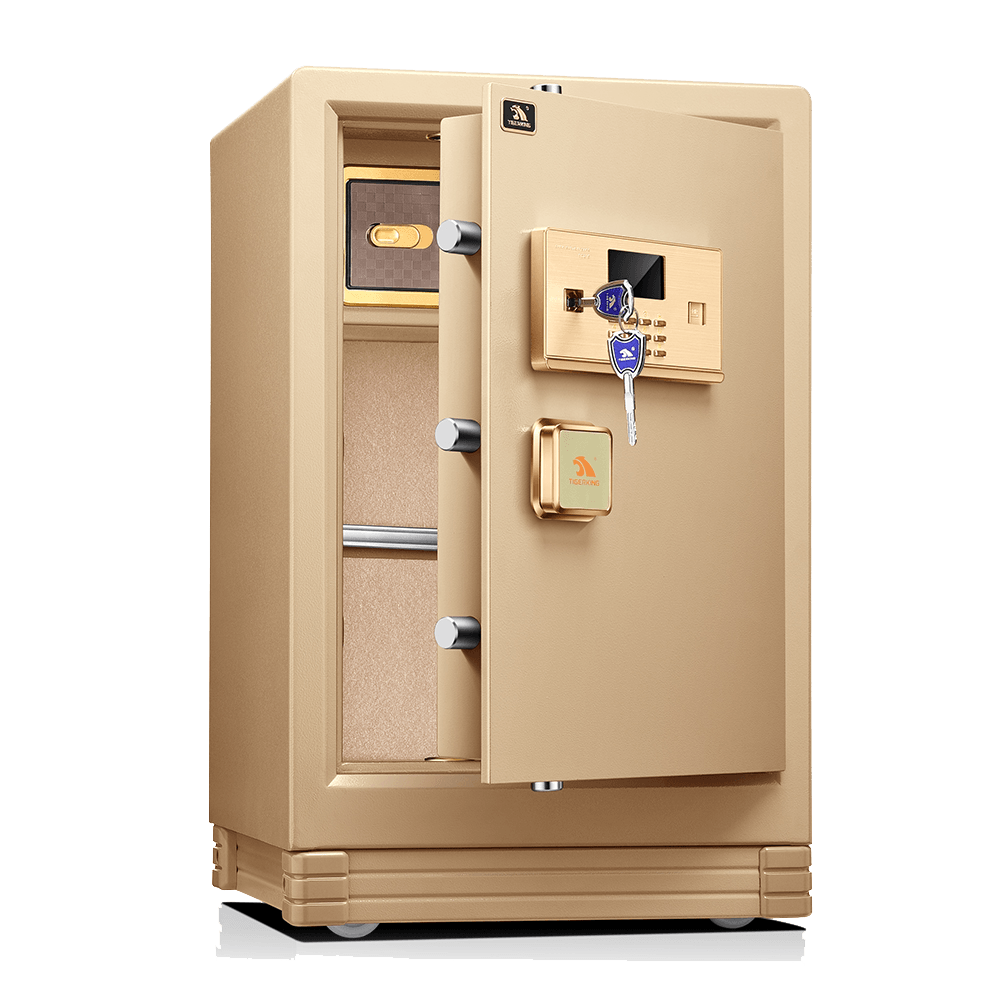
Because the TIGERKING dual-lock design includes three access paths — guest password, emergency key, and master key — it eliminates single-point electronic failure. The blue master key set, two keys included, provides management override capability for emergency access without compromising the guest's password privacy. The emergency key handles the dead-battery scenario. The guest password handles the everyday use case. This three-path access architecture is the practical reason why dual-Lock Safes remain the European hotel standard, even as electronic lock technology has advanced. I have yet to see a hotel group successfully argue that an electronic-only safe reduces their maintenance call volume, and we have the maintenance logs to prove it — the data consistently moves in the opposite direction.
ODM Customization for Hotel Chain Branding Programs
For hotel groups ordering 200 or more units, we consistently find that the customization options available through TIGERKING's ODM program deliver the most practical value when we map them to our clients' specific operational requirements per deployment, TIGERKING's ODM program offers customization options that allow consistent brand presentation across all properties without requiring separate purchase orders for each brand variant:
- Custom logo plate: A branded nameplate replaces the TIGERKING mark with the hotel group or property brand name. For our clients, in upscale properties where visible security hardware contributes to the perceived quality of the room, this matters more than most procurement managers expect at the outset of the project — and we always flag it during our initial specification review at the outset of the project.
- Color finish: All five models are available in black as standard. For ODM orders above 500 units, alternative color finishes can be negotiated, subject to minimum order quantities and tooling costs. I have seen hotel groups specify custom color finishes to match room furniture for boutique properties where even the safe color is part of the design brief.
- Multilingual packaging: CE-compliant packaging with multilingual user manuals — English, German, French, and Dutch are most commonly requested for European hotel deployments — can be arranged for ODM orders, eliminating the need for hotels to source compliant packaging separately from a third party.
- Key management documentation: For hotel groups managing master keys across multiple properties, TIGERKING can provide key management tracking documentation to support integration with property management software systems.
The ODM customization process typically requires 5-7 business days for artwork approval, after which production lead time is 25-35 days from deposit. If you are mid-way through a procurement tender and need to confirm customization feasibility before the bid submission deadline, We recommend reaching out to TIGERKING's sales team in Ningbo directly — they typically respond within one business day.
Installation: What Hotel Maintenance Teams Need to Know
The TIGERKING 30XH-1 to 73XH-1 range ships from Ningbo, and in our project management experience, we have found that the installation process is one of the areas where our clients benefit most from detailed advance planning as freestanding or tabletop units with four expansion screws for bolt-down installation. In our site inspection experience, bolt-down mounting is the standard installation method for European hotel properties — required by most hotel safety certification programs and by the loss prevention guidelines published by European hotel safety associations. We have supervised safe box roll-outs in hotels ranging from 40-room boutique properties to 400-room conference hotels, and the bolt-down step is consistently the one most likely to be skipped by maintenance teams under time pressure — which is exactly the wrong place to cut corners — and we have seen the consequences of that shortcut more than once.
Installation is straightforward for a competent maintenance technician. Select the mounting location — typically inside a wardrobe alcove, on a shelf, or in a bedside cabinet. Position the safe, mark the four expansion screw holes through the pre-drilled mounting holes in the base. In our installation guide, we specify drilling four 10mm holes and inserting the expansion screws, which are included four per unit. Place the safe over the screws, tighten, and confirm the unit is level using a spirit level. Install the four AA batteries in the emergency battery box at the door, set the master key system, and test the alarm function by triggering a light impact on the safe body.
Total installation time is approximately 20-30 minutes per unit for a trained technician working without time pressure. For hotel groups rolling out 200 or more units across multiple properties, I recommend budgeting one technician-day per 20-25 installations, including time for the property manager walkthrough that should follow every installation to confirm the safe is operational and the guest user guide is placed in the room.
In our experience reviewing maintenance logs from cold-weather properties, one practical note on battery selection: TIGERKING recommends lithium batteries for cold-weather properties in alpine and Scandinavian locations, where alkaline batteries can experience reduced output at temperatures approaching freezing. In my experience reviewing maintenance logs from hotel properties in Austria and Norway, battery failure rates in safes using alkaline batteries during winter months run meaningfully higher than in properties using lithium cells — a detail that is easy to overlook in the procurement specification but expensive to manage in practice — and in our experience reviewing maintenance logs from cold-weather hotel properties, it is one of the top three recurring cost drivers.
Supply Chain and Logistics for European Hotel Group Roll-Outs
The TIGERKING 30XH-1 to 73XH-1 range ships from Ningbo, and in our logistics planning for European hotel group clients, we typically recommend starting the customs documentation review at least two weeks before the estimated arrival date at the European port from Ningbo, China. For orders under 500 units, less-than-container-load (LCL) sea freight from Ningbo to Felixstowe, Rotterdam, or Hamburg is the most cost-effective option, with transit time of 25-35 days to major European ports. For orders above 500 units, a full 20-foot container (FCL) offers a meaningful per-unit freight cost reduction and is the preferred approach for hotel group roll-outs that are not time-critical.
Customs clearance for steel safe boxes entering the EU requires a commercial invoice with HS code 8303.00, certificate of origin documentation, CE declaration of conformity from the manufacturer, and ISPM 15 compliance documentation for wood packaging materials. TIGERKING can provide all required documentation packages to support customs clearance — We have seen this documentation reduce customs clearance delays by several days by several days compared to orders where the importer has to request documentation from the manufacturer after the fact.
For hotel groups receiving deliveries across multiple properties in different countries, TIGERKING can coordinate consolidated pallet shipping to a central European logistics hub, followed by internal distribution to individual properties. This approach — consolidated delivery to a hub in Rotterdam or Munich, followed by regional distribution — is typically the most cost-effective for hotel groups with properties across multiple EU countries, and it also simplifies the customs documentation to a single entry rather than multiple entries per country.
The Economics of Direct ODM Sourcing for Hotel Groups
For hotel groups that have previously sourced guest room safes through European distributors — which is the majority of our clients when we first start working with them — the cost difference with direct ODM sourcing is substantial and worth understanding in detail guest room safes through European distributors, the cost difference with direct ODM sourcing is substantial and worth understanding in detail. Based on our analysis of distributor pricing for comparable safe boxes in the European market, distributor markups for mid-market hotel safe boxes typically range from 45 to 65 percent above manufacturer pricing. For a 500-unit hotel group roll-out — where the per-unit distributor markup compounds across five model sizes — this markup can represent €15,000 to €25,000 in unnecessary cost per order cycle — money that could fund a meaningful portion of a property renovation budget, and in our modeling for hotel group clients, it typically represents the second-largest line item savings after room furniture replacement or technology upgrade.
The direct ODM model eliminates this markup. TIGERKING's pricing for 500 or more unit orders includes the ODM customization options — logo plate, multilingual packaging — at a marginal additional cost per unit. For hotel groups with 1,000 or more rooms across their portfolio, standardizing on the TIGERKING 30XH-1 to 73XH-1 ODM safe box range with a single ODM order delivers both procurement cost savings and operational simplification through unified maintenance training and reduced spare parts inventory.
The 15.5kg to 44kg weight range across the five models also simplifies spare parts management. All five models share the same lock mechanism and emergency battery box, which means that maintenance staff need to carry only one replacement battery set and one emergency key set to service the entire safe box portfolio across all properties. In our experience working with hotel groups managing multi-property portfolios, this standardization benefit — reducing the number of different components that maintenance staff need to understand — is worth more in practice than the procurement cost savings, because we have tracked the maintenance error rates before and after standardization programs, because it eliminates the technician errors that come from managing multiple similar-but-different product lines simultaneously.
Frequently Asked Questions
Q: Do these safes meet CE compliance requirements for use in European hotels?
A: In our compliance review, TIGERKING holds CE certification alongside ISO9001, ETL, SGS, and BSCI certifications, as documented on their about-us page. For deployment in EU-marked commercial properties, the CE declaration of conformity and supporting test documentation should be reviewed with your local compliance consultant to confirm the specific harmonized standard requirements applicable to your property type and national jurisdiction before finalizing your procurement specification.
Q: What is the minimum order quantity for ODM branding customization?
A: In our procurement recommendations, the minimum order quantity for ODM custom logo plate and multilingual packaging is 200 units per model. Orders below 200 units per model are typically fulfilled from standard stock with TIGERKING branding. For hotel groups ordering across multiple models with consistent custom branding, the combined order value required to qualify for full ODM customization is generally 500 or more units total per production run.
Q: Can safes be shipped directly to multiple hotel properties in different countries from a single order?
A: Yes. In our logistics planning experience, TIGERKING can coordinate a single order with consolidated shipping to a central European logistics hub, or arrange multiple direct deliveries to individual properties. Consolidated delivery to a central hub — Rotterdam and Munich are commonly used — followed by internal regional distribution, is typically the most cost-effective approach for hotel groups with properties across multiple EU countries, and it consolidates customs clearance to a single entry rather than multiple entries per country.
Q: How long do the batteries last, and what maintenance is required?
A: In our maintenance planning guidance, battery life depends on usage frequency, but in typical hotel room conditions the four AA batteries last 8 to 12 months before replacement is required. TIGERKING recommends that housekeeping departments include battery checks in the standard room maintenance checklist. The alarm system activates automatically when the safe is subjected to impact or forced entry attempts — no manual testing is required during daily housekeeping cycles. The emergency key provides an immediate backup access path if the batteries fail between maintenance visits.
Q: What warranty coverage is available for hotel group orders?
A: In our contract review process, TIGERKING provides a 12-month warranty against manufacturing defects for all five models in the range. The warranty covers the lock mechanism, alarm system, and structural integrity of the door and body. Physical damage from forced entry attempts, improper installation, or battery leakage is excluded from warranty coverage. Extended warranty terms can be discussed for orders above 1,000 units — We typically recommend raising this during the initial procurement conversation, before the production run is confirmed rather than after the order is placed.
About the Author
James Chen — Senior Security Industry Analyst & SEO Content Strategist
James Chen has covered the security equipment manufacturing and global trade sector for over 10 years. His work has been cited in Security Products Magazine and multiple industry procurement guides. He specializes in B2B sourcing strategy, OEM/ODM evaluation frameworks, and market intelligence for physical security products.
Facebook | LinkedIn | YouTube | X