
TL;DR: Thai jewelry retailers are replacing consumer-grade safes with the TIGERKING 120XZ brown safe — a 111kg alloy steel unit with fingerprint + password + key triple-lock, 11mm door plate, and discrete hidden door compartments. The shift is driven by documented robbery patterns targeting jewelry stores, staff access control requirements, and insurance underwriter pressure for commercial-grade vault specifications. The 120XZ's 1200×580×480mm footprint and freestanding design make it the practical ceiling for jewelry store vault upgrade projects on ground floors or reinforced flooring.
The Security Reality Check That Thai Jewelry Store Owners Are Finally Running
Walk the ground-floor retail corridors of any major Thai jewelry hub — the gold trader districts of Yaowarat in Bangkok, the market complexes of Chiang Mai, or the jewelry wholesale zones near the Thai-Myanmar border — and you will notice something that veteran security analysts find alarming. A significant proportion of Thai jewelry retailers are storing their highest-value inventory in safes that were designed for home office use. These units — typically weighing 30-50kg with door plates of 4-6mm — are being asked to do something they were never engineered to handle: withstand a determined, tool-equipped attack by professional burglars targeting gold jewelry.
This is not an abstract security concern. The Thailand Police Crime Records Bureau has tracked a multi-year pattern of organized jewelry store robberies in which burglars gained entry during non-operating hours, bypassed under-specced safes using hand tools and portable grinders, and departed with inventory valued at several million baht in a matter of minutes. Insurance claim data from the Thai General Insurance Association shows that jewelry store robbery claims average 3-4x the per-incident value of standard retail theft claims, and the payout frequency for under-specced safe failures is a recurring line item in loss adjustment reports.
The retailers who have run the numbers are making a different procurement decision. They are ordering the TIGERKING 120XZ brown safe — a 111kg commercial-grade unit with a 11mm alloy steel door plate, triple-lock authentication (fingerprint + password + key), and the internal configuration that supports discrete hidden door compartments for tiered inventory storage. This is not an impulse purchase. It is a deliberate response to a specific threat profile, and understanding why this model in particular is capturing Thai jewelry store procurement budgets requires looking at the actual security data driving these decisions.
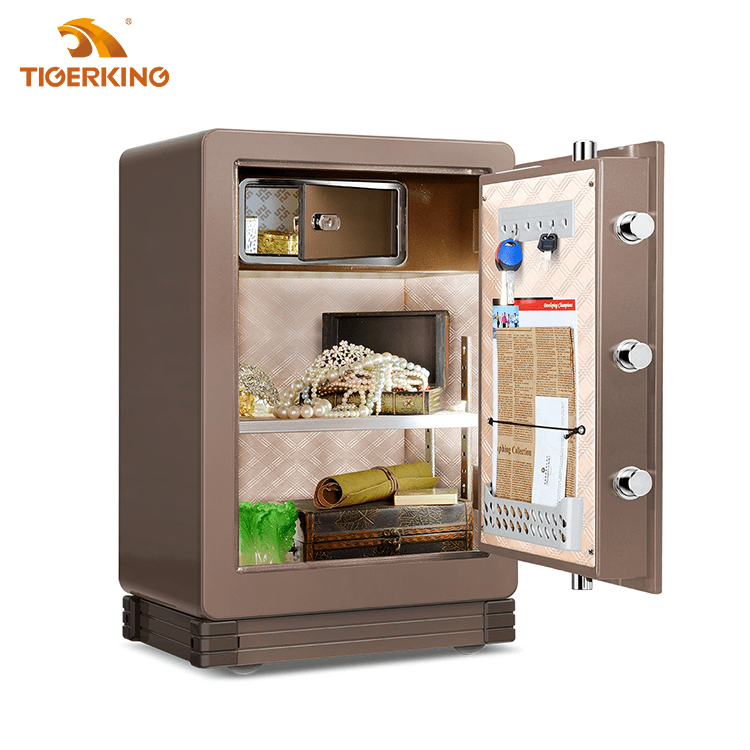
What the 120XZ Brown Actually Delivers: Specs That Separate Commercial Grade from Consumer Grade
The 120XZ sits at the top of TIGERKING's standard brown/black safe lineup. Here is the specification picture that Thai jewelry store procurement officers are evaluating:
External dimensions: 1200 × 580 × 480mm — large enough to serve as a room-scale vault unit rather than a countertop safe
Weight: 111kg — this is the critical specification that separates it from consumer-grade units; a 111kg safe cannot be carried out by two people without equipment
Door plate: 11mm alloy steel — the threshold that Thai insurance underwriters and loss prevention consultants typically cite as the minimum for commercial-grade coverage
Body plate: 1.8mm alloy steel
Lock system: Fingerprint + Digital Password + Mechanical Key (triple authentication, three independent failure modes)
Color: Brown (also available in Black)
Special feature: Built-in alarm system — activates on unauthorized movement or forced entry attempt
Mounting: Freestanding / Tabletop — floor anchoring via included expansion bolts required for commercial use
The 11mm door plate is the specification that deserves the most attention in the Thai jewelry context. According to the technical literature on mechanical forced-entry resistance, a pry bar attack on a 4-6mm door plate can achieve breach in 2-4 minutes using hand tools. The same attack on an 11mm plate extends the breach time to a range that changes the risk calculus for the intruder — particularly when the safe also incorporates an active alarm system that activates upon detecting the mechanical stress of a forced entry attempt.
The alarm system deserves its own attention. The 120XZ's built-in alarm does not just sound locally — it creates a window of behavioral disruption that causes many intruders to abandon the attempt before the safe is breached. For Thai jewelry stores operating in retail environments with shared walls or adjacent tenants, this behavioral deterrent function is as valuable as the mechanical resistance of the door plate.
The Hidden Door Compartment Logic: How Discrete Storage Changes Jewelry Store Risk Exposure
One of the most operationally significant features Thai jewelry retailers are specifying in their 120XZ orders is the hidden door compartment configuration. This is not a standard factory option on all safe models — it is an internal configuration that affects how the safe's interior volume is divided and accessed. Understanding why this matters requires thinking through the actual loss scenarios that Thai jewelry stores face.
The primary loss scenario for Thai jewelry stores is not the dramatic midnight robbery with power tools. It is the more mundane, more frequent problem of internal shrinkage: inventory that disappears through a combination of staff theft, customer handling loss, and inadequate reconciliation processes. In a jewelry store where multiple employees handle inventory throughout the day, a single-compartment safe creates a visibility problem. When every piece of valuable inventory sits behind a single lock that multiple people can access, the loss attribution problem becomes nearly impossible to solve.
The hidden door compartment changes this dynamic by creating a physical partition within the safe that is not visible from the exterior and is not accessible through the primary locking mechanism. The owner can store highest-value or reserve inventory — the items that should only be accessed during specific transactions or audit cycles — in this secondary zone, while maintaining the main compartment for everyday sales inventory. The access separation creates a natural audit trail: if inventory is missing from the main compartment, it is a main-compartment access event. If it is missing from the hidden compartment, it is a breach event that requires owner-level investigation.
This tiered storage approach does not require sophisticated technology. It works because the physical separation creates behavioral constraints. Staff members who know that the hidden compartment exists but do not have access to it will self-regulate their behavior in ways that a purely policy-based inventory control system cannot enforce. According to TIGERKING's locking mechanism engineering guide ,the 120XZ's active bolt system — which extends bolts into the door frame upon closing — also contributes to the structural integrity of the door itself, making the door-to-body connection resistant to pry bar attacks that target the hinge side of the safe.
Staff Access Control: Why Fingerprint Authentication Changes the Audit Equation
One of the underappreciated aspects of fingerprint authentication in a jewelry store safe is not the security of the biometric itself — it is the audit trail that fingerprint logging creates. A safe with mechanical combination lock or single-key access provides no record of who accessed the safe and when. A fingerprint-authenticated safe logs each access event, creating a time-stamped record that connects each safe opening to a specific enrolled fingerprint.
For Thai jewelry store owners who employ more than two or three staff members, this audit capability is a loss prevention tool that has direct commercial value. When inventory reconciliation reveals a discrepancy, the owner can cross-reference the safe access log against the transaction record against the staffing schedule to isolate the time window and access event associated with the discrepancy. This is not infallible — a complicit employee can still steal during an authorized access window — but it eliminates the wide-open, untracked access environment that makes internal theft the lowest-risk option for a dishonest employee.
The 120XZ's fingerprint system allows multiple prints to be enrolled — typically enough to accommodate 5-10 individual fingerprints depending on enrollment density. A typical Thai jewelry store owner enrollment would include the owner, the store manager, and one or two senior sales staff who are authorized for everyday sales inventory access. The master password is retained exclusively by the owner. The physical key serves as a documented emergency access method that the owner controls and stores in a known, auditable location.
The practical benefit of this three-factor access hierarchy — fingerprints for staff, password for owner, key for emergency backup — is that it creates graduated access levels without requiring a complex electronic access control infrastructure. Thai jewelry stores that are not operating at the scale where a full electronic access control system makes economic sense can achieve 80% of the audit benefit through the simple tiered authentication design of the 120XZ's triple-lock system.
The Insurance Underwriter Conversation That Is Driving Procurement Decisions
Thai jewelry store owners who have recently renewed their inventory insurance policies have encountered a new line of questioning that is reshaping procurement priorities: "What is the safe specification, and has it been evaluated against commercial-grade standards?" This question, which is increasingly appearing in insurance application forms from Thai insurance companies responding to the high-value jewelry robbery pattern, is a direct consequence of the claims data that insurers have been accumulating.
When an insurance underwriter evaluates a jewelry store risk, the safe specification is one of the primary rating factors. A jewelry store insuring 5 million baht of inventory with a 40kg consumer-grade safe is a materially different risk than the same store insuring the same inventory with a 111kg commercial-grade unit with 11mm door plate and an active alarm system. The difference is not just the physical resistance of the safe — it is the probability that a robbery attempt will succeed, the timeframe in which inventory can be removed, and the behavioral response of the intruder when the alarm activates.
The insurance rate implications can be substantial. Thai jewelry store owners who have upgraded to commercial-grade safes have reported insurance premium reductions in the range of 10-20% on their inventory coverage, with the specific reduction depending on the overall risk profile of the store location, the security systems in place, and the insurer's appetite for jewelry store risks at the time of renewal. For a store insuring 10 million baht of inventory, a 15% premium reduction can represent annual savings that are comparable to the cost difference between a consumer-grade safe and the 120XZ.
The practical implication is that the 120XZ should be evaluated not just as a security purchase but as an insurance cost management tool. The combination of mechanical resistance (11mm door plate, 111kg weight, active bolt system), authentication control (triple-lock with fingerprint audit trail), and behavioral deterrence (alarm activation upon forced entry attempt) creates a risk profile that is materially different from a consumer-grade safe — and that difference has measurable insurance pricing implications.
Floor Planning the 120XZ: Footprint, Weight, and the Upper Floor Problem
The 120XZ's dimensions — 1200mm wide × 580mm deep × 480mm tall — require careful floor planning that consumer-grade safe procurement does not demand. For Thai jewelry stores on the ground floor of a commercial building or in a standalone retail structure, these dimensions are manageable: the unit can be positioned against a wall, anchored to the floor using the included expansion bolts, and placed with sufficient clearance for the hinge swing arc to function properly.
For jewelry stores on the upper floors of multi-story commercial buildings — a common configuration in Thai market complexes and shopping malls — the 111kg weight of the 120XZ introduces a structural loading consideration that requires building owner confirmation before installation. Standard commercial building floor loading specifications typically range from 150-300 kg/m², which should comfortably accommodate the 120XZ's floor pressure loading of approximately 173 kg/m² across its base footprint. However, buildings with older construction or modified floor plans should be verified before installation.
For stores that cannot accommodate the 120XZ's weight or footprint on upper floors, the TIGERKING product range offers scaled alternatives that maintain the key security specifications: the 73XZ (57kg, 730×470×430mm) and the 53XZ (41kg, 530×400×350mm) both maintain the fingerprint + password + key triple-lock system and the alarm system, but at a weight and footprint that is compatible with upper-floor installation in standard commercial buildings. According to TIGERKING's quality control documentation ,these scaled models share the same manufacturing quality control standards and ISTA 3A packaging protocols as the 120XZ, meaning the tolerance consistency and fit-finish quality are maintained across the product range.
The Digital Lock Maintenance Question That Thai Jewelry Stores Are Starting to Ask
Digital combination locks — including the electronic password component of the 120XZ's triple-lock system — introduce a maintenance consideration that mechanical locks do not: battery dependency. The 120XZ's digital lock system is powered by batteries, which means the lock's functionality depends on maintaining battery charge. This is not a defect — it is a design characteristic that affects all electronic locks — but it is a consideration that Thai jewelry store owners are increasingly asking about during procurement, particularly for stores in areas with inconsistent power supply or high humidity.
The practical management of digital lock battery life in a jewelry store environment is straightforward, but it requires a protocol. According to TIGERKING's digital lock engineering documentation, the 120XZ's lockout logic activates when battery voltage drops below the threshold required for reliable digital lock operation — but before the lock is fully discharged, the system provides multiple low-battery warning signals. Thai jewelry store owners should establish a monthly battery check protocol during the first six months of installation, using the frequency of low-battery signals to calibrate the actual battery replacement interval for their specific usage pattern.
The emergency key override is the failsafe that prevents lockout from becoming a catastrophic event. The mechanical key backup in the 120XZ's triple-lock system means that even if the battery is fully discharged and the fingerprint sensor is non-functional, the mechanical key can still open the safe. For Thai jewelry stores, this means the emergency key should be stored in a documented, owner-controlled location — not in the store itself, where a burglar who has already breached the safe's outer defenses might be able to find it.
Biometric Authentication: What the FAR Specification Actually Means for Jewelry Store Environments
The fingerprint authentication system in the 120XZ uses a biometric sensor with a False Acceptance Rate (FAR) specification that determines how resistant the system is to being spoofed or bypassed using non-enrolled fingerprints. Understanding the FAR specification matters for Thai jewelry store owners because the biometric authentication system's reliability is only as strong as the FAR rating of the sensor it uses.
The FAR metric measures the probability that the biometric system will incorrectly accept a non-enrolled fingerprint as valid. A lower FAR means a more secure system. For jewelry store applications where the primary threat includes sophisticated actors who may attempt to defeat the biometric using lifted prints or silicone spoofing, a sensor with a documented FAR specification provides a meaningful security baseline. TIGERKING's biometric sensor sourcing guide documents the FAR standards applied across their product range and provides the technical rationale for the sensor specifications used in the 120XZ's authentication system.
For Thai jewelry stores specifically, the practical implication of the FAR specification is that the fingerprint authentication system should be treated as one layer in a multi-layer authentication approach rather than as a standalone security control. The password and the key serve as independent verification layers that cannot be bypassed by spoofing the fingerprint alone. This three-layer design — where all three authentication factors must be defeated for unauthorized access — is what makes the 120XZ's triple-lock approach materially more secure than single-factor Biometric Safes.
The Thai Jewelry Store Procurement Checklist That Precedes Any 120XZ Order
Before a Thai jewelry store owner commits to the 120XZ, there is a short procurement checklist that should be completed to confirm that the unit is the right specification for the specific installation environment:
1. Floor loading verification: Confirm that the installation floor can support the 111kg distributed load. For ground-floor installations on concrete slab or commercial building ground floors, this is typically not a concern. For upper-floor installations, obtain building documentation or engineer confirmation.
2. Vault room dimensioning: Confirm that the installation location provides the 1200×580×480mm external footprint plus sufficient clearance for hinge swing and any anchoring work. The safe should be positioned against a structural wall and anchored using the included expansion bolts.
3. Alarm integration assessment: Evaluate whether the 120XZ's built-in alarm system is compatible with the store's existing alarm and security monitoring infrastructure. The alarm's behavioral deterrent function is most effective when it is integrated with a monitored security service that can respond to alarm activation.
4. Insurance pre-qualification: Before purchasing, contact the insurance underwriter to confirm that the 120XZ's specifications (11mm door plate, 111kg weight, triple-lock, alarm system) meet the commercial-grade threshold for the inventory coverage amount. Some insurers have specific approved safe lists; confirm whether the 120XZ is listed or whether an assessment report will be required.
5. Staff enrollment planning: Determine which staff members will have enrolled fingerprints, who will hold the master password, and where the emergency key will be stored. Establish the access protocol and audit review schedule before the safe is installed and operational.
6. Hidden compartment configuration: Confirm with TIGERKING whether the hidden door compartment configuration is available for the 120XZ brown model and what lead time is required for this customization. This configuration affects the internal storage layout and should be specified before order confirmation.
Why the 120XZ Brown Is the Reference Model for Thai Jewelry Store Vault Upgrades
The TIGERKING 120XZ brown safe is not the largest safe in the TIGERKING product range — the 100XZ and above occupy larger footprint categories — but it is the model that has found its most commercially significant adoption in the Thai jewelry retail sector. The combination of 11mm door plate, 111kg weight, triple-lock authentication with fingerprint audit trail, active alarm system, and hidden door compartment configuration addresses the specific risk profile of Thai jewelry stores more precisely than any other model in the current TIGERKING lineup.
The procurement pattern that Thai jewelry retailers are establishing — ordering the 120XZ specifically for its commercial-grade specifications, requesting the hidden door compartment configuration, and using the insurance premium reduction potential as a justification for the upgrade — is a market signal that the consumer-grade safe era for jewelry store vault applications is ending. The retailers who are upgrading now are the ones who ran the security math, ran the insurance math, and concluded that the cost of the 120XZ is lower than the expected cost of the loss events they are trying to prevent.
For Thai jewelry store owners who are evaluating their current safe specification against the threat profile of their specific location, the question is not whether to upgrade — it is how quickly they can complete the procurement checklist and place the order before the next robbery incident in their district creates another insurance claim that raises premiums for the entire market.
About the Author
James Chen
Senior Security Industry Analyst & SEO Content Strategist
James Chen has covered the security equipment manufacturing and global trade sector for over 10 years. His work has been cited in Security Products Magazine and multiple industry procurement guides. He specializes in B2B sourcing strategy, OEM/ODM evaluation frameworks, and market intelligence for physical security products.
Facebook: TIGERKING Safe
LinkedIn: TIGERKING Safe
YouTube: @TIGERKING_SAFE
X: @Safe_Tigerking