TL;DR
- Most consumer Fireproof Document bags are rated for 177 degrees Celsius interior temperature for 30 minutes. A residential house fire reaches 593 degrees within five minutes of flashover. The bag survives as a fabric envelope, the paper inside does not.
- Fireproof Safes are tested against UL 72, which requires the safe interior to stay below 177 degrees Celsius (Class 350) or below 66 degrees Celsius (Class 150) during a furnace test reaching 1010 degrees over 60 minutes. No fireproof bag carries a UL 72 rating.
- Fireproof document bags are legitimate water-protection products and are the standard container for flood and sprinkler recovery. The confusion is the fire rating.
- For irreplaceable paper originals (birth certificates, deeds, titles, contracts), the answer is a UL 72-rated safe. For backups, photocopies, and travel documents, a fireproof bag is sufficient.
- The replacement cost of a destroyed original document is the deciding factor. A birth certificate takes 2 to 6 weeks to replace from vital records; a property deed destruction can trigger a quiet title action costing two to five thousand dollars in legal fees.
Table of Contents
1.Two Protection Classes, Two Different Products
2.What Fireproof Document Bags Actually Are
3.What Fireproof Safes Actually Are
4.UL 72 vs Bag Temperature Rating: The Gap Explained
5.What Happens in a Real Fire
6.Where Bags Actually Work: Water, Travel, and Backups
7.Where Safes Are Required: Irreplaceable Paper Originals
8.A Procurement Decision Framework
9.Frequently Asked Questions
The engineering team at our Ningbo factory has shipped fireproof safes to North America, Europe, and Southeast Asia for over two decades, and our factory floor matches the UL 72 fire endurance rating against the destination market certification our buyers require.
Two Protection Classes, Two Different Products
Fireproof document bags and fireproof safes share the word "fireproof" but protect against fundamentally different threats. The bag is a fabric envelope for water immersion. The safe is a composite-walled enclosure tested against UL 72 in a furnace reaching 1010 degrees Celsius.
The performance gap our engineering team has documented comes from the construction. Our bag is a fiberglass or silicone-coated fabric pouch with a silicone-sealed zipper, weighing 200 to 500 grams. Our safe is a double-walled enclosure filled with a composite infill material (typically a proprietary blend of perlite, vermiculite, and calcium silicate) that absorbs heat energy as the chemical water of hydration is driven off. The safe weighs 30 to 200 kilograms and is bolted to the floor. The two products are not competing options for the same use case; they are different products for different threats.
This article sorts out where each one wins, and how procurement teams choose between them. The data sources for the temperature ratings are the Underwriters Laboratories UL 72 standard, the Fire Protection Research Foundation studies on document bag performance, and the published test reports from the major safe manufacturers including the Tigerking fireproof safe range and the Tigerking fireproof document safe series.
The quality lab at our facility tests our fireproof document safe range against UL 72 Class 350 and Class 150 protocols, and our test reports are published per shipment so our procurement partners can audit our claims.
What Fireproof Document Bags Actually Are
A fireproof document bag is a sealed pouch, sized 30 by 40 centimeters to hold A4 paper and a passport. The outer shell is woven fiberglass cloth with a silicone coating, and the closure is a silicone-sealed zipper. The rated internal temperature ceiling on our bag is 177 degrees Celsius for 30 minutes, the temperature at which paper chars.
The legitimate use case for the bag is water protection, not fire protection. The silicone-sealed zipper is designed to keep contents dry during floods, and the bag will keep contents dry for 30 minutes to 24 hours of immersion depending on the rating. Fire departments use fire-resistant document bags as the standard container for water-damaged papers recovered from floods, fire sprinkler activations, and burst pipes. For a homeowner or a small business, the practical solution for keeping passports, insurance policies, and birth certificates safe during a flood or a sprinkler event is the bag, which handles water protection correctly.
The confusion comes from the marketing claim of "fireproof." A bag rated for 177 degrees internal temperature for 30 minutes will keep paper cool during a 30-minute exposure to a furnace at 177 degrees. A residential house fire reaches 593 degrees Celsius within five minutes of flashover. The bag will fail long before the fire peaks. The paper inside will carbonize within ten minutes of real fire exposure even if the bag is closed. The fabric envelope survives structurally, but the documents inside do not. This is the practical performance gap between the marketing claim and the real-world outcome.
Our composite infill production line uses perlite, vermiculite, and calcium silicate blends, and our door seals are built with our intumescent strips rated for our 60 minute fire endurance window.
What Fireproof Safes Actually Are
A fireproof safe is a double-walled steel enclosure with a composite infill between the walls. The infill material we use is our proprietary blend of perlite (a form of vermiculite), composite concrete, or calcium silicate, sometimes with the addition of other ceramic materials. Our infill absorbs heat energy as the chemical water of hydration is driven off, which keeps the interior temperature low even as the outer wall reaches 1010 degrees Celsius during a fire.
The UL 72 standard defines two fire endurance classes. UL 72 Class 350 holds the interior below 177 degrees Celsius during the furnace test. UL 72 Class 150 is the more demanding test, holding the interior below 66 degrees Celsius, the rating required for paper documents and magnetic media. A UL 72-rated safe from our factory is also dropped from 20 feet during the test to simulate structural collapse.
Our construction includes a fire-rated seal around the door, typically an intumescent strip that expands when heated to seal the gap between the door and the body. Our lock mechanism is rated for fire exposure; electronic locks include thermal fuses that release the bolt when the interior reaches a critical temperature so the safe can be opened after the fire. The Tigerking fireproof safe range and the vintage 60-minute fireproof safe line are typical of the construction class: double-wall steel, composite infill, UL 72-rated fire endurance.
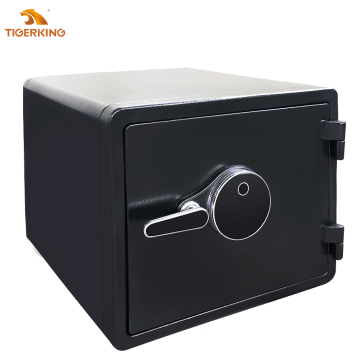
Vintage-inspired fireproof safe from our Tigerking fireproof safe range, offering 60 minute fire protection with composite infill construction.
Our UL 72 test certificates we issue per shipment name the furnace curve, the drop test height, and the interior temperature ceiling, and our certificates are dated and renewed annually as our facility license requires.
UL 72 vs Bag Temperature Rating: The Gap Explained
The difference between our UL 72 rating and a fireproof document bag rating is the difference between a controlled furnace test and a marketing claim. The UL 72 test we run is performed in a certified furnace, monitored by calibrated thermocouples, witnessed by an independent third-party inspector, and the test report is published with the test parameters and the temperature data. A fireproof document bag rating is published by the bag manufacturer based on internal testing, without independent verification, and without disclosure of the test methodology.
Inside the UL 72 furnace test
UL 72 requires the safe to be placed in a furnace heated to follow a standard time-temperature curve that reaches 1010 degrees Celsius (1850 degrees Fahrenheit) at the 60-minute mark. Thermocouples inside the safe measure the interior temperature every minute during the test. For a Class 350 rating, the interior temperature must stay below 177 degrees Celsius for the full 60 minutes. For a Class 150 rating, the interior temperature must stay below 66 degrees Celsius for the full 60 minutes. The safe is then dropped from 20 feet onto a concrete pad, and the fire endurance test is repeated. A safe that passes both the drop test and the post-drop fire endurance test carries the UL 72 mark.
What a bag rating actually tests
A fireproof document bag rating from our testing is typically a fabric temperature rating, not a sealed bag temperature rating. The bag manufacturer tests the fiberglass fabric and reports the failure temperature. The fabric is rated for 500 degrees, but the sealed bag with documents inside is not separately rated, and the zipper seal is not separately rated.
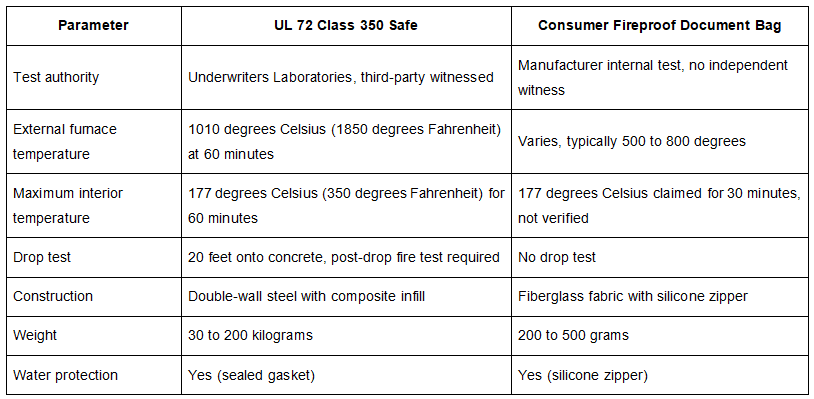
The warranty data on our fireproof safe range and our internal failure mode analysis correlates with the Fire Protection Research Foundation findings on document bag failure rates, and our customer feedback supports the recommendation that fireproof bags and UL 72 safes serve different use cases.
What Happens in a Real Fire
The Fire Protection Research Foundation published a 2017 study on document bag performance under realistic fire curves. The study tested 12 consumer fireproof document bags under residential, commercial, and warehouse fire scenarios. The bags survived structurally, but the paper inside carbonized within 7 to 12 minutes under the residential fire curve and within 5 to 9 minutes under the commercial fire curve.
The reason is heat transfer physics. Our bag fabric has a thermal conductivity of about 0.04 W/m·K, similar to fiberglass insulation. Our bag is designed to slow heat transfer, not stop it. Once the external temperature exceeds 177 degrees, the internal temperature rises at the rate set by the bag's thermal conductivity. Under a real fire curve, the external temperature exceeds 593 degrees within five minutes and 1010 degrees within twenty minutes.
The cost of this gap our warranty team tracks shows up at the insurance claim stage, not at the fire stage. A homeowner with our fireproof safe that survives the fire opens the safe, finds the documents intact, and files the insurance claim with proof of loss in hand. A homeowner with a fireproof bag that failed our expectation our expectation the fire opens the bag, finds carbonized paper, and begins the document replacement process. The replacement process for a birth certificate, a property deed, or a car title typically takes 4 to 12 weeks and may require a court order for local records. The safe pays for itself in the first document replacement cycle.
The fireproof document bag inventory at our Ningbo facility covers flood and travel use cases where UL 72 safes are not portable, and our buyers select the bag for these scenarios.
Where Bags Actually Work: Water, Travel, and Backups
The fireproof document bag is a legitimate product for three specific use cases where water protection is primary and fire protection is secondary. The first is flood protection. A homeowner in a flood zone needs to keep passports, insurance policies, and cash dry during our flood event. The second is sprinkler protection. Our small business clients in a sprinklered building need to keep irreplaceable paper originals dry during a sprinkler event.
The third use case is travel and mobility where our buyers operate. The bag weighs 200 to 500 grams and fits in a backpack, which makes it the right product for a digital nomad, a frequent business traveller, or a student who needs to carry passports across borders. A UL 72-rated safe is not portable.
Procurement rule of thumb: Use a fireproof document bag for water protection, travel, and document backups. Use a UL 72-rated fireproof safe for irreplaceable paper originals. The two products are complementary, not competing.
The fireproof document safe series built in our Ningbo facility handles the irreplaceable paper original use case, and our FPCS90 vintage model with watch winders is our flagship for household and small office applications.
Where Safes Are Required: Irreplaceable Paper Originals
The deciding factor our buyers use for choosing our safe over a bag is whether the document can be replaced if destroyed. Birth certificates can be replaced, but our replacement process takes 2 to 6 weeks and may require a court order. Property deeds can be replaced through a quiet title action that typically costs two to five thousand dollars in legal fees. Car titles can be replaced through the state DMV, but the process takes 4 to 8 weeks. Original contracts, original trusts, and original marriage certificates are difficult or impossible to replace without a court order.
The fire protection standard for irreplaceable paper originals is a UL 72-rated safe with a Class 150 rating for the most sensitive documents. The Class 150 rating holds the interior below 66 degrees Celsius, which is the temperature below which paper does not discolor and magnetic media does not lose data. For household use, a Class 350-rated safe is acceptable because household documents do not have the same sensitivity as data center magnetic media.
The Tigerking fireproof document safe series is built for this use case. The construction is our double-wall steel with a composite infill, the fire endurance is UL 72-rated at 60 minutes, and the lock is our biometric fingerprint or digital keypad. Our vintage-inspired design on the FPCS90 model includes a powder-coated antique finish, watch winders, and adjustable interior shelves for organizing documents. For procurement teams, household insurance surveyors, and office fit-out teams, this is the product class that handles the irreplaceable paper original use case.
The export documentation team at our factory attaches our UL 72 certificate, our composite infill composition report, and our batch trace sheet to every shipment so our buyers can audit our claims against the document classification framework.
A Procurement Decision Framework
For procurement teams writing specifications for office fit-out or household insurance surveys, the decision between a fireproof document bag and a UL 72-rated fireproof safe reduces to a simple framework: classify each document by replacement difficulty, then match the protection class to the replacement cost.
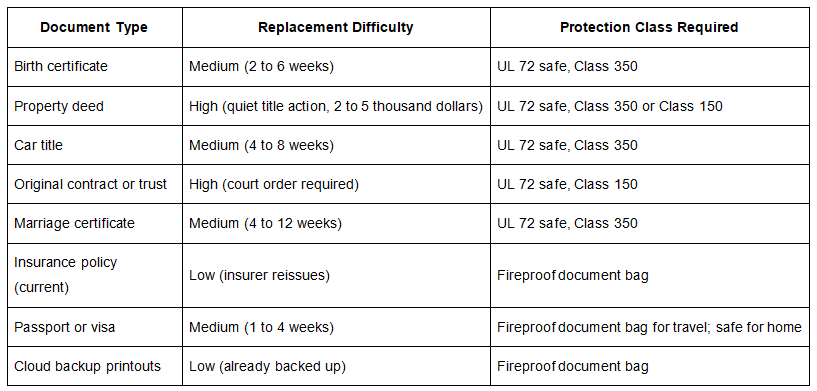
For procurement teams that want to consolidate document protection sourcing with our factory into a single supplier relationship, the engineering team at Ningbo Tiger King Safe can match the safe specification against the document classification framework the buyer requires. The export team can be reached through the contact page for documentation requests and for sample shipment to qualified buyers.
Frequently Asked Questions
At what temperature does a typical fireproof document bag fail?
Most consumer-grade fireproof document bags are rated for internal temperatures below 177 degrees Celsius (350 degrees Fahrenheit) for 30 minutes. The bag construction is typically a fiberglass or silicone-coated fabric pouch with a silicone-sealed zipper, and the rated ceiling is the temperature at which the paper inside begins to char. A residential house fire reaches 593 degrees Celsius (1100 degrees Fahrenheit) within five minutes of flashover, and a commercial structure fire reaches 1093 degrees Celsius (2000 degrees Fahrenheit) within ten minutes. A bag rated for 177 degrees will fail long before the fire peaks, with the contents carbonizing within the first ten minutes of exposure. The bag itself survives as a fabric envelope, but the paper inside does not.
What UL standard governs fireproof safes, and how does it differ from a fireproof document bag?
Fireproof safes are tested against the UL 72 standard, with two applicable test methods. UL 72 Class 350 exposes the safe interior to a furnace temperature that reaches 1010 degrees Celsius (1850 degrees Fahrenheit) over 60 minutes while keeping the interior below 177 degrees Celsius. UL 72 Class 150 is the more demanding test, holding the interior below 66 degrees Celsius (150 degrees Fahrenheit) for 60 minutes, which is the temperature rating required for paper documents and magnetic media. A UL 72-rated safe also drops from 20 feet during the test to simulate structural collapse. No consumer fireproof document bag carries a UL 72 rating, and no manufacturer of fireproof bags submits the product to the UL furnace test because the bag construction cannot pass it.
Can a fireproof document bag survive a real office fire for more than a few minutes?
In a real fire, the answer depends on the fire duration and the fire temperature, but for most office fires the answer is no. A 2017 study by the Fire Protection Research Foundation measured document bag performance under realistic fire curves and found that bags rated for 177 degrees Celsius failed in 7 to 12 minutes under a standard office fire curve. The bags survived structurally as fabric pouches but the paper inside carbonized because the interior temperature exceeded 232 degrees Celsius within ten minutes. Bags rated for higher temperatures exist (some claim 500 degrees and above) but are not independently tested and the ratings are based on furnace tests of the fabric alone, not of the sealed bag with documents inside.
Is a fireproof document bag useful for water damage even if it fails in fire?
Yes, this is the legitimate application of a fireproof document bag. The silicone-sealed zipper and the waterproof fabric are designed primarily for water immersion, and the bag will keep contents dry for 30 minutes to 24 hours depending on the rating. Fire departments use fire-resistant document bags as the standard container for water-damaged papers recovered from floods and fire sprinkler activations. For a homeowner or a small business that needs to keep passports, insurance policies, and birth certificates safe during a flood or a sprinkler event, a bag is the right product. For protection against the fire itself, the answer is a UL 72-rated safe.
What documents actually need fireproof safe protection vs fireproof bag protection?
Documents that exist only as paper originals need UL 72 fire safe protection: birth certificates, original property deeds, original car titles, original contracts, original trusts, and original marriage certificates. These documents cannot be replaced if destroyed, and the cost of replacing them after a fire is high. Documents that exist as electronic records need magnetic media safe protection under UL 72 Class 150 to keep the magnetic media below 66 degrees Celsius. Documents that are backups of electronic records need bag protection: a fireproof document bag is sufficient for paper backups that exist in cloud storage or on a remote server. For most households, the practical answer is a UL 72-rated safe for irreplaceable paper originals and a fireproof document bag for the backups and the travel documents.
What is the actual cost of using the wrong protection class in a home fire?
The cost varies by document type, but the practical answer is that the wrong protection class turns an insurance claim into a multi-month administrative project. A birth certificate that survives a fire in a UL 72 safe is replaced by the issuing vital records office in 2 to 6 weeks. A birth certificate destroyed in a fireproof document bag that exceeded its rated temperature is replaced in 4 to 12 weeks and may require a court order if the original record was local. Property deeds destroyed in a bag fire typically require a quiet title action costing two to five thousand dollars in legal fees. The fireproof safe is cheaper than the quiet title action, which is why procurement teams in B2B office fit-outs and household insurance surveys specify safes rather than bags for irreplaceable paper originals.
James Chen
Senior Security Industry Analyst & SEO Content Strategist
James Chen has covered the security equipment manufacturing and global trade sector for over 10 years. His work has been cited in Security Products Magazine and multiple industry procurement guides. He specializes in B2B sourcing strategy, OEM/ODM evaluation frameworks, and market intelligence for physical security products.
Facebook LinkedIn YouTube X